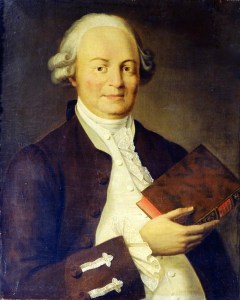
Russian
1703 – 1769
What sober intoxication
gives me voice for glorious cause?
Muses, pure adornment of Parnassus,
do I not see you now?
I hear the sound of your sweet strings
and the strength of lovely choirs.
All gives rise in me to exultant speech.
Nations! Receive my song joyously.
Stormy winds! Be silent.
I desire to sing of brave Anna’s glory.
In their songs, eternally in glory,
incomparable Pindar and Horace
rose up to the very stars in heaven
like swift, bold eagles.
But if the voice of my lyre
would equal my sincere zeal,
which burns eternally for Anna,
then Orpheus of Thrace himself,
together with Amphion of Thebes,
would surely marvel at its sweetness.
Sing, my lyre, a sweet song.
Sing of Anna, who is happy;
sing, to the greater downfall of all our foes,
to their eternal misfortune.
O her bravery and might!
O the joyous delight of all her subjects!
Conquering everything, her bravery inspires dread.
Happiness leads us to a strange ecstasy;
it removes our sorrowful thoughts,
swelling our hearts with pride.
Was it Neptune himself built these walls
that stand so proudly near the sea?
Do they not resemble those of Troy,
which sought long to be in quarrel
with arms most powerful in combat
and with a battle-hardened warrior?
Do not all call the Vistula River now
by the name of Skamander?
Does Mount Stalzenberg not
now bear the name of Ida?
That is not Troy, of fables’ subject;
not one Achilles alone wages battle.
Every warrior storms more valiantly
than the son of Thetis.
What leader shines with wondrous helmet?
Is it not Minerva hurling her spear?
‘Tis evident that Heaven sent her,
for in all respects she is a goddess;
fearful is she even without her shield or aegis.
‘Tis the Russian Empress Anna.
And ‘tis Russian warriors have
surrounded Danzig, hostile city.
Each who fought there deserved to be called Mars,
for in might each was more wondrous than Mars:
ready to shed his blood freely,
or carry off a complete victory in Anna’s name.
All embolden themselves with Anna’s good fortune;
only Anna is their strong hope,
and because Anna is gracious to them
they take greater anger at her enemies.
Beautiful and favorable sun
of the European and Asian sky!
O Russian monarch!
Many times blessed,
because you are so dear to your subjects,
because you rule them so benignly!
Your name is already fearful to the world
and the universe will not contain your glory.
Wishing to be obedient to you,
all of it marvels at the flower of beauty.
But what do I behold? Do my eyes not deceive me?
A youth opposed to Hercules,
raising high his proud brow,
desires to be the marvel of the entire world!
With unwise counsel, Danzig,
as if made drunk with heady beverage,
opposes – and now openly so –
the mighty empress of all Russia.
Judging rashly, it does not see the abyss,
as on a moonless night.
Into its very heart
it accepts as a friend Stanislaus,
who comes a second time in search of a crown.
It hopes for defense through fields
o’er which Neptune has flowed,
but fearing the Russian Perun
it seeks assistance of the nation
that dwells along the banks of the Seine.
But to its own loss does this nation beat drums
for the advantage of Weichselmünde.
Proud of its fire and iron
no less than of its warriors everywhere,
Danzig already places its machines
on embankments against the Russians.
That it is rich in many stores, it shouts,
“Long live Stanislaus!”
It encourages anger in its soldiers
who do not have stout hearts
and look only to
preserving their lives by flight.
O Danzig! Oh, what are you daring?
Collect your senses! Counsel with them.
You are approaching destruction.
Why have you stopped? Why do you hesitate? Surrender!
Wherefrom have you such audacity
that you do not pale before Anna?
Of their own will entire nations
submit themselves without a battle.
In order not to pay her tribute
the Chinese rulers twice revere her.
Whosoever beseeches kindness of her
learns that in kindness Anna has no equal.
There is no one upon the world more generous
to him who inflicts no war upon her.
Her sword, wound with the olive branch,
is fierce in battle, not in peace.
O Danzig, abandon this wicked thought.
You see the Alcidae are ready.
You behold the terrible woes of your inhabitants;
you hear wrathful Anna herself.
You are closely surrounded
on all sides by thousands of courageous athletes.
You have no hope of withstanding
the bolts of lightning raining down on you,
smashing everything before them.
And that thunder is real, not false.
On the ramparts there is no longer any defense.
The earth opens up abysses;
buildings fly up in the air;
many fortifications are seized.
Even though all the powers
came ardently to your defense now, Danzig;
if the elements themselves defended you;
even if brave soldiers came to you
from all over he world
and freely spilled their life’s blood for you –
verily these can in no way save you,
and though they made bold effort,
they cannot puck
you from the hands of Anna.
See, hostile nations,
how brave are the Russian people!
Fire does not harm them, nor water;
their chests are bared to everything.
See how they rush to the assault!
How they batter themselves without giving way!
The thunder of cannon scares them not;
they go as to dance at a wedding celebration,
and through the smoky clouds
it is clear to whom all bravery is familiar.
Within the walls of poor Danzig town,
fears are on the rise;
buildings crumble into dust;
the siege is everywhere triumphant.
When from the last remaining wall
the city magistrate beholds
that all their hope in aid from distant lands
and in the good will of Stanislaus was just in vain,
he shouts, standing dumbstruck like an ignoramus:
“Oh! Our glory has fallen!”
What I prophesied desires to come true:
Danzig already begins to tremble;
each person thinks now just of surrender as he thought earlier of fighting.
He thinks this way of saving himself
from the bombs flying in the air
and from the spirit bearing death in plague.
Everyone shouts: it is time to begin –
To all it was an unbearable burden.
Ah! It is time to open all the city’s gates
to Anna’s triumphant army.
And so it passed. Surrender’s sign is made;
at Anna’s feet Danzig has fallen.
The warrior has begun rejoicing at his success;
the fire has been extinguished; to all, the roads are free.
Soaring, Glory flies everywhere
and proclaims with her trumpet:
“Anna is supreme in fortune!
Anna, O our Anna! Braver than all is she!
Anna more august than Augustus!
The beauty and honor of all nations!”
Desist, lyre! ‘Tis time to end your song.
Who is it can properly bear praise
to the greatness of our Anna
and sing of a courage higher than hers?
In this there is much praise to Anna,
that she is loved by God Himself.
I desire her to conquer by this,
and she is always able to conquer
whomsoever dares oppose her.
With that, “Long live Anna!” I exclaim.
 Poets Corner