We present this work in honor of the poet’s 255th birthday.
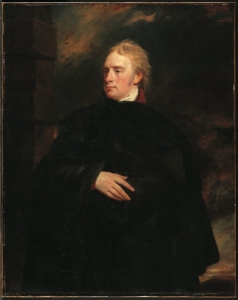
John Hookham Frere English 1769 – 1846
FRIEND OF HUMANITY.
“Needy Knife-grinder! whether are you going? Rough is the road, your wheel is out of order— Bleak blows the Blast;—your hat has got a hole in’t, So have your breeches!
“Weary Knife-grinder! little think the proud ones Who in their coaches roll along the turnpike- -road, what hard work ‘tis crying all day, ‘Knives and ‘Scissars to grind O!’
“Tell me Knife-grinder, how came you to grind knives? Did some rich man tyrannically use you? Was it the squire? or parson of the parish; Or the attorney?
“Was it the squire, for killing of his game? or Covetous parson, for his tithes distraining? Or roguish lawyer, made you lose your little All in a lawsuit?
“(Have you not read the Rights of Man, by Tom Paine?) Drops of compassion tremble on my eyelids, Ready to fall, as soon as you have told your Pitiful story.”
KNIFE-GRINDER.
“Story! God bless you! I have none to tell, Sir, Only last night a-drinking at the Chequers, This poor old hat and breeches, as you see, were Torn in a scuffle.
“Constables came up for to take me into Custody; they took me before the justice; Justice Oldmixon put me in the parish- stocks for a vagrant.
“I should be glad to drink your Honor’s health in A pot of beer, if you will give me sixpence; But for my part, I never love to meddle With Politics, Sir.”
FRIEND OF HUMANITY.
“I give thee sixpence! I will see thee damn’d first— Wretch! whom no sense of wrongs can rouse to vengeance— Sordid, unfeeling, reprobate, degraded, Spiritless outcast!”
Kicks the Knife-grinder, overturns his wheel, and exit in a transport of Republican enthusiasm and universal philanthropy.
We present this work in honor of the poet’s 320th birthday.
Jean Adam Scots 1704 – 1765
And are ye sure the news is true? And are ye sure he’s weel? Is this a time to talk o’ wark? Ye jades, fling by your wheel! Is this a time to think o’ wark, When Colin’s at the door? Gie me my cloak! I’ll to the quay, And see him come ashore.
For there’s nae luck aboot the hoose, There’s nae luck ava’; There’s little pleasure in the hoose, When our gudeman’s awa’.
Rise up, and mak a clean fire-side, Put on the muckle pot; Gie little Kate her cotton gown, And Jock his Sunday coat; And make their shoon as black as slaes, Their hose as white as snaw; It’s a’ to please my ain gudeman, He likes to see them braw.
For there’s nae luck aboot the hoose, There’s nae luck ava’; There’s little pleasure in the hoose, When our gudeman’s awa’.
There are twa hens upon the bauk, ‘Been fed this month and mair, Make haste and thraw their necks aboot, That Colin weel may fare; And spread the table neat and clean, Gar ilka thing look braw; It’s a’ to pleasure our gudeman, For he’s been lang awa’.
For there’s nae luck aboot the hoose, There’s nae luck ava’; There’s little pleasure in the hoose, When our gudeman’s awa’.
Come gie me down my bigonets, My bishop-satin gown; And rin and tell the Bailie’s wife That Colin’s come to town; My Sunday sheen they maun gae on, My hose o’ pearl blue, It’s a’ to please my ain gudeman, For he’s baith leal and true.
For there’s nae luck aboot the hoose, There’s nae luck ava’; There’s little pleasure in the hoose, When our gudeman’s awa’.
Sae true his words, sae smooth his speech, His breath like caller air, His very foot has music in’t, When he comes up the stair: And will I see his face again? And will I hear him speak? I’m downright dizzie wi’ the thought, In troth I’m like to greet!
For there’s nae luck aboot the hoose, There’s nae luck ava’; There’s little pleasure in the hoose, When our gudeman’s awa’.
The cauld blasts o’ the winter wind, That thrilled through my heart. They’re a’ blawn by; I hae him safe, ‘Till death we’ll never part; But what puts parting in my mind? It may be far awa; The present moment is our ain. The niest we never saw!
For there’s nae luck aboot the hoose, There’s nae luck ava’; There’s little pleasure in the hoose, When our gudeman’s awa’.
Since Colin’s weel, I’m weel content, I hae nae mair to crave; Could I but live to make him blest, I’m blest aboon the lave; And will I see his face again? And will I hear him speak? I’m downright dizzie wi’ the thought, In troth I’m like to greet!
For there’s nae luck aboot the hoose, There’s nae luck ava’; There’s little pleasure in the hoose, When our gudeman’s awa’.
We present this work in honor of the 165th anniversary of the poet’s death.
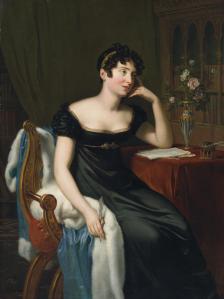
Sydney, Lady Morgan Irish 1781 – 1859
I.
And must I, ghastly guest of this dark dwelling, Pale, senseless tenant must I come to this; And shall this heart congeal, now warmly swelling To woe’s soft langour, rapture’s melting bliss!
II.
And must this pulse that beats to joy’s gay measure, Throbbing with bloomy health, this pulse lie still; And must each sense alive to guileless pleasure, Torpid resist the touch of transport’s thrill?
III.
And must each sensate feeling too decay, (Each feeling anguished by another’s sorrow,) This from that blushes youth and health to-day, Lie cold and senseless thus, like thee, to-morrow?
IV.
Terrific Death! to shun thy dreaded pow’r, Who would not brave existence’ direst strife? But that beyond thy dark shade’s gloomy low’r, Faith points her vista to eternal life!
My pain endures and my eyes shed tears every day; separation causes unbearable pain that has no reason to be! Her name’s engraved in my burning heart; I found no cure or counsel for my pain! My hair’s turning white, O lord, after separation from those I love and wish to be with again! Such separation’s made my heart bleed and tears run down my cheeks all day long! I miss them so much I’m wasting away in despair; my tears rage like ocean waves against these sad days! All this is so unfair I wasted my life wandering in lands of exile and feeling low!
Why are we Scholars plagu’d to write, On Days devoted to Delight? In Honour of the King, I’d play Upon his Coronation Day: But as for Loyalty in Rhyme, Defer that to another Time.
Now to excuse this to my Master– (This Want of Rhyme’s a sad Disaster) Sir, we confess you take great Pains, And break your own, to mend our Brains. You strive to make us learn’d, and wise; But to what End? — We shall not rise: In vain should at Preferment aim, Whilst Strangers make their happier Claim. Why should we labour to excel, Doom’d in Obscurity to dwell? Then, since our Welfare gives you Pain, (And yet your Toil may prove in vain) I wish, for your, and for our Ease, That all were Coronation Days.
What sober intoxication gives me voice for glorious cause? Muses, pure adornment of Parnassus, do I not see you now? I hear the sound of your sweet strings and the strength of lovely choirs. All gives rise in me to exultant speech. Nations! Receive my song joyously. Stormy winds! Be silent. I desire to sing of brave Anna’s glory.
In their songs, eternally in glory, incomparable Pindar and Horace rose up to the very stars in heaven like swift, bold eagles. But if the voice of my lyre would equal my sincere zeal, which burns eternally for Anna, then Orpheus of Thrace himself, together with Amphion of Thebes, would surely marvel at its sweetness.
Sing, my lyre, a sweet song. Sing of Anna, who is happy; sing, to the greater downfall of all our foes, to their eternal misfortune. O her bravery and might! O the joyous delight of all her subjects! Conquering everything, her bravery inspires dread. Happiness leads us to a strange ecstasy; it removes our sorrowful thoughts, swelling our hearts with pride.
Was it Neptune himself built these walls that stand so proudly near the sea? Do they not resemble those of Troy, which sought long to be in quarrel with arms most powerful in combat and with a battle-hardened warrior? Do not all call the Vistula River now by the name of Skamander? Does Mount Stalzenberg not now bear the name of Ida?
That is not Troy, of fables’ subject; not one Achilles alone wages battle. Every warrior storms more valiantly than the son of Thetis. What leader shines with wondrous helmet? Is it not Minerva hurling her spear? ‘Tis evident that Heaven sent her, for in all respects she is a goddess; fearful is she even without her shield or aegis. ‘Tis the Russian Empress Anna.
And ‘tis Russian warriors have surrounded Danzig, hostile city. Each who fought there deserved to be called Mars, for in might each was more wondrous than Mars: ready to shed his blood freely, or carry off a complete victory in Anna’s name. All embolden themselves with Anna’s good fortune; only Anna is their strong hope, and because Anna is gracious to them they take greater anger at her enemies.
Beautiful and favorable sun of the European and Asian sky! O Russian monarch! Many times blessed, because you are so dear to your subjects, because you rule them so benignly! Your name is already fearful to the world and the universe will not contain your glory. Wishing to be obedient to you, all of it marvels at the flower of beauty.
But what do I behold? Do my eyes not deceive me? A youth opposed to Hercules, raising high his proud brow, desires to be the marvel of the entire world! With unwise counsel, Danzig, as if made drunk with heady beverage, opposes – and now openly so – the mighty empress of all Russia. Judging rashly, it does not see the abyss, as on a moonless night.
Into its very heart it accepts as a friend Stanislaus, who comes a second time in search of a crown. It hopes for defense through fields o’er which Neptune has flowed, but fearing the Russian Perun it seeks assistance of the nation that dwells along the banks of the Seine. But to its own loss does this nation beat drums for the advantage of Weichselmünde.
Proud of its fire and iron no less than of its warriors everywhere, Danzig already places its machines on embankments against the Russians. That it is rich in many stores, it shouts, “Long live Stanislaus!” It encourages anger in its soldiers who do not have stout hearts and look only to preserving their lives by flight.
O Danzig! Oh, what are you daring? Collect your senses! Counsel with them. You are approaching destruction. Why have you stopped? Why do you hesitate? Surrender! Wherefrom have you such audacity that you do not pale before Anna? Of their own will entire nations submit themselves without a battle. In order not to pay her tribute the Chinese rulers twice revere her.
Whosoever beseeches kindness of her learns that in kindness Anna has no equal. There is no one upon the world more generous to him who inflicts no war upon her. Her sword, wound with the olive branch, is fierce in battle, not in peace. O Danzig, abandon this wicked thought. You see the Alcidae are ready. You behold the terrible woes of your inhabitants; you hear wrathful Anna herself.
You are closely surrounded on all sides by thousands of courageous athletes. You have no hope of withstanding the bolts of lightning raining down on you, smashing everything before them. And that thunder is real, not false. On the ramparts there is no longer any defense. The earth opens up abysses; buildings fly up in the air; many fortifications are seized.
Even though all the powers came ardently to your defense now, Danzig; if the elements themselves defended you; even if brave soldiers came to you from all over he world and freely spilled their life’s blood for you – verily these can in no way save you, and though they made bold effort, they cannot puck you from the hands of Anna.
See, hostile nations, how brave are the Russian people! Fire does not harm them, nor water; their chests are bared to everything. See how they rush to the assault! How they batter themselves without giving way! The thunder of cannon scares them not; they go as to dance at a wedding celebration, and through the smoky clouds it is clear to whom all bravery is familiar.
Within the walls of poor Danzig town, fears are on the rise; buildings crumble into dust; the siege is everywhere triumphant. When from the last remaining wall the city magistrate beholds that all their hope in aid from distant lands and in the good will of Stanislaus was just in vain, he shouts, standing dumbstruck like an ignoramus: “Oh! Our glory has fallen!”
What I prophesied desires to come true: Danzig already begins to tremble; each person thinks now just of surrender as he thought earlier of fighting. He thinks this way of saving himself from the bombs flying in the air and from the spirit bearing death in plague. Everyone shouts: it is time to begin – To all it was an unbearable burden. Ah! It is time to open all the city’s gates to Anna’s triumphant army.
And so it passed. Surrender’s sign is made; at Anna’s feet Danzig has fallen. The warrior has begun rejoicing at his success; the fire has been extinguished; to all, the roads are free. Soaring, Glory flies everywhere and proclaims with her trumpet: “Anna is supreme in fortune! Anna, O our Anna! Braver than all is she! Anna more august than Augustus! The beauty and honor of all nations!”
Desist, lyre! ‘Tis time to end your song. Who is it can properly bear praise to the greatness of our Anna and sing of a courage higher than hers? In this there is much praise to Anna, that she is loved by God Himself. I desire her to conquer by this, and she is always able to conquer whomsoever dares oppose her. With that, “Long live Anna!” I exclaim.
We present this work in honor of National Freedom Day.
Judith Sargent Murray American 1751 – 1820
See the concomitants of baleful war, Famine, and pestilence, and wild uproar! Mark how they hover o’er Columbia’s head, Mingling her heroes with the mighty dead! Portentous omens with terrific glare! Stamp on the breast the horrors of despair! War, desolating war, stalks o’er the land, And in his ranks appear a murd’rous band; They shake the leaden spear and death pervades, At whose dire touch undaunted valour fades! The hostile grounds by slaughter covered o’er, Mountains and vallies reek with human gore! While agonized shrieks, and groans of death, Torture the air and swell the ling’ring breath. Dire is the scene, with various woes replete, When rage and malice they insatiate meet. Look down great God, our wand’ring steps explore, The golden hours of harmony restore, Give dark suspicion, baneful bird of night, Far from our plains to wing its distant flight, To climes congenial, some chaotic shore, Where it can vex this younger world no more; And when each hour shall be with concord crown’d, When laughing confidence looks gaily round, Contentment will advance her fair domain, And peace unrival’d o’er our borders reign.
We present this work in honor of the poet’s 295th birthday.
Anne Penny Welsh 1729 – 1784
Ye Bards who erst, in Mona’s shadowy isle, With harmony celestial wrapt the foul; Whose sounds symphonious taught e’en Care to smile, And ev’ry ruder passion could controul:
Bless’d be your friendly aid, for that alone Could Parry’s artless hand with skill inspire; His fancy swell to raise the rapt’rous tone, His flying fingers guide to skin the lyre.
To you, ye Bards, seraphic sounds were giv’n, That soothing rais’d and charm’d the soul to peace; Delightful foretaste of a future heav’n, Where harmony divine shall never cease.
Still o’er your much-lov’d Cambria, still preside, Seat once of flowing verse, of magic song; Your mighty shades the feeblest hand can guide, And bid their silent harps again be strung.
Your potent aid can fan their dying fire, Can call back Genius to each desart grove; Your sons will rouse when you their Bards inspire, Elate, their mighty origin to prove.
The pampered steed, of swiftness proud, Pranced o’er the plains, and neighed aloud. A Mule he met, of sober pace, And straight defied her to a race. Long she declined to try the course; How could she match in speed the horse? At length, while pawing side by side, A precipice the Mule espied, And in her turn the Horse defied. Near to its foot there stood a tree, Which both agreed the goal should be. Hasty rushed on the bounding steed, And slowly sees the Mule proceed: He sees, he scorns; but as they bend From the rough mountain to descend, He finds his boasted swiftness vain, For footing here he can’t maintain. The steady Mule the toil abides, And skillful down the hill she slides, Reaching the goal, well pleased to find The vaunting Horse creep slow behind; Who, tumbling from the mountain’s brow, Came battered to the vale below; Too late convinced, by what had passed, That ” slow and sure goes far at last”.





 Poets Corner