We present this work in honor of the poet’s 185th birthday.
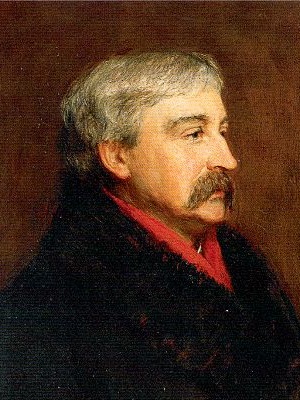
Bret Harte American 1836 – 1902
(a chemical narrative)
Certain facts which serve to explain The physical charms of Miss Addie De Laine, Who, as the common reports obtain, Surpassed in complexion the lily and rose; With a very sweet mouth and a retrousse nose; A figure like Hebe’s, or that which revolves In a milliner’s window, and partially solves That question which mentor and moralist pains, If grace may exist minus feeling or brains.
Of course the young lady had beaux by the score, All that she wanted,—what girl could ask more? Lovers that sighed and lovers that swore, Lovers that danced and lovers that played, Men of profession, of leisure, and trade; But one, who was destined to take the high part Of holding that mythical treasure, her heart,— This lover, the wonder and envy of town, Was a practicing chemist, a fellow called Brown.
I might here remark that ‘twas doubted by many, In regard to the heart, if Miss Addie had any; But no one could look in that eloquent face, With its exquisite outline and features of grace, And mark, through the transparent skin, how the tide Ebbed and flowed at the impulse of passion or pride,— None could look, who believed in the blood’s circulation As argued by Harvey, but saw confirmation That here, at least, Nature had triumphed o’er art, And as far as complexion went she had a heart.
But this par parenthesis. Brown was the man Preferred of all others to carry her fan, Hook her glove, drape her shawl, and do all that a belle May demand of the lover she wants to treat well. Folks wondered and stared that a fellow called Brown— Abstracted and solemn, in manner a clown, Ill dressed, with a lingering smell of the shop— Should appear as her escort at party or hop. Some swore he had cooked up some villainous charm, Or love philter, not in the regular Pharm- Acopoeia, and thus, from pure malice prepense, Had bewitched and bamboozled the young lady’s sense; Others thought, with more reason, the secret to lie In a magical wash or indelible dye; While Society, with its censorious eye And judgment impartial, stood ready to damn What wasn’t improper as being a sham.
For a fortnight the townfolk had all been agog With a party, the finest the season had seen, To be given in honor of Miss Pollywog, Who was just coming out as a belle of sixteen. The guests were invited; but one night before A carriage drew up at the modest back door Of Brown’s lab’ratory, and, full in the glare Of a big purple bottle, some closely veiled fair Alighted and entered: to make matters plain, Spite of veils and disguises, ‘twas Addie De Laine.
As a bower for true love, ‘twas hardly the one That a lady would choose to be wooed in or won: No odor of rose or sweet jessamine’s sigh Breathed a fragrance to hallow their pledge of troth by, Nor the balm that exhales from the odorous thyme; But the gaseous effusions of chloride of lime, And salts, which your chemist delights to explain As the base of the smell of the rose and the drain. Think of this, O ye lovers of sweetness! and know What you smell when you snuff up Lubin or Pinaud.
I pass by the greetings, the transports and bliss, Which of course duly followed a meeting like this, And come down to business,—for such the intent Of the lady who now o’er the crucible leant, In the glow of a furnace of carbon and lime, Like a fairy called up in the new pantomime,— And give but her words, as she coyly looked down In reply to the questioning glances of Brown: ‘I am taking the drops, and am using the paste, And the little white powders that had a sweet taste, Which you told me would brighten the glance of my eye, And the depilatory, and also the dye, And I’m charmed with the trial; and now, my dear Brown, I have one other favor,—now, ducky, don’t frown,— Only one, for a chemist and genius like you But a trifle, and one you can easily do. Now listen: to-morrow, you know, is the night Of the birthday soiree of that Pollywog fright; And I’m to be there, and the dress I shall wear Is too lovely; but’— ‘But what then, ma chere?’ Said Brown, as the lady came to a full stop, And glanced round the shelves of the little back shop. ‘Well, I want—I want something to fill out the skirt To the proper dimensions, without being girt In a stiff crinoline, or caged in a hoop That shows through one’s skirt like the bars of a coop; Something light, that a lady may waltz in, or polk, With a freedom that none but you masculine folk Ever know. For, however poor woman aspires, She’s always bound down to the earth by these wires. Are you listening? Nonsense! don’t stare like a spoon, Idiotic; some light thing, and spacious, and soon— Something like—well, in fact—something like a balloon!’
Here she paused; and here Brown, overcome by surprise, Gave a doubting assent with still wondering eyes, And the lady departed. But just at the door Something happened,—’tis true, it had happened before In this sanctum of science,—a sibilant sound, Like some element just from its trammels unbound, Or two substances that their affinities found.
The night of the anxiously looked for soiree Had come, with its fair ones in gorgeous array; With the rattle of wheels and the tinkle of bells, And the ‘How do ye do’s’ and the ‘Hope you are well’s;’ And the crush in the passage, and last lingering look You give as you hang your best hat on the hook; The rush of hot air as the door opens wide; And your entry,—that blending of self-possessed pride And humility shown in your perfect-bred stare At the folk, as if wondering how they got there; With other tricks worthy of Vanity Fair. Meanwhile, the safe topic, the beat of the room, Already was losing its freshness and bloom; Young people were yawning, and wondering when The dance would come off; and why didn’t it then: When a vague expectation was thrilling the crowd, Lo! the door swung its hinges with utterance proud! And Pompey announced, with a trumpet-like strain, The entrance of Brown and Miss Addie De Laine.
She entered; but oh! how imperfect the verb To express to the senses her movement superb! To say that she ‘sailed in’ more clearly might tell Her grace in its buoyant and billowy swell. Her robe was a vague circumambient space, With shadowy boundaries made of point-lace; The rest was but guesswork, and well might defy The power of critical feminine eye To define or describe: ‘twere as futile to try The gossamer web of the cirrus to trace, Floating far in the blue of a warm summer sky.
‘Midst the humming of praises and glances of beaux That greet our fair maiden wherever she goes, Brown slipped like a shadow, grim, silent, and black, With a look of anxiety, close in her track. Once he whispered aside in her delicate ear A sentence of warning,—it might be of fear: ‘Don’t stand in a draught, if you value your life.’ (Nothing more,—such advice might be given your wife Or your sweetheart, in times of bronchitis and cough, Without mystery, romance, or frivolous scoff.) But hark to the music; the dance has begun. The closely draped windows wide open are flung; The notes of the piccolo, joyous and light, Like bubbles burst forth on the warm summer night. Round about go the dancers; in circles they fly; Trip, trip, go their feet as their skirts eddy by; And swifter and lighter, but somewhat too plain, Whisks the fair circumvolving Miss Addie De Laine. Taglioni and Cerito well might have pined For the vigor and ease that her movements combined; E’en Rigelboche never flung higher her robe In the naughtiest city that’s known on the globe. ‘Twas amazing, ‘twas scandalous; lost in surprise, Some opened their mouths, and a few shut their eyes.
But hark! At the moment Miss Addie De Laine, Circling round at the outer edge of an ellipse Which brought her fair form to the window again, From the arms of her partner incautiously slips! And a shriek fills the air, and the music is still, And the crowd gather round where her partner forlorn Still frenziedly points from the wide window-sill Into space and the night; for Miss Addie was gone! Gone like the bubble that bursts in the sun; Gone like the grain when the reaper is done; Gone like the dew on the fresh morning grass; Gone without parting farewell; and alas! Gone with a flavor of hydrogen gas!
When the weather is pleasant, you frequently meet A white-headed man slowly pacing the street; His trembling hand shading his lack-lustre eye, Half blind with continually scanning the sky. Rumor points him as some astronomical sage, Re-perusing by day the celestial page; But the reader, sagacious, will recognize Brown, Trying vainly to conjure his lost sweetheart down, And learn the stern moral this story must teach, That Genius may lift its love out of its reach.
We present this work in honor of National Senior Citizens Day.
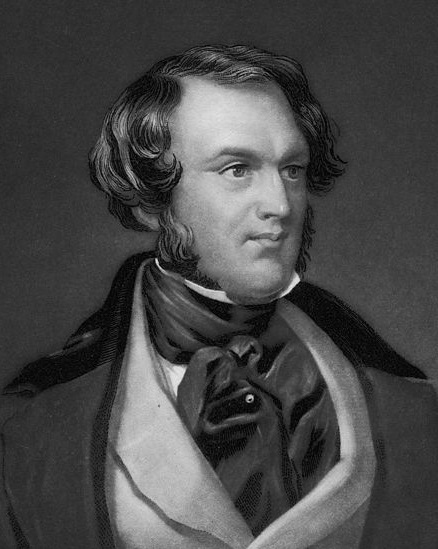
Matthew Arnold English 1822 – 1888
What is it to grow old? Is it to lose the glory of the form, The lustre of the eye? Is it for beauty to forego her wreath? Yes, but not for this alone.
Is it to feel our strength – Not our bloom only, but our strength – decay? Is it to feel each limb Grow stiffer, every function less exact, Each nerve more weakly strung?
Yes, this, and more! but not, Ah, ‘tis not what in youth we dreamed ‘twould be! ‘Tis not to have our life Mellowed and softened as with sunset-glow, A golden day’s decline!
‘Tis not to see the world As from a height, with rapt prophetic eyes, And heart profoundly stirred; And weep, and feel the fulness of the past, The years that are no more!
It is to spend long days And not once feel that we were ever young. It is to add, immured In the hot prison of the present, month To month with weary pain.
It is to suffer this, And feel but half, and feebly, what we feel: Deep in our hidden heart Festers the dull remembrance of a change, But no emotion -none.
It is – last stage of all – When we are frozen up within, and quite The phantom of ourselves, To hear the world applaud the hollow ghost Which blamed the living man.
We present this work in honor of the poet’s 250th birthday.
Sir Walter Scott Scots 1771 – 1832
Breathes there the man, with soul so dead, Who never to himself hath said, This is my own, my native land! Whose heart hath ne’er within him burn’d, As home his footsteps he hath turn’d From wandering on a foreign strand! If such there breathe, go, mark him well; For him no Minstrel raptures swell; High though his titles, proud his name, Boundless his wealth as wish can claim; Despite those titles, power, and pelf, The wretch, concentred all in self, Living, shall forfeit fair renown, And, doubly dying, shall go down To the vile dust, from whence he sprung, Unwept, unhonour’d, and unsung.
We present this work in honor of World Elephant Day.
James McIntyre Canadian 1828 – 1906
On Ganges banks roams the tiger, And lion rules by the Niger, Hunder heard shrill cry of peacocks, In Indian jungles go in flocks.
And he saw tiger crouch and spring, To crush a bird with beauteous wing, But the tiger missed his aim, And he hung his head with shame.
Then there came a mighty crush, Of elephants rush through the bush, The tiger cat-like crouched on ground, And elephants rushed in with bound.
In front was baby elephant, To crush its bones did tiger want, But mother saw fierce forest ranger, And she gave a cry of danger.
Leader of herd he madly rushed, Resolved the tiger should be crushed, But tiger strove to run away, Willing to relinquish prey.
But when he found that he must fight, On elephant’s back he strove to light, But elephant struck him with his foot, And then with tusks he did him root.
So now once more must praise be sung, To beasts who nobly fight for young, And grateful feelings were now stirred, Towards the leader of the herd.
Insects and dust. A leaden atmosphere Where loud the clappings of the thunder sound. Like swans in mud, pure white against a ground Of ashes, clouds immaculate appear. The sea has paralyzed its waves, their clear Green rush is still; above that bosom round Lightning, within a frame of peace profound, Lets forth a swift and sudden crimson spear. Dreamily nods the lazy tree its head; Deep calm, unbalanced, reels before attack,
And rapid sea gulls rend the air amain. Across the spacious vault a bolt is sped, And then upon the earth’s great smoking back Sharply descend the crackling drops of rain.
In honor of the Canadian holiday, Civic Day, we present this work by one of Canada’s most heartfelt poets.
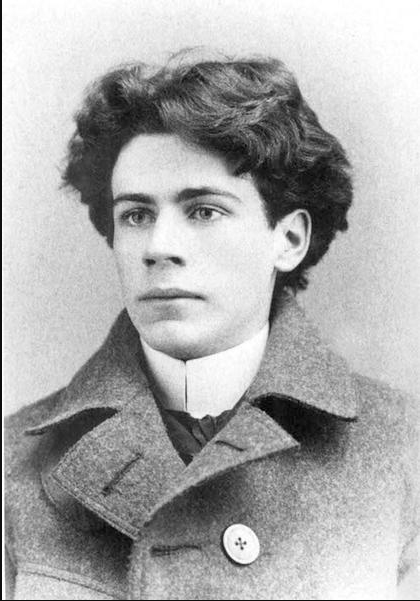
Emile Nelligan Canadian 1879 – 1941
She was a massive ship, hewn in heavy gold, with masts that fingered heaven on seas unknown. Under redundant sun, with scattered hair, was prowed outspread Venus, bare;
but then one night she hit the huge reef in waters where the Sirens sing, and this ghastly shipwreck tilted its keel to the depths of the chasm, that immutable
tomb. She was a ship of gold, but her diaphanous flanks showed treasures over which the blasphemous sailors Psychosis, Spite and Nausea clashed.
So, what has survived this flash of storm? What about my heart, abandoned ship? …O, still it sinks, deep in Dream’s abyss.



 Poets Corner