We present this work in honor of the poet’s 215th birthday.
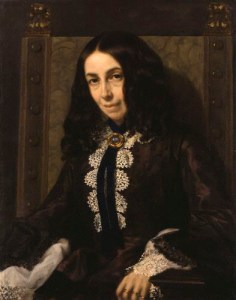
Elizabeth Barrett Browning English 1806 – 1861
If thou must love me, let it be for nought
Except for love’s sake only. Do not say
‘I love her for her smile—her look—her way
Of speaking gently,—for a trick of thought
That falls in well with mine, and certes brought
A sense of pleasant ease on such a day’—
For these things in themselves, Beloved, may
Be changed, or change for thee,—and love, so wrought,
May be unwrought so. Neither love me for
Thine own dear pity’s wiping my cheeks dry,—
A creature might forget to weep, who bore
Thy comfort long, and lose thy love thereby!
But love me for love’s sake, that evermore
Thou mayst love on, through love’s eternity.
We present this work in honor of the poet’s 230th birthday.
Manuel Carpio Mexican 1791 – 1860
From a lofty peak how terrible to behold
The murky tempests far below,
And in the vast solitudes
The flash of the magnificent lightning.
Popocatepetel and Orizaba,
Crush the ground with their enormous massiveness,
And their cuspises of ice and lava
Are enveloped in a dense cloud.
There the deer, with antlered forhead,
Cross the woods with graceful bounds,
And among the pines and elevated cliffs
The waters dash in torrents.
How awe-inspiring are thine immense volcanoes
With their ponderous rocks ;
Among thy wooded mountains roar the tempest,
And their stormy summit is a crater.
Globules of fire are hurled from their mouths ;
Columns of smoke and grand flashes of fire ;
Burning sulphur, glowing sands,
Black pitch and calcined stones.
Then the foundation of the blue mountains
Trembles, and from this furnace
The rude and tremendous shaking
Extends for a hundred leagues around.
The great God of all nations said,
When distributing His treasures over the land,
“Let Mexico have silver and gold,”
And poured on thee His affluent gifts.
We present this work in honor of the 200th anniversary of the poet’s death.
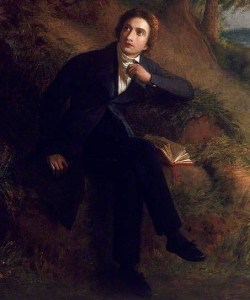
John Keats English 1795 –1821
Bright star, would I were stedfast as thou art—
Not in lone splendour hung aloft the night
And watching, with eternal lids apart,
Like nature’s patient, sleepless Eremite,
The moving waters at their priestlike task
Of pure ablution round earth’s human shores,
Or gazing on the new soft-fallen mask
Of snow upon the mountains and the moors—
No—yet still stedfast, still unchangeable,
Pillow’d upon my fair love’s ripening breast,
To feel for ever its soft fall and swell,
Awake for ever in a sweet unrest,
Still, still to hear her tender-taken breath,
And so live ever—or else swoon to death.
We present this work in honor of the poet’s 185th birthday.
Gustavo Adolfo Bécquer Spanish 1836 – 1870
The dusky swallows will return
To hang their nests beneath thy eaves,
And playing to their nestlings call
As once they called of old.
But those who checked their flight
To gaze upon the beauty and my joy,
Who learnt our names—Ah Love!
They—will return no more!
The twining honeysuckles once again
Shall scale thy garden walls;
And once again at eve, more beautiful,
Their flowers will unfold.
But those of yore, begemmed with dews
Whose drops we watched together
Tremble and fall like tears of bright day,
They—will return no more!
Once more within thine ears, the words
Of burning love shall sound,
And from its slumber deep, perchance
Thy heart will wake.
But spellbound, speechless, kneeling low,
As saints before their altars are adored,
As I have loved thee—oh! deceive thee not!
Thus shall none love thee more!
We present this work in honor of the 80th anniversary of the poet’s death.
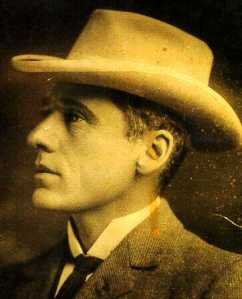
Banjo Paterson Australian 1864 – 1941
There was movement at the station, for the word had passed around
That the colt from old Regret had got away,
And had joined the wild bush horses – he was worth a thousand pound,
So all the cracks had gathered to the fray.
All the tried and noted riders from the stations near and far
Had mustered at the homestead overnight,
For the bushmen love hard riding where the wild bush horses are,
And the stock-horse snuffs the battle with delight.
There was Harrison, who made his pile when Pardon won the cup,
The old man with his hair as white as snow;
But few could ride beside him when his blood was fairly up-
He would go wherever horse and man could go.
And Clancy of the Overflow came down to lend a hand,
No better horseman ever held the reins;
For never horse could throw him while the saddle girths would stand,
He learnt to ride while droving on the plains.
And one was there, a stripling on a small and weedy beast,
He was something like a racehorse undersized,
With a touch of Timor pony – three parts thoroughbred at least –
And such as are by mountain horsemen prized.
He was hard and tough and wiry – just the sort that won’t say die –
There was courage in his quick impatient tread;
And he bore the badge of gameness in his bright and fiery eye,
And the proud and lofty carriage of his head.
But so slight and weedy, one would doubt his power to stay,
And the old man said, “That horse will never do
For a long and tiring gallop-lad, you’d better stop away,
Those hills are far too rough for such as you.”
So he waited sad and wistful – only Clancy stood his friend –
“I think we ought to let him come,” he said;
“I warrant he’ll be with us when he’s wanted at the end,
For both his horse and he are mountain bred.”
“He hails from Snowy River, up by Kosciusko’s side,
Where the hills are twice as steep and twice as rough,
Where a horse’s hoofs strike firelight from the flint stones every stride,
The man that holds his own is good enough.
And the Snowy River riders on the mountains make their home,
Where the river runs those giant hills between;
I have seen full many horsemen since I first commenced to roam,
But nowhere yet such horsemen have I seen.”
So he went – they found the horses by the big mimosa clump –
They raced away towards the mountain’s brow,
And the old man gave his orders, “Boys, go at them from the jump,
No use to try for fancy riding now.
And, Clancy, you must wheel them, try and wheel them to the right.
Ride boldly, lad, and never fear the spills,
For never yet was rider that could keep the mob in sight,
If once they gain the shelter of those hills.”
So Clancy rode to wheel them – he was racing on the wing
Where the best and boldest riders take their place,
And he raced his stockhorse past them, and he made the ranges ring
With stockwhip, as he met them face to face.
Then they halted for a moment, while he swung the dreaded lash,
But they saw their well-loved mountain full in view,
And they charged beneath the stockwhip with a sharp and sudden dash,
And off into the mountain scrub they flew.
Then fast the horsemen followed, where the gorges deep and black
Resounded to the thunder of their tread,
And the stockwhips woke the echoes, and they fiercely answered back
From cliffs and crags that beetled overhead.
And upward, ever upward, the wild horses held their sway,
Were mountain ash and kurrajong grew wide;
And the old man muttered fiercely, “We may bid the mob good day,
No man can hold them down the other side.”
When they reached the mountain’s summit, even Clancy took a pull,
It well might make the boldest hold their breath,
The wild hop scrub grew thickly, and the hidden ground was full
Of wombat holes, and any slip was death.
But the man from Snowy River let the pony have his head,
And he swung his stockwhip round and gave a cheer,
And he raced him down the mountain like a torrent down its bed,
While the others stood and watched in very fear.
He sent the flint stones flying, but the pony kept his feet,
He cleared the fallen timbers in his stride,
And the man from Snowy River never shifted in his seat –
It was grand to see that mountain horseman ride.
Through the stringybarks and saplings, on the rough and broken ground,
Down the hillside at a racing pace he went;
And he never drew the bridle till he landed safe and sound,
At the bottom of that terrible descent.
He was right among the horses as they climbed the further hill
And the watchers on the mountain standing mute,
Saw him ply the stockwhip fiercely, he was right among them still,
As he raced across the clearing in pursuit.
Then they lost him for a moment, where two mountain gullies met
In the ranges, but a final glimpse reveals
On a dim and distant hillside the wild horses racing yet,
With the man from Snowy River at their heels.
And he ran them single-handed till their sides were white with foam.
He followed like a bloodhound in their track,
Till they halted cowed and beaten, then he turned their heads for home,
And alone and unassisted brought them back.
But his hardy mountain pony he could scarcely raise a trot,
He was blood from hip to shoulder from the spur;
But his pluck was still undaunted, and his courage fiery hot,
For never yet was mountain horse a cur.
And down by Kosciusko, where the pine-clad ridges raise
Their torn and rugged battlements on high,
Where the air is clear as crystal, and the white stars fairly blaze
At midnight in the cold and frosty sky,
And where around The Overflow the reed beds sweep and sway
To the breezes, and the rolling plains are wide,
The man from Snowy River is a household word today,
And the stockmen tell the story of his ride.
We present this work in honor of the 125th anniversary of the poet’s death.
Lady Jane Wilde Irish 1821 – 1896
He stands alone in the lordly hall
He, with the high, pale brow;
But never a one at the festival
Was half so great, I trow.
They kiss the hand, and they bend the knee,
Slaves to an earthly king!
But the heir of a loftier dynasty
May scorn that courtly ring.
They press, with false and flattering words,
Around the blood‐bought throne;
But the homage never yet won by swords
Is his—the Anointed One!
His sway over every nation
Extendeth from zone to zone;
He reigns as a god o’er creation
The universe is his own.
No star on his breast is beaming,
But the light of his flashing eye
Reveals, in its haughtier gleaming,
The conscious majesty.
For the Poet’s crown is the godlike brow
Away with that golden thing!
Your fealty was never yet due till now
Since I am corruptly fallen,
Straying from you constantly,
To ascend your sacred mountain
Is the right of rights for me.
There on high your veils are riven,
Every cover nullified,
There above all worldly nothings
Is your glory magnified.
Oh to drink on high forever
Where redemption’s waters flow,
Drink until I thirst no longer
For the fading world below,
Live in wait for my Lord’s coming,
Wakeful for the coming night
When I swiftly open to him
In his image, in his sight.


 Poets Corner