We present this work in honor of the poet’s 240th birthday.
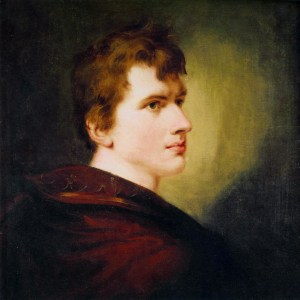
Achim von Arnim German 1781 – 1831
O nightingale, your noble sound, brings us great joy,
Your voice roams all mountains and valleys, in the beautiful summertime,
When you start to pull out, the birds are silent
Nobody shows up, nobody wants to sing anymore.
The tree is happy because it is scarcely sentient;
the hard rock is happier still, it feels nothing:
there is no pain as great as being alive,
no burden heavier than that of conscious life.
To be, and to know nothing, and to lack a way,
and the dread of having been, and future terrors…
And the sure terror of being dead tomorrow,
and to suffer all through life and through the darkness,
and through what we do not know and hardly suspect…
And the flesh that temps us with bunches of cool grapes,
and the tomb that awaits us with its funeral sprays,
and not to know where we go,
nor whence we came!
We present this work in honor of the 85th anniversary of the poet’s death.
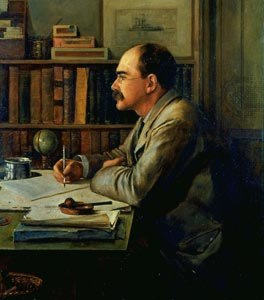
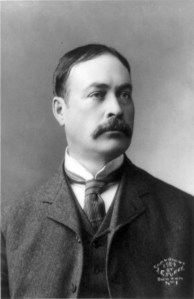
Rudyard Kipling English 1865 – 1936
That night, when through the mooring-chains
The wide-eyed corpse rolled free,
To blunder down by Garden Reach
And rot at Kedgeree,
The tale the Hughli told the shoal
The lean shoal told to me.
‘Twas Fultah Fisher’s boarding-house,
Where sailor-men reside,
And there were men of all the ports
From Mississip to Clyde,
And regally they spat and smoked,
And fearsomely they lied.
They lied about the purple Sea
That gave them scanty bread,
They lied about the Earth beneath,
The Heavens overhead,
For they had looked too often on
Black rum when that was red.
They told their tales of wreck and wrong,
Of shame and lust and fraud,
They backed their toughest statements with
The Brimstone of the Lord,
And crackling oaths went to and fro
Across the fist-banged board.
And there was Hans the blue-eyed Dane,
Bull-throated, bare of arm,
Who carried on his hairy chest
The maid Ultruda’s charm—
The little silver crucifix
That keeps a man from harm.
And there was Jake Without-the-Ears,
And Pamba the Malay,
And Carboy Gin the Guinea cook,
And Luz from Vigo Bay,
And Honest Jack who sold them slops
And harvested their pay.
And there was Salem Hardieker,
A lean Bostonian he—
Russ, German, English, Halfbreed, Finn,
Yank, Dane, and Portuguee,
At Fultah Fisher’s boarding-house
The rested from the sea.
Now Anne of Austria shared their drinks,
Collinga knew her fame,
From Tarnau in Galicia
To Jaun Bazaar she came,
To eat the bread of infamy
And take the wage of shame.
She held a dozen men to heel—
Rich spoil of war was hers,
In hose and gown and ring and chain,
From twenty mariners,
And, by Port Law, that week, men called
Her Salem Hardieker’s.
But seamen learnt—what landsmen know—
That neither gifts nor gain
Can hold a winking Light o’ Love
Or Fancy’s flight restrain,
When Anne of Austria rolled her eyes
On Hans the blue-eyed Dane.
Since Life is strife, and strife means knife,
From Howrah to the Bay,
And he may die before the dawn
Who liquored out the day,
In Fultah Fisher’s boarding-house
We woo while yet we may.
But cold was Hans the blue-eyed Dane,
Bull-throated, bare of arm,
And laughter shook the chest beneath
The maid Ultruda’s charm—
The little silver crucifix
That keeps a man from harm.
“You speak to Salem Hardieker;
“You was his girl, I know.
“I ship mineselfs to-morrow, see,
“Und round the Skaw we go,
“South, down the Cattegat, by Hjelm,
“To Besser in Saro.”
When love rejected turns to hate,
All ill betide the man.
“You speak to Salem Hardieker”—
She spoke as woman can.
A scream—a sob—“He called me—names!”
And then the fray began.
An oath from Salem Hardieker,
A shriek upon the stairs,
A dance of shadows on the wall,
A knife-thrust unawares—
And Hans came down, as cattle drop,
Across the broken chairs.
…In Anne of Austria’s trembling hands
The weary head fell low:—
“I ship mineselfs to-morrow, straight
“For Besser in Saro;
“Und there Ultruda comes to me
“At Easter, und I go
“South, down the Cattegat—What’s here?
“There—are—no—lights—to guide!”
The mutter ceased, the spirit passed,
And Anne of Austria cried
In Fultah Fisher’s boarding-house
When Hans the mighty died.
Thus slew they Hans the blue-eyed Dane,
Bull-throated, bare of arm,
But Anne of Austria looted first
The maid Ultruda’s charm—
The little silver crucifix
That keeps a man from harm.
We present this work in honor of the poet’s 205th birthday.
Frances Browne Irish 1816 – 1879
Oh! bright on the silvery Shannon lies
The light of the setting sun,
And stately the city’s spires arise,
Where the isle’s last field was won!
But now, no stain of the battle’s blood
Remains, to sully that peaceful flood,—
Nor sound in the summer-evening swells,
Save that of St. Mary’s vesper bells.
There came a late and a lonely boat,
O’er the shining river’s breast;
And it bore, from a land far, far remote,
A sad and a stranger guest:—
A darker tint had tinged his brow
Than the skies that bent above him, now,
Could give their sons—and a brighter beam
Had shone on his youth, by Tiber’s stream.
His was the peerless land of song,
By the Muses blest, of yore;
But his steps had wandered, far and long,
From the bright Hesperian shore:
And his early home was a darkened spot,—
For the love, that brightened his hearth, was not;
And heavy and chill the clouds of age
Fell on his lonely pilgrimage.
But still, in his memory’s echo, swelled
A sweet and a solemn chime,—
That oft, through the golden twilight pealed,
In his own far southern clime:—
Oh! many a city and many a shore
Had the weary pilgrim wandered o’er,—
But they never sent to his aged ear
The sounds he had loved—and pined to hear!
Yet why doth the stranger start,—and turn
From his lonely musings, now?
And why doth such glowing gladness burn
In his aged eye and brow?
‘Tis only the vesper bells, again,
That ring from St. Mary’s sacred fane,—
But oh! to the wanderer’s heart they tell
Of scenes and voices remembered well!
His arm was strong, and his hope was bright,
When he tuned to melody
Those vesper bells, in the cloudless light
Of his own Italian sky;—
And now, on a distant northern shore,
That music breathed on his heart once more—
Though the strength and hope of his years were past—
As sweet as when he heard it last!
For the light of many a twilight hour,
And the breath of many a strain,
From cottage porch, and from myrtle bower,
With that sound returned again:—
And the wanderer listened, like one whose soul
Had found the path to its early goal,—
But his eyes were fixed, and his very breath
Seemed hush in the changeless hush of death!
Fainter and fainter the last low note
On the waters died away;
And the rowers paused,—for the lonely boat
By the stately city lay.
But the wanderer moved not—spoke not—still,
Though the dews of night fell fast and chill,
And strangers lifted his drooping head,—
But they found that the weary soul had fled!
Oh! strange were the yearning thoughts and fond
Round that lone heart’s ruined shrine,—
As the Hebrew’s thirst for the fount beyond
Philistia’s leaguering line!
But the sounds, that in life he loved the best,
May peal, unheeded, above his rest,—
For still, through the summer twilight, swells
The sound of St. Mary’s vesper bells!
I have children and a husband… I have more;
I have a loving and affectionate mother,
Brothers who love me and whom I love,
And instead of the false glitter of wealth
I have a modest and tranquil home
In another time my fervent heart
Dreamed restlessly, and I lived on the dream,
Fantastic chimeras night and day,
Delusions crowded in… I dreamed anyway
But then the horizon cleared,
The dark cloud turned to dawn,
Calm returned to my heart, and now
The present ensures my future
Alone at another time, like an errant bird
That crosses desert sands,
And after long mortal years of anxiety,
Arrived at the oasis it had faithfully sought;
Feeling myself finally free of fatigue,
And if I cast a look to the past,
It is only to bring it from burdensome effusion
To rest it on my present love.
On wan dark night on Lac St. Pierre,
De win’ she blow, blow, blow,
An’ de crew of de wood scow “Julie Plante”
Got scar’t an’ run below—
For de win’ she blow lak hurricane,
Bimeby she blow some more,
An’ de scow bus’ up on Lac St. Pierre
Wan arpent from de shore.
De captinne walk on de fronte deck,
An’ walk de hin’ deck too—
He call de crew from up de hole,
He call de cook also.
De cook she ‘s name was Rosie,
She come from Montreal,
Was chambre maid on lumber barge,
On de Grande Lachine Canal.
De win’ she blow from nor’ -eas’ -wes’,—
De sout’ win’ she blow too,
W’en Rosie cry, “Mon cher captinne,
Mon cher, w’at I shall do ?”
Den de captinne t’row de beeg ankerre,
But still de scow she dreef,
De crew he can’t pass on de shore,
Becos’ he los’ hees skeef.
De night was dark lak wan black cat,
De wave run high an’ fas’,
W’en de captinne tak’ de Rosie girl
An’ tie her to de mas’.
Den he also tak’ de life preserve,
An’ jomp off on de lak’,
An’ say, “Good-bye, ma Rosie dear,
I go drown for your sak’.”
Nex’ morning very early
‘Bout ha’f-pas’ two—t’ree—four—
De captinne—scow—an’ de poor Rosie
Was corpses on de shore,
For de win’ she blow lak hurricane,
Bimeby she blow some more,
An’ de scow bus’ up on Lac St. Pierre,
Wan arpent from de shore.
MORAL
Now all good wood scow sailor man
Tak’ warning by dat storm
An’ go an’ marry some nice French girl
An’ leev on wan beeg farm.
De win’ can blow lak hurricane
An’ s’pose she blow some more,
You can’t get drown on Lac St. Pierre
So long you stay on shore.
We present this work in honor of the 150th anniversary of the poet’s death.
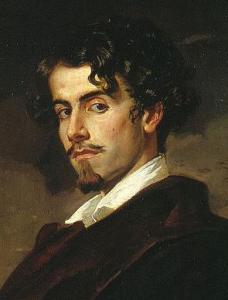
Gustavo Adolfo Bécquer Spanish 1836 – 1870
The face of the sun may darken forever;
The oceans may run dry in an instant;
The axis spinning our planet may shatter;
Like a brittle crystal.
Yes, all of that may happen! At the end, Death
May cover my flesh with his funeral shroud;
But none of it will reach within my soul and extinguish
The bright flame of your love.
We present this work in honor of the poet’s 200th birthday.
Carolina Coronado Spanish 1820 – 1911
Bravo! thou nation of a noble line!
Thou mean’st to fashion after beasts thy men.
How well thy mission thou dost now divine,
Escaping from the Latin Church’s shrine
To intrench thyself around the fighters’ pen!
New Plazas for the bull-figlit let there be;
Build them, Country! pour thy treasures free!
Ah! stranger lands are wiser far than we, —
For here we are but cowherds, we are fools:
Which do we value most, the laws or bulls?
Who cares for liberty, while he doth roar,
The hunted bull, along the spacious plain.
Or tear the arena, and his victim gore?
When swells his passion with the pricking pain,
Who sees the vision of our mournful Spain?
And when he draws his breath with hoarsest sigh,
And from his pierced heart come out the groans,
And men fall down to earth, and horses die,
How sweet to hear the rosy children nigh
Break out in merry laughter’s silvery tones!
But hark! I see before my vision rise,
Brave to uphold the war of beasts and men,
Some spirited hidalgo, listening wise.
“I glory in the speetaele,” he cries;
“The thing is Spanish, — it has always been!”
O patriotie ardor! Lot them bind
A starry crown upon the learned brow
Of every noble knight, who thinks to find
Our highest strength within the bull enshrined,
Our Spanish glory in the Picador’s bow!
With all the fairest ladies of repute
The love of country so refined has grown
They look with rapture even on this brute;
For tenderness is here a foreign shoot,
And cruelty is Spanish-born alone!



 Poets Corner