We present this work in honor of the poet’s 250th birthday.
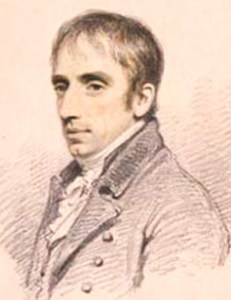
William Wordsworth English 1770 – 1850
Earth has not anything to show more fair:
Dull would he be of soul who could pass by
A sight so touching in its majesty:
This City now doth, like a garment, wear
The beauty of the morning; silent, bare,
Ships, towers, domes, theatres, and temples lie
Open unto the fields, and to the sky;
All bright and glittering in the smokeless air.
Never did sun more beautifully steep
In his first splendour, valley, rock, or hill;
Ne’er saw I, never felt, a calm so deep!
The river glideth at his own sweet will:
Dear God! the very houses seem asleep;
And all that mighty heart is lying still!
In honor of April Fool’s Day, we present this work by the author popularly considered the worst poet in history.
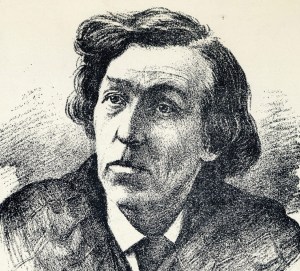
William Topaz McGonagall Scots 1825 – 1902
‘Twas in the month of December, and in the year l883,
That a monster whale came to Dundee,
Resolved for a few days to sport and play,
And devour the small fishes in the silvery Tay.
So the monster whale did sport and play
Among the innocent little fishes in the beautiful Tay,
Until he was seen by some men one day,
And they resolved to catch him without delay.
When it came to be known a whale was seen in the Tay,
Some men began to talk and to say,
We must try and catch this monster of a whale,
So come on, brave boys, and never say fail.
Then the people together in crowds did run,
Resolved to capture the whale and to have some fun!
So small boats were launched on the silvery Tay,
While the monster of the deep did sport and play.
Oh! it was a most fearful and beautiful sight,
To see it lashing the water with its tail all its might,
And making the water ascend like a shower of hail,
With one lash of its ugly and mighty tail.
Then the water did descend on the men in the boats,
Which wet their trousers and also their coats;
But it only made them the more determined to catch the whale,
But the whale shook at them his tail.
Then the whale began to puff and to blow,
While the men and the boats after him did go,
Armed well with harpoons for the fray,
Which they fired at him without dismay.
And they laughed and grinned just like wild baboons,
While they fired at him their sharp harpoons:
But when struck with,the harpoons he dived below,
Which filled his pursuers’ hearts with woe.
Because they guessed they had lost a prize,
Which caused the tears to well up in their eyes;
And in that their anticipations were only right,
Because he sped on to Stonehaven with all his might:
And was first seen by the crew of a Gourdon fishing boat
Which they thought was a big coble upturned afloat;
But when they drew near they saw it was a whale,
So they resolved to tow it ashore without fail.
So they got a rope from each boat tied round his tail,
And landed their burden at Stonehaven without fail;
And when the people saw it their voices they did raise,
Declaring that the brave fishermen deserved great praise.
And my opinion is that God sent the whale in time of need,
No matter what other people may think or what is their creed;
I know fishermen in general are often very poor,
And God in His goodness sent it drive poverty from their door.
So Mr John Wood has bought it for two hundred and twenty-six pound,
And has brought it to Dundee all safe and all sound;
Which measures 40 feet in length from the snout to the tail,
So I advise the people far and near to see it without fail.
Then hurrah! for the mighty monster whale,
Which has got 17 feet 4 inches from tip to tip of a tail!
Which can be seen for a sixpence or a shilling,
That is to say, if the people all are willing.
We present this work in honor of the 165th anniversary of the poet’s death.
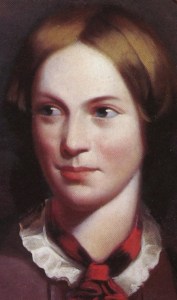
Charlotte Brontë English 1816 – 1855
The human heart has hidden treasures,
In secret kept, in silence sealed;¬
The thoughts, the hopes, the dreams, the pleasures,
Whose charms were broken if revealed.
And days may pass in gay confusion,
And nights in rosy riot fly,
While, lost in Fame’s or Wealth’s illusion,
The memory of the Past may die.
But, there are hours of lonely musing,
Such as in evening silence come,
When, soft as birds their pinions closing,
The heart’s best feelings gather home.
Then in our souls there seems to languish
A tender grief that is not woe;
And thoughts that once wrung groans of anguish,
Now cause but some mild tears to flow.
And feelings, once as strong as passions,
Float softly back ¬a faded dream;
Our own sharp griefs and wild sensations,
The tale of others’ sufferings seem.
Oh ! when the heart is freshly bleeding,
How longs it for that time to be,
When, through the mist of years receding,
Its woes but live in reverie!
And it can dwell on moonlight glimmer,
On evening shade and loneliness;
And, while the sky grows dim and dimmer,
Feel no untold and strange distress¬
Only a deeper impulse given
By lonely hour and darkened room,
To solemn thoughts that soar to heaven,
Seeking a life and world to come.
We present this work in honor of the poet’s 250th birthday.
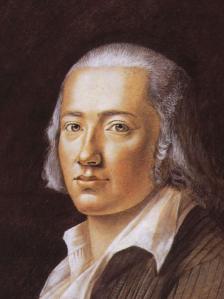
Friedrich Hölderlin German 1770 – 1843
Round about the city rests. The illuminated streets grow
Quiet, and coaches rush along, adorned with torches.
Men go home to rest, filled with the day’s pleasures;
Busy minds weigh up profit and loss contentedly
At home. The busy marketplace comes to rest,
Vacant now of flowers and grapes and crafts.
But the music of strings sounds in distant gardens:
Perhaps lovers play there, or a lonely man thinks
About distant friends, and about his own youth.
Rushing fountains flow by fragrant flower beds,
Bells ring softly in the twilight air, and a watchman
Calls out the hour, mindful of the time.
Now a breeze rises and touches the crest of the grove —
Look how the moon, like the shadow of our earth,
Also rises stealthily! Phantastical night comes,
Full of stars, unconcerned probably about us —
Astonishing night shines, a stranger among humans,
Sadly over the mountain tops, in splendor.
We present this work in honor of St. Patrick’s Day.
Lady Jane Wilde Irish 1821 – 1896
There is woe, there is clamour, in our desolated land,
And wailing lamentation from a famine‐stricken band;
And weeping are the multitudes in sorrow and despair,
For the green fields of Munster lying desolate and bare.
Woe for Lorc’s ancient kingdom, sunk in slavery and grief;
Plundered, ruined, are our gentry, our people, and their Chief;
For the harvest lieth scattered, more worth to us than gold,
All the kindly food that nourished both the young and the old.
Well I mind me of the cosherings, where princes might dine,
And we drank until nightfall the best seven sorts of wine;
Yet was ever the Potato our old, familiar dish,
And the best of all sauces with the beeves and the fish.
But the harp now is silent, no one careth for the sound;
No flowers, no sweet honey, and no beauty can be found;
Not a bird its music thrilling through the leaves of the wood,
Nought but weeping and hands wringing in despair for our food.
And the Heavens, all in darkness, seem lamenting our doom,
No brightness in the sunlight, not a ray to pierce the gloom;
The cataract comes rushing with a fearful deepened roar,
And ocean bursts its boundaries, dashing wildly on the shore.
Yet, in misery and want, we have one protecting man,
Kindly Barry, of Fitzstephen’s old hospitable clan;
By mount and river working deeds of charity and grace:
Blessings ever on our champion, best hero of his race!
Save us, God! In Thy mercy bend to hear the people’s cry,
From the famine‐stricken fields, rising bitterly on high;
Let the mourning and the clamour cease in Lorc’s ancient land,
And shield us in the death‐hour by Thy strong, protecting hand!
I meant to be so strong and true!
The world may smile and question, When?
But what I might have been to you
I cannot be to other men.
Just one in twenty to the rest,
And all in all to you alone, –
This was my dream; perchance ’tis best
That this, like other dreams, is flown.
For you I should have been so kind,
So prompt my spirit to control,
To win fresh vigor for my mind,
And purer beauties for my soul;
Beneath your eye I might have grown
To that divine, ideal height,
Which, mating wholly with your own,
Our equal spirits should unite.
We present this work in honor of the 100th anniversary of the poet’s death.
Rafael Obligado Argentine 1851 – 1920
Runs the tale that on an evening
When itself the pampa abysses
In its own far-reaching acres,
Without its crown of stars atwinkle,
O’er the loftiest of the hillocks
Where there is most smiling clover
Shines the torch without an owner.
Amid the vague mist’s formless curtains,
To the end the breeze may temper
The soft wings of wooing slumber.
Yet if the faintness be altered
To a tempest from its bosom,
Wildly bursts the concave thunder—
Which is speech of the dread lightning—
Strikes the lone ombu obliquely
Flaming tongue of ruddy serpent,
Which, calcinating its branches,
Serpentines, runs and mounts upward,
And from the tall tip discharges
Its scales in a brilliant shower.
Ah, not this marble, dead and cold:
Far from its base and shaft expanding—the round zones circling, comprehending,
Thou, Washington, art all the world’s, the continents’ entire—not yours alone, America,
Europe’s as well, in every part, castle of lord or laborer’s cot,
Or frozen North, or sultry South—the African’s—the Arab’s in his tent,
Old Asia’s there with venerable smile, seated amid her ruins;
(Greets the antique the hero new? ‘tis but the same—the heir legitimate, continued ever,
The indomitable heart and arm—proofs of the never-broken line,
Courage, alertness, patience, faith, the same—e’en in defeat
defeated not, the same:)
Wherever sails a ship, or house is built on land, or day or night,
Through teeming cities’ streets, indoors or out, factories or farms,
Now, or to come, or past—where patriot wills existed or exist,
Wherever Freedom, pois’d by Toleration, sway’d by Law,
Stands or is rising thy true monument.

 Poets Corner