We present this work in honor of the poet’s 165th birthday.
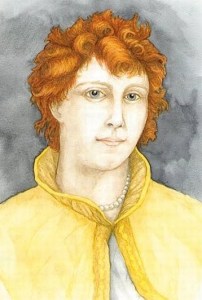
Victor Daley Australian 1858 – 1905
I have been dreaming all a summer day Of rare and dainty poems I would write; Love-lyrics delicate as lilac-scent, Soft idylls woven of wind, and flower, and stream, And songs and sonnets carven in fine gold.
The day is fading and the dusk is cold; Out of the skies has gone the opal gleam, Out of my heart has passed the high intent Into the shadow of the falling night Must all my dreams in darkness pass away?
I have been dreaming all a summer day: Shall I go dreaming so until Life’s light Fades in Death’s dusk, and all my days are spent? Ah, what am I the dreamer but a dream! The day is fading and the dusk is cold.
My songs and sonnets carven in fine gold Have faded from me with the last day-beam That purple lustre to the sea-line lent, And flushed the clouds with rose and chrysolite; So days and dreams in darkness pass away.
I have been dreaming all a summer day Of songs and sonnets carven in fine gold; But all my dreams in darkness pass away; The day is fading, and the dusk is cold.
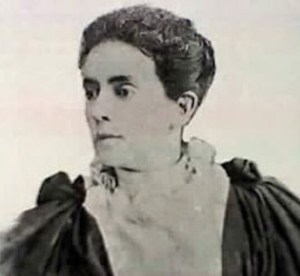
We present this work in honor of the poet’s 175th birthday.
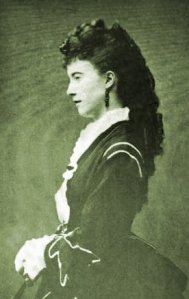
Fanny Parnell Irish 1848 – 1882
Shall mine eyes behold thy glory, oh, my country? Shall mine eyes behold thy glory? Or shall the darkness close around them ere the sun-blaze Break at last upon thy story?
When the nations ope for thee their queenly circle, As sweet new sister hail thee, Shall these lips be sealed in callous death and silence, That have known but to bewail thee?
Shall the ear be deaf that only loved thy praises, When all men their tribute bring thee? Shall the mouth be clay that sang thee in thy squalor, When all poets’ mouths shall sing thee?
Ah! the harpings and the salvos and the shoutings Of thy exiled sons returning, I should hear, tho’ dead and mouldered, and the grave-damps Should not chill my bosom’s burning.
Ah! the tramp of feet victorious! I should hear them ’Mid the shamrocks and the mosses, And my heart should toss within the shroud and quiver As a captive dreamer tosses.
I should turn and rend the cere-cloths round me— Giant sinews I should borrow— Crying, “Oh, my brothers, I have also loved her In her loneliness and sorrow!
“Let me join with you the jubilant procession, Let me chant with you her story; Then, contented, I shall go back to the shamrocks, Now mine eyes have seen her glory!”
We present this work in honor of the 140th anniversary of the poet’s death.
Ivan Turgenev Russian 1818 – 1883
There lived a fool.
For a long time he lived in peace and contentment; but by degrees rumours began to reach him that he was regarded on all sides as a vulgar idiot.
The fool was abashed and began to ponder gloomily how he might put an end to these unpleasant rumours.
A sudden idea, at last, illuminated his dull little brain… And, without the slightest delay, he put it into practice.
A friend met him in the street, and fell to praising a well-known painter…
‘Upon my word!’ cried the fool,’ that painter was out of date long ago… you didn’t know it? I should never have expected it of you… you are quite behind the times.’
The friend was alarmed, and promptly agreed with the fool.
‘Such a splendid book I read yesterday!’ said another friend to him.
‘Upon my word!’ cried the fool, ‘I wonder you’re not ashamed. That book’s good for nothing; every one’s seen through it long ago. Didn’t you know it? You’re quite behind the times.’
This friend too was alarmed, and he agreed with the fool.
‘What a wonderful fellow my friend N. N. is!’ said a third friend to the fool. ‘Now there’s a really generous creature!’
‘Upon my word!’ cried the fool. ‘N. N., the notorious scoundrel! He swindled all his relations. Every one knows that. You’re quite behind the times.’
The third friend too was alarmed, and he agreed with the fool and deserted his friend. And whoever and whatever was praised in the fool’s presence, he had the same retort for everything.
Sometimes he would add reproachfully: ‘And do you still believe in authorities?’
‘Spiteful! malignant!’ his friends began to say of the fool. ‘But what a brain!’
‘And what a tongue!’ others would add, ‘Oh, yes, he has talent!’
It ended in the editor of a journal proposing to the fool that he should undertake their reviewing column.
And the fool fell to criticising everything and every one, without in the least changing his manner, or his exclamations.
Now he, who once declaimed against authorities, is himself an authority, and the young men venerate him, and fear him.
And what else can they do, poor young men? Though one ought not, as a general rule, to venerate any one … but in this case, if one didn’t venerate him, one would find oneself quite behind the times!
We present this work in honor of the 155th anniversary of the poet’s death.
Adah Isaacs Menken American 1835 – 1868
Where is the promise of my years; Once written on my brow? Ere errors, agonies and fears Brought with them all that speaks in tears, Ere I had sunk beneath my peers; Where sleeps that promise now?
Naught lingers to redeem those hours, Still, still to memory sweet! The flowers that bloomed in sunny bowers Are withered all; and Evil towers Supreme above her sister powers Of Sorrow and Deceit.
I look along the columned years, And see Life’s riven fane, Just where it fell, amid the jeers Of scornful lips, whose mocking sneers, For ever hiss within mine ears To break the sleep of pain.
I can but own my life is vain A desert void of peace; I missed the goal I sought to gain, I missed the measure of the strain That lulls Fame’s fever in the brain, And bids Earth’s tumult cease.
Myself! alas for theme so poor A theme but rich in Fear; I stand a wreck on Error’s shore, A spectre not within the door, A houseless shadow evermore, An exile lingering here.
We present this work in honor of the Canadian holiday, Civic Day.
Susanna Moodie Canadian 1803 – 1885
The Northern Lights are flashing On the rapids’ restless flow, But o’er the wild waves dashing Swift darts the light canoe: The merry hunters come,— “What cheer? What cheer?” We ’ve slain the deer!” “Hurrah! you ’re welcome home!”
The blithesome horn is sounding, And the woodman’s loud halloo; And joyous steps are bounding To meet the birch canoe. “Hurrah! the hunters come!” And the woods ring out To their noisy shout, As they drag the dun deer home!
The hearth is brightly burning, The rustic board is spread; To greet their sire returning The children leave their bed. With laugh and shout they come, That merry band, To grasp his hand And bid him welcome home!
We present this work in honor of The Twelfth (Battle of the Boyne).
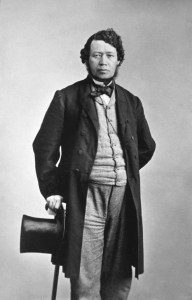
Thomas d’Arcy McGee Irish 1825 – 1868
Child of Loch Ramor, gently seaward stealing, In thy placid depths hast thou no feeling Of the stormy gusts of other days? Does thy heart, O gentle, nun-faced river, Passing Schomberg’s obelisk, not quiver, While the shadow on thy bosom weighs?
Thou hast heard the sounds of martial clangor, Seen fraternal forces clash in anger, In thy Sabbath valley, River Boyne! Here have ancient Ulster’s hardy forces Dressed their ranks and fed their travelled horses, Tara’s hosting as they rode to join.
Forgettest thou that silent summer morning When William’s bugles sounded sudden warning And James’s answered chivalrously clear? When rank to rank gave the death-signal duly, And volley answered volley quick and truly, And shouted mandates met the eager ear?
The thrush and linnet fled beyond the mountains, The fish in Inver Colpa sought their fountains, The unchased deer scampered through Tredagh’s gates, St. Mary’s bells in their high places trembled, And made a mournful music which resembled A hopeless prayer to the unpitying Fates.
Ah! well for Ireland had the battle ended When James forsook what William well defended, Crown, friends, and kingly cause; Well, if the peace thy bosom bid recover Had breathed its benediction broadly over Our race and rites and laws.
Not in thy depths, not in thy fount, Loch Ramor! Were brewed the bitter strife and cruel clamor Our wisest long have mourned; Foul faction falsely made thy gentle current To Christian ears a stream and name abhorrent, And all thy waters into poison turned.
But, as of old God’s prophet sweetened Mara, Even so, blue bound of Ulster and of Tara, Thy waters to our exodus gave life; Thrice holy hands thy lineal foes have wedded, And healing olives in thy breast embedded, And banished far the littleness of strife.
Before thee we have made a solemn foedus, And for chief witness called on Him who made us, Quenching before his eyes the brands of hate; Our pact is made, for brotherhood and union, For equal laws to class and to communion, — Our wounds to stanch, our land to liberate.
Our trust is not in musket or in sabre, Our faith is in the fruitfulness of labor, The soul-stirred, willing soil; In homes and granaries by justice guarded, In fields from blighting winds and agents warded, In franchised skill and manumitted toil.
Grant us, O God, the soil and sun and seasons! Avert despair, the worst of moral treasons, Make vaunting words be vile. Grant us, we pray, but wisdom, peace, and patience, And we will yet relift among the nations Our fair and fallen, but unforsaken Isle!
We present this work in honor of the poet’s 225th birthday.
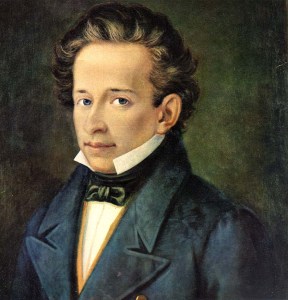
Giacomo Leopardi Italian 1798 – 1837
This solitary hill has always been dear to me And this hedge, which prevents me from seeing most of The endless horizon. But when I sit and gaze, I imagine, in my thoughts Endless spaces beyond the hedge, An all encompassing silence and a deeply profound quiet, To the point that my heart is almost overwhelmed. And when I hear the wind rustling through the trees I compare its voice to the infinite silence. And eternity occurs to me, and all the ages past, And the present time, and its sound. Amidst this immensity my thought drowns: And to flounder in this sea is sweet to me.
I don’t sense the tortured depths of love when I contemplate with studied gaze the rare perfection of your head and your body, that Hellenic sculpture. As if, printed in your genteel figure sealed with august and manly nobility, in your bright clear gaze, the light of thought never shines. As I contemplate it without pain or desire, worthy model of an immortal artist, your magnificent beauty, so enchanting, only manages to inspire in my soul the calm admiration sparked by the beauty of a brute or of silver.




 Poets Corner