We present this work in honor of the 45th anniversary of the poet’s death.
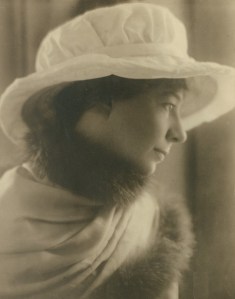
Rosario Castellanos Mexican 1925 – 1974
We kill what we love. What’s left
Was never alive.
No one else is close. What is forgotten,
What else is absent or less, hurts no one else.
We kill what we love. Enough of drawing a choked breath
Through someone else’s lung!
There is not air enough for both of us. And the earth will not hold
Both our bodies
And our ration of hope is small
And pain cannot be shared.
Man is an animal of solitudes,
A deer that bleeds as it flees
With an arrow in its side.
Ah, but hatred with its insomniac
Glass eyes; its attitude
Of menace and repose.
The deer goes to drink and a tiger
Is reflected in the water.
The deer drinks the water and the image. And becomes
-before he is devoured – (accomplice, fascinated)
his enemy.
We give life only to what we hate.
In honor of Civic Day, we present this work by one of Canada’s most important poets.
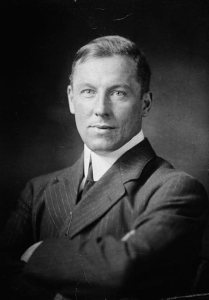
Robert Service Canadian 1874 – 1958
The cruel war was over — oh, the triumph was so sweet!
We watched the troops returning, through our tears;
There was triumph, triumph, triumph down the scarlet glittering street,
And you scarce could hear the music for the cheers.
And you scarce could see the house-tops for the flags that flew between;
The bells were pealing madly to the sky;
And everyone was shouting for the Soldiers of the Queen,
And the glory of an age was passing by.
And then there came a shadow, swift and sudden, dark and drear;
The bells were silent, not an echo stirred.
The flags were drooping sullenly, the men forgot to cheer;
We waited, and we never spoke a word.
The sky grew darker, darker, till from out the gloomy rack
There came a voice that checked the heart with dread:
“Tear down, tear down your bunting now, and hang up sable black;
They are coming — it’s the Army of the Dead.”
They were coming, they were coming, gaunt and ghastly, sad and slow;
They were coming, all the crimson wrecks of pride;
With faces seared, and cheeks red smeared, and haunting eyes of woe,
And clotted holes the khaki couldn’t hide.
Oh, the clammy brow of anguish! the livid, foam-flecked lips!
The reeling ranks of ruin swept along!
The limb that trailed, the hand that failed, the bloody finger tips!
And oh, the dreary rhythm of their song!
“They left us on the veldt-side, but we felt we couldn’t stop
On this, our England’s crowning festal day;
We’re the men of Magersfontein, we’re the men of Spion Kop,
Colenso — we’re the men who had to pay.
We’re the men who paid the blood-price. Shall the grave be all our gain?
You owe us. Long and heavy is the score.
Then cheer us for our glory now, and cheer us for our pain,
And cheer us as ye never cheered before.”
The folks were white and stricken, and each tongue seemed weighted with lead;
Each heart was clutched in hollow hand of ice;
And every eye was staring at the horror of the dead,
The pity of the men who paid the price.
They were come, were come to mock us, in the first flush of our peace;
Through writhing lips their teeth were all agleam;
They were coming in their thousands — oh, would they never cease!
I closed my eyes, and then — it was a dream.
There was triumph, triumph, triumph down the scarlet gleaming street;
The town was mad; a man was like a boy.
A thousand flags were flaming where the sky and city meet;
A thousand bells were thundering the joy.
There was music, mirth and sunshine; but some eyes shone with regret;
And while we stun with cheers our homing braves,
O God, in Thy great mercy, let us nevermore forget
The graves they left behind, the bitter graves.
In honor of the Moroccan holiday, Enthronement, we present this work by one of the great Berber poets.
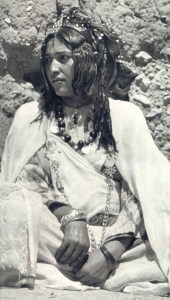
Mririda n’Ait Attik Moroccan c. 1900 – c. 1940’s
People called me Mririda, Mririda,
Mririda, the gaile rennet of meadows…
With eyes of gold…
But the rennet’s white chest I do not have
Nor do I have her green tunic.
Yet, like her, I have my ‘zrarit’, my ‘zrarit’
Which reach the sheep-folds
My ‘zrarit’, my ‘zrarit’
Of which people talk in the entire valley
And even on the other sides of the mountains.
My “zrarit” which marvel, which arouse desire…
Because ever since my first steps in the fields,
I slowly took the agile rennet in my hands,
And long pressed her white chest onto mine,
And then onto my maiden lips.
That is how the rennet gave me the marvelous virtue
Of the baraka which makes her sing
A song so clear, so vibrant, so pure
In the Summer nights bathed by the moon,
A song like crystal,
Like the clear noise of an anvil
In the resonant air that precedes rain…
And thanks to the gift that Mririda gave me
They call me: Mririda, Mririda…
He who takes me will feel
My heart beating in his hand
As I often felt under my fingers
The crazy heart-beats of the rennet.
In the nights bathed by the moon
He will call me Mririda, Mririda,
The soft nickname that is so dear to me
For him I will release my sharp ‘zrarit’,
My strident, prolonged ‘zrarit’,
That men admire and women envy,
And such that the valley has never witnessed…
Sun and moon have no light left, earth is dark;
Our women’s world is sunk so deep, who can help us?
Jewelry sold to pay this trip across the seas,
Cut off from my family I leave my native land.
Unbinding my feet I clean out a thousand years of poison,
With heated heart arouse all women’s spirits.
Alas, this delicate kerchief here
Is half stained with blood, and half with tears.
The pockets of our greatcoats full of barley…
No kitchens on the run, no striking camp…
We moved quick and sudden in our own country.
The priest lay behind ditches with the tramp.
A people hardly marching… on the hike…
We found new tactics happening each day:
We’d cut through reins and rider with the pike
And stampede cattle into infantry,
Then retreat through hedges where cavalry must be thrown.
Until… on Vinegar Hill… the final conclave.
Terraced thousands died, shaking scythes at cannon.
The hillside blushed, soaked in our broken wave.
They buried us without shroud or coffin
And in August… the barley grew up out of our grave.
Along the road the magpies walk
with hands in pockets, left and right.
They tilt their heads, and stroll and talk.
In their well-fitted black and white.
They look like certain gentlemen
who seem most nonchalant and wise
until their meal is served – and then
what clashing beaks, what greedy eyes!
But not one man that I have heard
throws back his head in such a song
of grace and praise – no man nor bird.
Their greed is brief; their joy is long.
For each is born with such a throat
as thanks his God with every note.
We present this work in honor of National Ice Cream Day.
Wallace Stevens American 1879 – 1955
Call the roller of big cigars,
The muscular one, and bid him whip
In kitchen cups concupiscent curds.
Let the wenches dawdle in such dress
As they are used to wear, and let the boys
Bring flowers in last month’s newspapers.
Let be be finale of seem.
The only emperor is the emperor of ice-cream.
Take from the dresser of deal,
Lacking the three glass knobs, that sheet
On which she embroidered fantails once
And spread it so as to cover her face.
If her horny feet protrude, they come
To show how cold she is, and dumb.
Let the lamp affix its beam.
The only emperor is the emperor of ice-cream.
Death is the bullies bashing
against the black walls and roof tiling,
death is the women being loved
in the course of onion peeling.
Death the squalid, unimportant streets
with their glamorous and pompous names,
the olive-grove, the surrounding sea, and even
the sun, death among all other deaths.
Death the policeman bending over
to weigh, a “lacking” portion,
death the harebells on the balcony
and the teacher with the newspaper.
Base, Guard, Sixty-man Prevezian Rule.
On Sunday we’ll listen to the band.
I’ve taken out a savings booklet,
my first deposit drachmas thirty one.
Walking slowly on the quay,
“do I exist?” you say, and then: “you do not!”
The ship approaches. The flag is flying.
Perhaps Mr. Prefect will be coming.
If at least, among these people,
one would die of sheer disgust
silent, bereaved, with humble manners,
at the funeral we’d all have fun.


 Poets Corner