How? Growling down into the gravel
of a rough dream that dragged the
lids off coffins, he stopped
at the grave of Osimandeus. Or
was it Alexander? Yes, Alexander.
But the single howling question…
shaking the quiet lichen from its
settling place. He stood before the end
once more, saw the last hope die and him,
not given to poetry or nonsense, wanting
to sing a lament a troubadour may have sung
to a lady far from butchery and defeat.
One very rough day on the Pride of the Fray
In the scuppers a poor little cabin-boy lay,
When the Bosun drew nigh with wrath in his eye
And gave him a kick to remember him by,
As he cried with a sneer: “What good are you here?
Go home to your mammy, my bold buccaneer.”
Now the Captain beheld, and his pity upwelled:
With a plug in the peeper the Bosun he felled.
With humility grand he extended his hand
And helped the poor lad, who was weeping, to stand,
As he cried: “Have no fear; I’m the manager here.
Take heart, and you’ll yet be a bold buccaneer.”
But how he did flare when the lad then and there
Doffed his cap and shook down a gold banner of hair.
Though his movements were shy, he’d a laugh in his eye,
And he sank on the Captain’s broad breast with a sigh,
As he cried: “Is it queer that I’ve followed you here?
I’m your sweetheart from Bristol, my bold buccaneer.”
On an isle in the west, by the breezes caressed,
The bold buccaneer has a warm little nest,
And he sits there in state amid pieces of eight
And tackles his rum with a manner elate,
As he cries: “O my dear little cabin-boy, here
Is a toast to the babe of the bold buccaneer!”
One sad shoe that someone has probably flung
out of a car or truck. Why only one?
This happens on an average one year
in four. But always throughout my
life, my travels, I see it like
a memorandum. Something I have
forgotten to remember,
that there are always
mysteries in life. That shoes
do not always go in pairs, any more
than we do. That one fits;
the other, not. That children can
thoughtlessly and in a merry fashion
chuck out someone’s shoe, split up
someone’s life.
But usually that shoe that I
see is a man’s, old, worn, the sole
parted from the upper.
Then why did the owner keep the other,
keep it to himself? Was he
afraid (as I so often am with
inanimate objects) to hurt its feelings?
That one shoe in the road invokes
my awe and my sad pity.
Houses in a line, in a line,
in a line there.
Squares, squares, squares.
Houses in a line.
Even people now have square souls,
Ideas in file, I declare,
And on their shoulders, angles wear.
Just yesterday I shed a tear and it
Oh, God, was square!
At five in the afternoon.
It was exactly five in the afternoon.
A boy brought the white sheet
at five in the afternoon.
A frail of lime ready prepared
at five in the afternoon.
The rest was death, and death alone.
The wind carried away the cottonwool
at five in the afternoon.
And the oxide scattered crystal and nickel
at five in the afternoon.
Now the dove and the leopard wrestle
at five in the afternoon.
And a thigh with a desolated horn
at five in the afternoon.
The bass-string struck up
at five in the afternoon.
Arsenic bells and smoke
at five in the afternoon.
Groups of silence in the corners
at five in the afternoon.
And the bull alone with a high heart!
At five in the afternoon.
When the sweat of snow was coming
at five in the afternoon,
when the bull ring was covered with iodine
at five in the afternoon.
Death laid eggs in the wound
at five in the afternoon.
At five in the afternoon.
At five o’clock in the afternoon.
A coffin on wheels is his bed
at five in the afternoon.
Bones and flutes resound in his ears
at five in the afternoon.
Now the bull was bellowing through his forehead
at five in the afternoon.
The room was iridiscent with agony
at five in the afternoon.
In the distance the gangrene now comes
at five in the afternoon.
Horn of the lily through green groins
at five in the afternoon.
The wounds were burning like suns
at five in the afternoon.
At five in the afternoon.
Ah, that fatal five in the afternoon!
It was five by all the clocks!
It was five in the shade of the afternoon!
2. The Spilled Blood
I will not see it!
Tell the moon to come,
for I do not want to see the blood
of Ignacio on the sand.
I will not see it!
The moon wide open.
Horse of still clouds,
and the grey bull ring of dreams
with willows in the barreras.
I will not see it!
Let my memory kindle!
Warm the jasmines
of such minute whiteness!
I will not see it!
The cow of the ancient world
passed har sad tongue
over a snout of blood
spilled on the sand,
and the bulls of Guisando,
partly death and partly stone,
bellowed like two centuries
sated with threading the earth.
No.
I will not see it!
Ignacio goes up the tiers
with all his death on his shoulders.
He sought for the dawn
but the dawn was no more.
He seeks for his confident profile
and the dream bewilders him
He sought for his beautiful body
and encountered his opened blood
Do not ask me to see it!
I do not want to hear it spurt
each time with less strength:
that spurt that illuminates
the tiers of seats, and spills
over the cordury and the leather
of a thirsty multiude.
Who shouts that I should come near!
Do not ask me to see it!
His eyes did not close
when he saw the horns near,
but the terrible mothers
lifted their heads.
And across the ranches,
an air of secret voices rose,
shouting to celestial bulls,
herdsmen of pale mist.
There was no prince in Sevilla
who could compare to him,
nor sword like his sword
nor heart so true.
Like a river of lions
was his marvellous strength,
and like a marble toroso
his firm drawn moderation.
The air of Andalusian Rome
gilded his head
where his smile was a spikenard
of wit and intelligence.
What a great torero in the ring!
What a good peasant in the sierra!
How gentle with the sheaves!
How hard with the spurs!
How tender with the dew!
How dazzling the fiesta!
How tremendous with the final
banderillas of darkness!
But now he sleeps without end.
Now the moss and the grass
open with sure fingers
the flower of his skull.
And now his blood comes out singing;
singing along marshes and meadows,
sliden on frozen horns,
faltering soulles in the mist
stoumbling over a thousand hoofs
like a long, dark, sad tongue,
to form a pool of agony
close to the starry Guadalquivir.
Oh, white wall of Spain!
Oh, black bull of sorrow!
Oh, hard blood of Ignacio!
Oh, nightingale of his veins!
No.
I will not see it!
No chalice can contain it,
no swallows can drink it,
no frost of light can cool it,
nor song nor deluge og white lilies,
no glass can cover mit with silver.
No.
I will not see it!
3. The Laid Out Body
Stone is a forehead where dreames grieve
without curving waters and frozen cypresses.
Stone is a shoulder on which to bear Time
with trees formed of tears and ribbons and planets.
I have seen grey showers move towards the waves
raising their tender riddle arms,
to avoid being caught by lying stone
which loosens their limbs without soaking their blood.
For stone gathers seed and clouds,
skeleton larks and wolves of penumbra:
but yields not sounds nor crystals nor fire,
only bull rings and bull rings and more bull rings without walls.
Now, Ignacio the well born lies on the stone.
All is finished. What is happening! Contemplate his face:
death has covered him with pale sulphur
and has place on him the head of dark minotaur.
All is finished. The rain penetrates his mouth.
The air, as if mad, leaves his sunken chest,
and Love, soaked through with tears of snow,
warms itself on the peak of the herd.
What is they saying? A stenching silence settles down.
We are here with a body laid out which fades away,
with a pure shape which had nightingales
and we see it being filled with depthless holes.
Who creases the shroud? What he says is not true!
Nobody sings here, nobody weeps in the corner,
nobody pricks the spurs, nor terrifies the serpent.
Here I want nothing else but the round eyes
to see his body without a chance of rest.
Here I want to see those men of hard voice.
Those that break horses and dominate rivers;
those men of sonorous skeleton who sing
with a mouth full of sun and flint.
Here I want to see them. Before the stone.
Before this body with broken reins.
I want to know from them the way out
for this captain stripped down by death.
I want them to show me a lament like a river
wich will have sweet mists and deep shores,
to take the body of Ignacio where it looses itself
without hearing the double planting of the bulls.
Loses itself in the round bull ring of the moon
which feigns in its youth a sad quiet bull,
loses itself in the night without song of fishes
and in the white thicket of frozen smoke.
I don’t want to cover his face with handkerchiefs
that he may get used to the death he carries.
Go, Ignacio, feel not the hot bellowing
Sleep, fly, rest: even the sea dies!
4. Absent Soul
The bull does not know you, nor the fig tree,
nor the horses, nor the ants in your own house.
The child and the afternoon do not know you
because you have dead forever.
The shoulder of the stone does not know you
nor the black silk, where you are shuttered.
Your silent memory does not know you
because you have died forever
The autumn will come with small white snails,
misty grapes and clustered hills,
but no one will look into your eyes
because you have died forever.
Because you have died for ever,
like all the dead of the earth,
like all the dead who are forgotten
in a heap of lifeless dogs.
Nobady knows you. No. But I sing of you.
For posterity I sing of your profile and grace.
Of the signal maturity of your understanding.
Of your appetite for death and the taste of its mouth.
Of the sadness of your once valiant gaiety.
It will be a long time, if ever, before there is born
an Andalusian so true, so rich in adventure.
I sing of his elegance with words that groan,
and I remember a sad breeze through the olive trees.
We present this work in honor of the 55th anniversary of the poet’s death.
Zora Cross Australian 1890 – 1964
Late, late last night, when the whole world slept,
Along to the garden of dreams I crept.
And I pulled the bell of an old, old house
Where the moon dipped down like a little white mouse.
I tapped the door and I tossed my head:
“Are you in, little girl? Are you in?” I said.
And while I waited and shook with cold
Through the door tripped me—just eight years old.
I looked so sweet with my pigtails down,
Tied up with a ribbon of dusky brown,
With a dimpled chin full of childish charme,
And my old black dolly asleep in my arms.
I sat me down when I saw myself,
And I told little tales of a moonland elf.
I laughed and sang as I used to do
When the world was ruled by Little Boy Blue.
Then I danced with a toss and a twirl
And said: “Now have you been a good, good girl?
Have you had much spanking since you were Me?
And does it feel fine to be twenty-three?”
I kissed me then, and I said farewell,
For I’ve earned more spanks than I dared to tell,
And Eight must never see Twenty-three
As she peeps through the door of Memory.
Long-summer scorched, my surfing children
Catch random waves or thump in dumpers,
Whirling, gasping, tossed disjointed.
I watching, fear they may be broken –
That all those foaming limbs will never
Re-assemble whole, together.
All under such a peaceful sky.
All under such another sky
The pictures show some village children
Caught at random, tossed, exploded,
Torn, disjointed, like sticks broken,
Whose jagged scorching limbs will never
Re-assemble whole together.
Why an introduction dear, you are within me,
reflections on starry nights, memories of a life,
creations of life in short spells, eyes notice
creations of life in short spells, eyes notice
gentle footsteps!
I don’t much to treasure anymore,
you are the treasure I have in me.
Your dazzling, radiant smile like sunrise
Is the reflection of fragrant sorrow,
it is consciousness, and dreamy slumber,
Let me tire and sleep incessantly, for
Would I understand the creation, big-bang!!
You are drawn, I am just an outline,
you are the sweet melody, I am just a string of notes,
you are limitless, I am but an illusion of limits,
In the secrecy of real image-reflection,
why enact to be lovers!!!
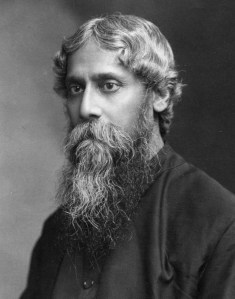
Where the mind is without fear and the head is held high Where knowledge is free Where the world has not been broken up into fragments By narrow domestic walls Where words come out from the depth of truth Where tireless striving stretches its arms towards perfection Where the clear stream of reason has not lost its way Into the dreary desert sand of dead habit Where the mind is led forward by thee Into ever-widening thought and action Into that heaven of freedom, my Father, let my country awake.




 Poets Corner