We present this work in honor of Colombian Independence Day.
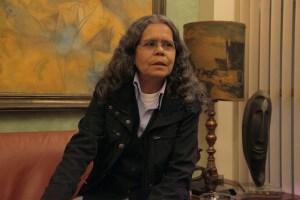
Mery Yolanda Sánchez Colombian b. 1956
The other day at the Court House he barked as the flames blistered his snout. Sniffed the ones lined up and transferred to the blind house on the corner, where he’d often wag his tail in military marches. It’s Friday, old Lázaro the street dog goes into a restaurant and is arrested, a criminal record was the last thing he’d want it would prove even more he was a man. Now they all keep an eye on him, point him out, issue warnings, possible convictions he feels for his tail and his two paws left behind like fingerprints. He signs, cries, needs a hug. Cries, signs, looks for a handkerchief, signs, cries, asks for a kiss. The man at his side growls like he did before. Lázaro just cries and signs. The little dog with smoke in her eyes rummages on the other side of the bars. Outside they read off the lists, Lázaro isn’t there.
When the earth with the naturalness of women “mujer is more than senora or senorita”— receives openly at the first rains, I think of nothing then but you.
It was hardly war, the hardliest of wars. Hardly, hardly. It occurred to me that this particular war was hardly war because of kids, more kids, those poor kids. The kids were hungry until we GIs fed them. We dusted them with DDT. Hardly done. Rehabilitation of Korea, that is. It needs chemical fertilizer from the States, power to build things like a country. In the end it was the hardliest of wars made up of bubble gum, which GIs had to show those kids how to chew. In no circumstance whatever can man be comfortable without art. They don’t want everlasting charity, and we are not giving it to them. We are just lending them a hand until they can stand on their own two feet. A novel idea. This is why it occurred to me that this particular war was hardly war, the hardliest of wars.
My father was hardly himself during the war, then I was born during the era that hardly existed, and, therefore, I hardly existed without DDT. Beauty is pleasure regarded as the quality of a thing. I prefer a paper closet with real paper dresses in it. To be born hardly, hardly after the hardliest of wars, is a matter of debate. Still going forward. We are, that is. Napalm again. This is THE BIG PICTURE. War and its masses. War and its men. War and its machines. Together we form THE BIG PICTURE. From Korea to Germany, from Alaska to Puerto Rico. All over the world, the US Army is on the alert to defend our country, you the people, against aggression. This is THE BIG PICTURE, an official television report to the nation from the army. This is Korea! Is one thing better than another? These South Koreans are all right. Woe is you, woe is war, hardly war, woe is me, woe are you? My father is still alive, and this is how I came to prefer a paper closet with real paper dresses in it.
Well, it’s morning in Korea. The most violently mountainous place on Earth. Everyone has been dusted, existence hardly done, whereas beauty has been regarded as the quality of a thing. At Uncle Dann’s Huddle doughnuts and coffee are free and in case there are any, for there are many, the unescorted ladies are not permitted. The decision has been made in Tokyo for the hardliest of wars, an old soldier made it. The situation in Korea is so critical that we the Navy must give the Eighth Army practical support. Do you remember how you began this day? How did you spend this morning? Woe are you? Well, pinecones fall every day. So why do we fail? Miles and miles of homeless refugees set adrift by the Red scourge.
It’s seven o’clock: throw two trash bags from the balcony. Turn on the oven for the Middle Eastern food and the book of Go down to the end of the night:
to the friend that dies at the hands of a madwoman, nobody feels like closing his eyelids. * April 29th. Drinking spoiled wine
The fridge has always brought on the passions that overflow the schedule. The list disagrees with her stomach that presupposes one problem per can: the milk for the night, the cheese for the pillow, the soy for the martyrdom of the nation is inaugurated in us, the servants * May 1st. Wants to jump
There is a need to be clear a voice that is as mature as it is floating because the ball is rubber, it resists when it’s pushed under water. * May 24th
Tomorrow is a holiday: the way the species suffers with a snack, offers evidence. There is no pure milk and there is no bread: The loneliness of the spirit has hypotonic ideas. * May 25th
The epigonal holiday curses us like a worn stanza little revelations in the shape of a fold, poorly sewn, compelling the shirt: that time when the power went out and they didn’t propose to use candles and crayons to paint, the melancholy of making collages with magazines, scissors and coating samples, a family with aspirations of changing the kitchen table set * June 24th. To polish, to scratch
He wipes with a cloth, he makes symmetrical the wet parts that he wipes with the cloth but leaves crumbs every time he grabs a cookie.
Already at nine, he felt life wasn’t going to make him less nervous.
Not knowing how to enjoy things is a slow blow, and he’s blind the guest who does not even contribute a pound of noodles per week * July 7th. We don’t live in the country
Each bus that goes by with its injury wants to repeat with its engine: “it’s not gonna happen, no truck is going to kidnap us,” that won’t take place without the body of the future.
The goat cannot be revived. She died while we were biting the grass.
We present this work in honor of Algerian Independence Day.
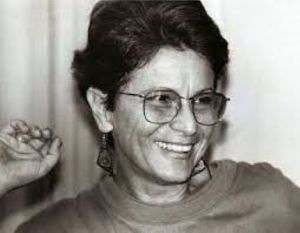
Zeinab Laouedj Algerian b. 1954
My country I am a Lion And I will make you tremble til your forests Me, the Crazed Mad for the love of his land Where no other madman Resembles me My Stature Stands tall Your Grave Cannot Contain it… The earth turns Even lying down I Rise Like A Palmtree In The soil Of the earth.
A predilection for stone fruit sees a trail of peach and plum stones in his shadow You had traced him down this discreet path to where his casual touch was six light insect feet on your forearm
In the magazine you read about the ten sexiest women for April; they all live in suburbs beginning with W and wear impossible shoes
You hunt for modern equivalents of One hundred ways with mince and watch his hand become refined under its wedding ring, the fingers longer and nails less bitten
He coaxes your shoulders straight, uncurling them with firm hands
but you were merely bent over with laughter Now your tongue forks into four: one part for being good-natured one for lamentation the third part of irony and the last for an imaginary language
You move to a newly-invented suburb beginning with X where you will use the four parts of the tongue with equilibrium
We present this work in honor of National Dry Martini Day.
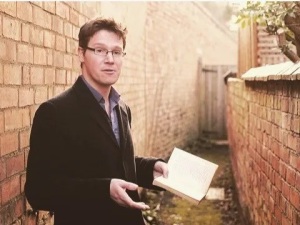
Oliver Tearle English 21st Century
Long dream of summer in short skirt of glass. The glass as prism: multiplying all colours that meet it, sunshine, a right eyeful, rendering all beyond it meaningless
at least for now, for this moment, more or less. The eye is blind to what the mouth will feel: the space where light meets water in the pool, the driest water you will ever kiss.
Now turn to the vermouth. Just enough to vault the drink into another region: wave towards Italy, home of Petrarch. Give a minute or so for things to settle down. Stir (not shake) until distinction’s gone. Try not to mistake this for a new religion.
Meet my father, who refuses food – pecks at it like a bird or not at all – the beard disguising his thin cheeks. This, for a man whose appetite was legend, hoovering up the scraps his daughters couldn’t eat.
The dustbin man, we joked. And here he is, trailing his fork through food we’ve laboured to make soft, delicious, sweet. Too salty, or too tough, it tastes of nothing, makes him choke, he keeps insisting, stubbornly. In truth, the logic’s clear. His very life is bitter and the spice it lacks is hope. He wants to stop. Why do we keep on spooning dust and ashes down his throat?
We present this work in honor of the Nigerian holiday, Democracy Day.
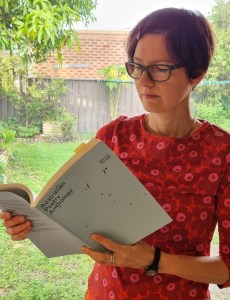
Toyin Adewale-Gabriel Nigerian b. 1969
Our dreams are hindsights travelling to the people under the earth journeying down the cities filling the centuries with sons so fat they can’t pass the needle’s eye
Only the ointment keeps faith in the hands of a daughter preparing you for burial the unleavened bread calls forth mourners
And prostitutes eating bread with hallowed hands. Henna mingles with hungers at the eleventh hour when rejected pebbles fall like death sentences on brown earth
This wine sets my eyes on edge to stilled waters on barren hillsides this wine red in the cup the scarlet thread the broken donkey Linen breeches dyed in crimson.
The air is rich in prophecies and revolutions within the olive tree a copulation is a flame burning the bush full of grass windows the light shimmers upon the waters
Light is a quiver of arrows Light is an earthquake Light is a stormy wind Light is a great cry electric on bones and skulls
The bones are diving for flesh The shrouds are dying in the stars There is light in our loins.
We present this work in honor of the poet’s 40th birthday.
Nina Belén Robins American b. 1984
Sometimes I wonder if bacteria pray. Swim along their host and wonder where they came from. Thank the body where they live for the warmth they call home. Mourn the death of their loved ones when their time is up or when the medicine works or when their host dies. I wonder if the bad bacteria make war with the good, if they can tell the difference. If there are battles for areas of skin, for food. If the famine of cleanliness wipes out entire colonies. If they wonder where sanitizer comes from. See immunity as evolution. Rejoice in tolerance for antibiotics, claim death of weaker varieties as natural selection. I wonder if bacteria come in race, have hierarchy, call the stronger ones leader,follow them blindly Can see outside the body, know we are aware of their presence, feel guilty when we medicate and obliterate them. Preach that we know which ones we punish, \try to change the ones they blame. I wonder if they call us God. Their big world a dot, a crevice, a membrane. We are giant and powerful and almighty I wonder if they know we are smaller than so much else. Fallible. Just as fragile as they are, just as mortal. That we call the space we live on earth, universe. That we are born, and die, and damage and fight and love and prey and kill and cleanse. That we are small beings in huge spaces. That we get wiped out with famine and disease. That we do not know where we came from. That we also are so small, on a bigger being, in a big space. I wonder if they know we pray.




 Poets Corner