In honor of the Moroccan holiday, Revolution Day, we present this work by one of Morocco’s most revolutionary poets.
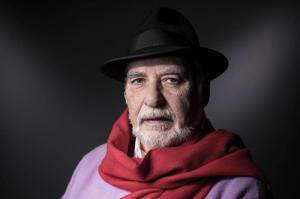
Tahar Ben Jelloun Moroccan b. 1944
Before
a long time ago
I lived in a tree, then in a cemetery.
My tomb was under an oak. Dogs and men pissed on my head. I said nothing. Little
mauve flowers, scentless, grew there.
I had nothing to say.
Today shovels picked me up and threw me in this well.
I pace the abyss.
I descend. I am suspended.
The ashes still smolder. They rise, surround me, then fall again,
grey dust that makes my body a sand-filled hourglass.
I crumble. I am old abandoned rock.
I am sand and time.
I am faceless.
I nourish the land and pour my words into the land’s blood.
I irrigate the tree roots in late spring.
I count the days and the deaths while
men carry their households on their backs.
This body which was once a word will no longer look at the sea and think of Homer.
It did not pass away. It was touched by a flash from the sky crushing speech and breath.
These crystals mixed in the sand are the last words pronounced by these unarmed men.
In this country the dead travel
as statues and flames
They wear eyeglasses
and stretch out their scorched arms for flight.
We say they became invisible
Left to offer the living the years that remained of their lives.
Thus only years litter the desert: a century, more.
Lives for the taking, as jackals gorged on lives tremble to say:
“Death is not fatal just as night is the sun’s shadow.”
In honor of the Moroccan holiday, Allegiance Day, we present this work by one of Morocco’s great contemporary writers.
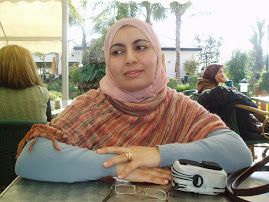
Amina El Bakouri Moroccan b. 1969
Oswaldo
It happens that my soul quivers before your wavelike presence
So in evenings not like these evenings
My mature blossoms start budding…
It happens that towards you
Sweeping nostalgia transports me
So to your lantern-lit boulevards I rush
Seeking, amid daybreak variegations,
My grief-stricken voice…
When it laid for your veins’ itinerary,
Plans from erring poems
And moons
Oswaldo
I am no object of desire of yours…
The blades of my soul
Are overladen with racemes of light.
Smeared with the mysterious darkness from the glow of words
My hands confiscate my days
glaring with ink
that flows painfully opaque
on the breast of dreams…
Horror-stricken, I drink at the lofty heights
Whose marine dew blessings surround me
With vows of nothingness
And wild goats of whiteness…
The sky’s fibres testify
To my disobedience
And my disengagement from the sin of original disclosure…
From the pain that lurks
Behind the white sun
And the musical minaret of speech.
Oswaldo
Remember I was obedient to your deep kisses
My nights were not only ash
I would gaze at your mysterious face
preoccupied as it was with the stars’ movement
And embellished with strange songs
And poems.
Let me for a while
Comb the night’s chest
With the cooing of words…
I soar as high as the swings of your wild soul
To secretly overview the splendor of distant lands
And light a moon in the universal ink-pot
Let me, from your large, beautiful eyes, extract
The honey of the stars
And sip the nectar of your lisp
Secretly filling the carafe
Like the virgin of the dormant tribes!
Oswaldo
Suppose you are a mutilated idea
Floating in the kingdom of Air
Arranged by coincidence
To redeem yourself from hell fire…
Suppose your dreams have, forever, forsaken you
When, all at once you dreamed them
With no prior notice or time limit…
Suppose Lorca offered you
The wild mint of paper
On a furious civil war night
Will the wild mint then
Have the self-same malice of beautiful roses
On the coffin of jasmin?
Suppose Al Khanssa’
Tore up grievously the bosom of her femininty
And the eagles of her anguish fell to pieces as did Sakhr, her brother.
Will the distressed bands of sand
Send forth the same inevitable wailing
When the pigeon coos in tears
mending the patches of pain?
Oswaldo
Rarely did I whisper my erotic poems to you…
A single eyelash twitch suffices
To awaken the soul from its slumber…
To distress a flock of sand-grouses in their nests
To open the gate of probability
Towards a mutilated poem
That might wail, but never come…
Or thus whoop the falling nights!
My own night was not enough
As I stared at the same glare fading slowly into
The blossoms of speech…
Perplexed larvae ripped up on the loom of
My own killing letters.
Marble thirst beat me
With a feeble whip.
I aimed thus the spark of nostagia at your secret water…
O disdainful passer-by
Let our words fall like hail
On the jujube trees of time
Let us by means of water
Pay allegiance to the metaphor therein
So that poetry exalts in us…
Let us see the dead sea off towards its own exile
Let us wait a little…
Tell me
Why are poets first to die?
Oswaldo
Do not torture me anymore
I do not carry Diogenes’ lamp in daylight
But I may come to you
On the morrow of a dark windy day
To present a succulent laudation
That makes you shake all over
I may, with true intuition, trap you into a dilemma
And stir the fire of your open wakefulness
Or in my transparent boudoir
Shield you from the straits
Of extreme redolence
When the female
Of awesome,
Terrible,
Erring fields
Clothes herself in Sheba’s stars.
Believe me. The glass sheets
And the dew of poetry may tell lies
Amid the uproar of slammed doors.
The dazzle of glass may fool us
Like the body’s intuition
When an illusory vision
Blinds eyesight!
O passer-by
The words’ encounter has long been rare
The heat has fallen
You have long enough deceived my pain
Do not cure me with feverish silence…
The echo of water has reached the shelter of the soul
And this very night, screened by my surmise,
Adorned by my insomnia
Has sailed far away into the distance
I have but on very rare occasions whispered my repulsion.
So tell me
Why does poetry not come smoothly anymore…
Why does it not resemble truth and light anymore?
Oswaldo
A fire fiercer than the glow
Of passionate hearts
Erupts volcano-like into the ribs of words
Awakening the ecstacy of quickly receding
Rhymes!
I am no inexperienced marine woman
To be fooled by a water poem…
Or am I to blame for feeling thirsty?
So why does the choke betray
The water drinker?
Or am I to blame for profound fascination?
So why does water flow downwards
All the time?
Oswaldo
“The only good that looks like gold is… the road”
So said uncle Boulos
Once, one fleeting dawn.
Verses are ablaze on your pernicious head.
Trees now border your long foggy path.
I am not yours through any kind of belonging
And I have but unwillingly
Appointed you a guardian of my solemn pledges.
So… proceed in your visions.
The way of poetry is rather long…
Proceed adventurously… opening your arms to the wind
To the virginity of the land
The road will not mistake you
When it sees you coming far away like a cross or a martyr
The road will not mistake you
The road will not mistake you!
In honor of the Egyptian holiday, Revolution Day, we present this work by one of Egypt’s greatest living poets.
Iman Mersal Egyptian b. 1966
I will receive your death
as the last wrong you committed against me.
I will not feel relief as you’d hoped.
And I will firmly believe
that you have denied me the opportunity
to diagnose the tumors
that lay dormant between us.
In the morning
I may be surprised by my puffed eyelids
and that the stoop in my back
We present this work in honor of Argentine Independence Day.
Carlos Barbarito Argentine b. 1955
Against a wind that breaks,
some are suspended by a thread over earth
that meets no boundary;
in some remote Orient
others will pierce a bone
and through the cavity they will look at what is born and dies;
here the eyelids lick each other,
the thighs bite each other, between one light
from above and another from below.
Tomorrow, perhaps, they will try out gas masks,
they will draw chalk lines
to separate desire from logic;
tomorrow, perhaps, they may weep
and do their clothes up tight
to plunge once more into darkness;
but now, they swing embraced
and naked, placed in such a way
that they look like birds made only of veins;
by their action, even though ephemeral,
the beasts slough their skin,
red tears fall into the sea
and burn it.
We present this work in honor of Independence Day.
Linda Pastan American b. 1932
We invent our gods
the way the Greeks did,
in our own image—but magnified.
Athena, the very mother of wisdom,
squabbled with Poseidon
like any human sibling
until their furious tempers
made the sea writhe.
Zeus wore a crown
of lightning bolts one minute,
a cloak of feathers the next,
as driven by earthly lust
he prepared to swoop
down on Leda.
Despite their power,
frailty ran through them
like the darker veins
in the marble of these temples
we call monuments.
Looking at Jefferson now,
I think of the language
he left for us to live by.
I think of the slave
in the kitchen downstairs.
I would like to say, I don’t know the road to paradise… that my tongue, the people, and that man sitting contemplating the railway lines in a deep meditation nobody will ever know, existed. My house existed — in a place I am still seeking. It wasn’t in this village where I witnessed other children being born on the same blood-stained mattress I was born on in the same room to which the midwife regularly came, when she went away with the bit and took away the tongue. I saw myself searching for that old mattress stained with the blood of all those who had already come into the world so there would be another child round here. I saw myself not looking for a house but making the search for a house my way. So much blood dried like rust as each cut of the scalpel breached my skin, each cut of the scalpel piercing me, as I lay deadened, anaesthetized.I would have loved the time of the anaesthesia to lead me to the day you are no more, a day you can calculate for 50 dollars on the net.
I would like to say
I write about what I lost, about my vanished blood, about my laughter
frozen into a mask, about this young girl who was chased away because
she sighed next to the wheat dunes, that stuffed the young girls’ mouths with secrets, about this girl who was and is no more, about another one I saw spinning under the ceiling of the empty living room, her dress on fire, she calls to her master to save her, and standing naked in front of all those men. I say: I want neither father nor mother, nor to have them put on my road, or slipped into my story. Without them, I remain, and in spite of them all, I am:
I don’t know the road to paradise
I didn’t save you from hell
Sharia, that void, didn’t strike me,
I will not go to the one who has gone and will inevitably return
I wrote lines, licked the drops from the face
I said: she is of those whose past bears the present
she dashed along the wide avenue trying to cross
like me, you also are a traveller
without coyness, you come bearing that light,
or is it this myth that kills us
Shoot!
Kill, ash-dark bird!
Fall to earth on your feathers
that a wind blowing from the Sahara scatters
sand dunes, purple light
that you cross from where you are not,
this Sahara, our home.
There, two poles.
The coming will not come
visiting rather
he is your guest
suddenly shy when he sets foot,
vanishes enchanted
to where your awakening is
you, the sublime Magus
Amon
tell me, where you keep your remains
where can I find what leads me to them
You, the Thing, the Non-being
when they appeared, fire had covered the light
I write on your whereabouts
to meditate on you,
to envision
imagine
your shadow,
you, sublime creature
Be, a little, that I may see you
Cairo, imaginary date; written unthinkingly 31-11-2013
In honor of the Commemoration of Ataturk, we present this work by one of Turkey’s finest modern poets.
Nurduran Duman Turkish b. 1974
Is it the bird’s rush
or do the clouds dance?
The surface is frosted glass.
Listen! The sounds are building their bridge in the lunar park;
between yesterday and later, from words to frou-frous. The sounds take
their places – in the water, on trees; recorded forever in space as
radio waves. We have the ability not to listen. But if we listen we do
not have to hear.
The city’s getting taller.
Yellows flow with the boat,
birds hit windows.
This city loves its clouds, but clouds aren’t the bad guy in this life
story. Neither is the sun, even though it takes days to break through.
Does the sun’s smile have a sound?
Stained glass love is restored
waiting for the wind’s tune.
Paper ships flutter on roofs.
From behind the moon boys’ graves
bleed endlessly; from photograph
to browning photograph they blacken
headlines, stranded outside of time
at the story’s frigid edge.
Though they are long buried
in French soil, we are still speaking
of trenches, of who rose, who fell,
who merely hung on. The morning drills
secretly, like an element that absorbs.
We are right back where we were
before the world turned over,
the dreary steeples of Fermanagh and Tyrone
are all that Sunday means. Their North
was not ‘The North that never was’.
Artemis, protector of virgins, shovels up
fresh pain with the newly-wed
long-stemmed roses, pressing two worlds
like a wedding kiss upon another Margaret:
lip-Irish and an old family ring.
It’s like asking for grey
when that colour is not recognised,
or changes colour from friend to friend.
I track the muse through subwoods, curse
the roads, but cannot write the kiss.
We present this work in honor of the poet’s 50th birthday.
Gabeba Baderoon South African b. 1969
From the end of the bed, I pull
the sheets back into place.
An old man paints a large sun striped
by clouds of seven blues.
Across the yellow centre each
blue is precisely itself and yet,
at the point it meets another,
the eye cannot detect a change.
The air shifts, he says,
and the colours.
When you touched me in a dream,
your skin an hour ago did not end
where it joined mine. My body continued
the movement of yours. Something flowed
between us like birds in a flock.
In a solitude larger than our two bodies
the hardening light parted us again
But under the covering the impress
of our bodies is a single, warm hollow.




 Poets Corner