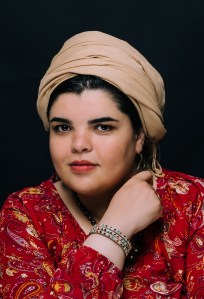
Moroccan
b. 1989
Everything in you grew, but not your hand.
Whenever they pushed your way a finger,
A dry stick or a blade,
Incautious, undiscerning
As a babe’s,
Your rude fist wrapped it round
And clung.
Everything in you grew, but not your hand.
Whenever they pushed your way a finger,
A dry stick or a blade,
Incautious, undiscerning
As a babe’s,
Your rude fist wrapped it round
And clung.
We present this work in honor of the poet’s 75th birthday.
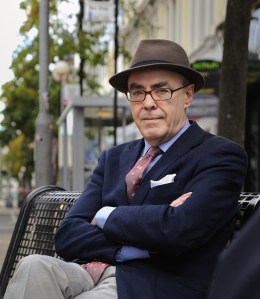
in room
after book-
filled room
upon storey
after storey
I scan spine
after spine
upon shelf
after shelf
trying to locate
a volume
lodged at
the back
of my mind
We present this work in honor of Gandhi Jiyanti.

Again and again the same questions, my love,
those that confront us
and vex nations,
or so they claim –
how to disarm
when we still hear
the rattle of sabre,
the hiss of tyre
from the time I rode my red cycle
all those summers ago
in my grandmother’s back-garden
over darting currents of millipede,
watching them,
juicy, bulging, with purpose,
flatten in moments
into a few hectic streaks of slime,
how to disarm,
how to choose
mothwing over metal,
underbelly over claw,
how to reveal raw white nerve fibre
even while the drowsing mind still clutches
at carapace and fang,
how to believe
this gift of inner wrist
is going to make it just a little easier
for a whale to sing again in a distant ocean
or a grasshopper to dream
in some sunwarmed lull of savannah.
We present this work in honor of the South African holiday, Heritage Day.

I stepped out of the rain
into an Etruscan tomb.
It was a long walk
and a long way yet,
but the map said
they were here,
the old graves
on some farmer’s land.
Between tilled fields,
a shaded space
and now the rain
in grey-fall from the leaves.
I stopped alone, ducked in,
one small step down,
a coomb of earth and stone.
You stood outside
and waited while
I breathed the history bodily.
Soil, leaf, moist
must, membrane memory
and somewhere here, the bones.
My own limbs aching
from the marching day
and now this dusky interval,
an indentation, swerving
off the rutted track.
You call. I turn, step back,
re-join you to press on
between the leaning trees,
ancient coordinates,
each dip and hollow on the path
still slowly filling up with rain.
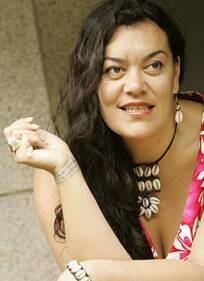
It has pink bricks and a big tree. This is the driveway, you can lie on it in the summer, it keeps you warm if you are wet. This is the screen door, swallow. Front green door, hold your chest. The carpet is dark grey and hurts your knees, it doesn’t show any blood. Here are the walls, be careful of the small girl in the corner. Here is the door into the hall, be careful of that too. Here is the line where the carpet stops and the kitchen starts, that is a different country-if you are in the kitchen you are safe, if you are in the lounge on your knees you are not. Watch out for the corners. She isn’t going anywhere. There is the piano. There is the ghost. Here is the hall, it is very dark. Here is the bedroom. Here is the other bedroom, babies come from there. Here is the last bedroom, it is very cold, there is a trapdoor in the wardrobe, it goes down under the floor and you can hide if there is a flood or a tornado. There is the bath. The aunty punched the uncle in the face till he bled, they lived in the small room, the cold one, that was before I was born. Here is the lounge again, here is the phone: ringthepoliceringthepolice. Here is the couch, it is brown, watch out for the man, he is dangerous. Here is the beginning of the lino in the kitchen again, here is the woman. Watch out for the girl in the corner, she is always here. There is the woman, she just watches and then she forgets.
I am cutting a big hole in the roof. Look down through the roof, there is the top of the man, you can’t see his face, but see his arm, see it moving fast.
I am removing the outside wall of the bedroom. Look inside, there are the Spirits, that’s where they live.
Stand outside in the dark and watch the rays come out through the holes-those are the people’s feelings.
We present this work in honor of 9/11.

And the Wright brothers said they thought they had invented
something that could make peace on earth
(if the wrong brothers didn’t get hold of it)
when their wonderful flying machine took off at Kitty Hawk
into the kingdom of birds but the parliament of birds was freaked out
by this man-made bird and fled to heaven
And then the famous Spirit of Saint Louis took off eastward and
flew across the Big Pond with Lindy at the controls in his leather
helmet and goggles hoping to sight the doves of peace but he did not
Even though he circled Versailles
And then the famous Yankee Clipper took off in the opposite
direction and flew across the terrific Pacific but the pacific doves
were frighted by this strange amphibious bird and hid in the orient sky
And then the famous Flying Fortress took off bristling with guns
and testosterone to make the world safe for peace and capitalism
but the birds of peace were nowhere to be found before or after Hiroshima
And so then clever men built bigger and faster flying machines and
these great man-made birds with jet plumage flew higher than any
real birds and seemed about to fly into the sun and melt their wings
and like Icarus crash to earth
And the Wright brothers were long forgotten in the high-flying
bombers that now began to visit their blessings on various Third
Worlds all the while claiming they were searching for doves of
peace
And they kept flying and flying until they flew right into the 21st
century and then one fine day a Third World struck back and
stormed the great planes and flew them straight into the beating
heart of Skyscraper America where there were no aviaries and no
parliaments of doves and in a blinding flash America became a part
of the scorched earth of the world
And a wind of ashes blows across the land
And for one long moment in eternity
There is chaos and despair
And buried loves and voices
Cries and whispers
Fill the air
Everywhere

My love
many things
could have happened in August
but will not happen
many fireflies
could have shone in your eyes
but will not shine
and the month of August will be buried
without pomp or circumstance
without flowers or processions
like so many days
that never got to be trees
like so many trees
that never got to be birds
like so many birds
that never got to fly
We present this work in honor of the poet’s 70th birthday.
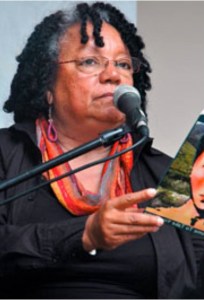
My name is February.
I was sold
my breasts, private parts and eyes
my brain
are not mine yet
like the São José
I am ruined
often sank by another storm
no Jesus walking on water for me.
My name is February
I am searching for the rod of the steering wheel
Because the family lies at the bottom
The child stitched to a mother’s dress
Mother’s hand locked in father’s fist
How deep down are they lying, on which side?
My name is February
auctioned, sold, the highest bidder
disposed of my real name
paid no compensation
for that, my name, stolen, sunked
underwater it still lies
with the family
wrecks of the São José
ran aground by a wind
furious waves that decided
the future of the loot
smashing the profit against the embankment.
My name is February
the Masbieker on the São José
that’s how I was called
when my mother tongue of here came into being
when tongues started to form a bond
and letters started walking freely
in a desperate attempt at survival and hope
that forces should not strip this identity too
I became the Masbieker, only a name
born under a different sky
and deeply filled with shame.
My name is February
I rearranged this landscape.
my hands wove the patterns of the vineyards
my feet pressed the grapes
and I was paid with the wine.
I carry Alcohol-Foetal Syndrome children on my back.
My name is February.
I still march on the eve of December one,
I walk the cobblestones of this city
when I cry in desperation,
“remember the emancipation of the slaves!”
My name is February.
two hundred years after the São José
I was given the vote,
they said I was free
But do you see how often I am submerged,
weighed down?
I am the sunken, the soiled,
forgotten
and yet memory will not leave me!
My name is February,
stranded at Third beach
but no one comes to look for me,
no one waves from the dunes,
no bridges back to Mozambique.
My name is February.
I will be resurrected,
brought to the surface
unshackled, unchained, unashamed!
My name is February!
We present this work in honor of the Moroccan holiday, Allegiance Day.
At its
peak,
war leaves the battle-front, wipes
with oblivion its own eyes, passes by the hairdresser’s,
hurls down the world from the tenth floor,
to be free for the evening show
For sure
the land will offer
new dead people as sacrifice,
processions of the blind,
and more medals.
At its
peak, I will weave other battle-fronts,
straw leaders, trenches and taverns,
wine-blood, and letter processions
And in the well of oblivion I bury
names not meant for oblivion, a perplexed woman,
hearts that didn’t stop at my port, eyes
that didn’t keep watch over me,
paradises I never inhabited.
I have
time for grief
And time for love
And I trust
my fits of sorrow to the womb of amazement.
Did the child know
that I would lead him into a dark tunnel and weave
from his shadow a king that will feed on lovely grief?
Did I know that vertigo will hurl me
far away from the palm-tree of oblivion,
and that I will force my crimes
onto heaven?
This
war toppled down the towers of Babel
The mills of Aden, the voices of Rimbaud, the majestic silence of Hawi.
This war exhausted me, I will stop it
for a little while till the battle-front cools down
or the cloud of questions
takes shape on my shoulders
This
war might come to an end. But not
my obsession which flows from the turmoil that renders
names,
things,
and lovely passion to fragments
my eyes
will only ever
leave her lips
to inhabit her eyes
I mean
the most gorgeous female
not the war of oblivion

This is me..
I thought of a people that says, Yes & No.
I adjusted what I had thought of because – simply – I
adjusted what I had thought of.
I thought of a people that says, Yes to No.
I thought of the number of victims, orphans, widows,
and thieves.
I thought of letters fleeting from the texts.
I thought of a people leaving its land
with its women and men, camels and dogs.
I thought of that orphan – the government –
It was solely importing clapping
from a concert of a soprano that is singing to the gazelle,
to justice, and to the Christ.
I thought of an eloquent silence.
Life has gone as it has gone.
Life has gone in rushing & in vain.
I’d read a poem to Al-Asha al Kabir in the bar
when wine ran out and the cock and the crow of the city
cried in its night:
“– O, folks!
There is no tomorrow – after now – over there.”
 Poets Corner