Lately, I’ve become accustomed to the way
The ground opens up and envelopes me
Each time I go out to walk the dog.
Or the broad edged silly music the wind
Makes when I run for a bus…
Things have come to that.
And now, each night I count the stars.
And each night I get the same number.
And when they will not come to be counted,
I count the holes they leave.
Nobody sings anymore.
And then last night I tiptoed up
To my daughter’s room and heard her
Talking to someone, and when I opened
The door, there was no one there…
Only she on her knees, peeking into
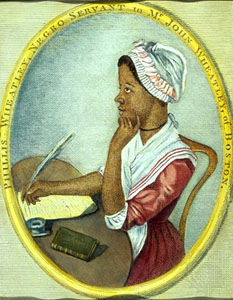
In honor of National Freedom Day, we present this work by a poet who had her freedom taken from her.
Phillis Wheatley American 1753 – 1784
I
Lo! for this dark terrestrial ball
Forsakes his azure-paved hall
A prince of heav’nly birth!
Divine Humanity behold,
What wonders rise, what charms unfold
At his descent to earth!
II
The bosoms of the great and good
With wonder and delight he view’d,
And fix’d his empire there:
Him, close compressing to his breast,
The sire of gods and men address’d,
“My son, my heav’nly fair!
III
“Descend to earth, there place thy throne;
“To succour man’s afflicted son
“Each human heart inspire:
“To act in bounties unconfin’d
“Enlarge the close contracted mind,
“And fill it with thy fire.”
IV
Quick as the word, with swift career
He wings his course from star to star,
And leaves the bright abode.
The Virtue did his charms impart;
Their G—! then thy raptur’d heart
Perceiv’d the rushing God:
V
For when thy pitying eye did see
The languid muse in low degree,
Then, then at thy desire
Descended the celestial nine;
O’er me methought they deign’d to shine,
And deign’d to string my lyre.
VI
Can Afric’s muse forgetful prove?
Or can such friendship fail to move
A tender human heart?
Immortal Friendship laurel-crown’d
The smiling Graces all surround
With ev’ry heav’nly Art.
We present this work in honor of the 160th anniversary of the poet’s death.
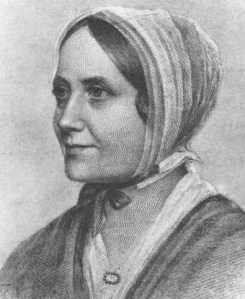
Eliza Lee Follen American 1787 – 1860
When children play the livelong day,
Like birds and butterflies;
As free and gay, sport life away,
And know not care nor sighs:
Then earth and air seem fresh and fair,
All peace below, above:
Life’s flowers are there, and everywhere
Is innocence and love.
When children pray with fear all day,
A blight must be at hand:
Then joys decay, and birds of prey
Are hovering o’er the land:
When young hearts weep as they go to sleep,
Then all the world seems sad:
The flesh must creep, and woes are deep
When children are not glad.
In honor of Martin Luther King Day, we present this work by a poet who helped lead the campaign to establish the holiday.
Gil Scott-Heron American 1949 – 2011
From the Indians who welcomed the pilgrims
And to the buffalo who once ruled the plains
Like the vultures circling beneath the dark clouds
Looking for the rain
Looking for the rain
Just like the cities staggered on the coastline
Living in a nation that just can’t stand much more
Like the forest buried beneath the highway
Never had a chance to grow
Never had a chance to grow
And now it’s winter
Winter in America
Yes and all of the healers have been killed
Or sent away, yeah
But the people know, the people know
It’s winter
Winter in America
And ain’t nobody fighting
‘Cause nobody knows what to say
Save your soul, Lord knows
From Winter in America
The Constitution
A noble piece of paper
With free society
Struggled but it died in vain
And now Democracy is ragtime on the corner
Hoping for some rain
Looks like it’s hoping
Hoping for some rain
And I see the robins
Perched in barren treetops
Watching last-ditch racists marching across the floor
But just like the peace sign that vanished in our dreams
Never had a chance to grow
Never had a chance to grow
And now it’s winter
It’s winter in America
And all of the healers have been killed
Or been betrayed
Yeah, but the people know, people know
It’s winter, Lord knows
It’s winter in America
And ain’t nobody fighting
Cause nobody knows what to save
Save your souls
From Winter in America
And now it’s winter
Winter in America
And all of the healers done been killed or sent away
Yeah, and the people know, people know
It’s winter
Winter in America
And ain’t nobody fighting
Cause nobody knows what to save
And ain’t nobody fighting
Cause nobody knows, nobody knows
And ain’t nobody fighting
Cause nobody knows what to save
You are beautiful and faded
Like an old opera tune
Played upon a harpsichord;
Or like the sun-flooded silks
Of an eighteenth-century boudoir.
In your eyes
Smoulder the fallen roses of out-lived minutes,
And the perfume of your soul
Is vague and suffusing,
With the pungence of sealed spice-jars.
Your half-tones delight me,
And I grow mad with gazing
At your blent colours.
My vigour is a new-minted penny,
Which I cast at your feet.
Gather it up from the dust,
That its sparkle may amuse you.
I met a dragon face to face
the year when I was ten,
I took a trip to outer space,
I braved a pirate’s den,
I wrestled with a wicked troll,
and fought a great white shark,
I trailed a rabbit down a hole,
I hunted for a snark.
I stowed aboard a submarine,
I opened magic doors,
I traveled in a time machine,
and searched for dinosaurs,
I climbed atop a giant’s head,
I found a pot of gold,
I did all this in books I read
when I was ten years old.
We present this work in honor of the Christmas holiday.
Frank O’Hara American 1926 – 1966
There’s no holly, but there is
the glass and granite towers
and the white stone lions
and the pale violet clouds. And
the great tree of balls in
Rockefeller Plaza is public.
Christmas is green and general
like all great works of the
imagination, swelling from minute
private sentiments in the desert,
a wreath around our intimacy
like children’s voices in a park.
For red there is our blood
which, like your smile, must be
protected from spilling into
generality by secret meanings,
the lipstick of life hidden
in a handbag against violations.
Christmas is the time of cold air
and loud parties and big expense,
but in our hearts flames flicker
answeringly, as on old-fashioned
trees. I would rather the house
burn down than our flames go out.
Shirtsleeved afternoons
turn toward leather as the trees
blush, scatter a last
few bright, weary wisps across
the great bruised heart of the South.
The spirit cup drifts
down the pond’s moon-sparked highway.
Far laughter, shadows.
Love or poison? Your turn. Drink
to the star-drenched latitudes
We present this work in honor of St. Nicholas’ Day.
Clement Clarke Moore American 1779 – 1863
‘Twas the night before Christmas, when all through the house
Not a creature was stirring, not even a mouse;
The stockings were hung by the chimney with care,
In hopes that St. Nicholas soon would be there;
The children were nestled all snug in their beds,
While visions of sugar-plums danced in their heads;
And mamma in her ‘kerchief, and I in my cap,
Had just settled down for a long winter’s nap,
When out on the lawn there arose such a clatter,
I sprang from the bed to see what was the matter.
Away to the window I flew like a flash,
Tore open the shutters and threw up the sash.
The moon on the breast of the new-fallen snow
Gave the lustre of mid-day to objects below,
When, what to my wondering eyes should appear,
But a miniature sleigh, and eight tiny reindeer,
With a little old driver, so lively and quick,
I knew in a moment it must be St. Nick.
More rapid than eagles his coursers they came,
And he whistled, and shouted, and called them by name;
“Now, Dasher! Now, Dancer! Now, Prancer and Vixen!
On, Comet! On Cupid! On, Donder and Blitzen!
To the top of the porch! to the top of the wall!
Now dash away! dash away! dash away all!”
As dry leaves that before the wild hurricane fly,
When they meet with an obstacle, mount to the sky,
So up to the house-top the coursers they flew,
With the sleigh full of toys, and St. Nicholas too.
And then, in a twinkling, I heard on the roof
The prancing and pawing of each little hoof.
As I drew in my hand, and was turning around,
Down the chimney St. Nicholas came with a bound.
He was dressed all in fur, from his head to his foot,
And his clothes were all tarnished with ashes and soot;
A bundle of toys he had flung on his back,
And he looked like a peddler just opening his pack.
His eyes — how they twinkled! his dimples how merry!
His cheeks were like roses, his nose like a cherry!
His droll little mouth was drawn up like a bow,
And the beard of his chin was as white as the snow;
The stump of a pipe he held tight in his teeth,
And the smoke it encircled his head like a wreath;
He had a broad face and a little round belly,
That shook, when he laughed like a bowlful of jelly.
He was chubby and plump, a right jolly old elf,
And I laughed when I saw him, in spite of myself;
A wink of his eye and a twist of his head,
Soon gave me to know I had nothing to dread;
He spoke not a word, but went straight to his work,
And filled all the stockings; then turned with a jerk,
And laying his finger aside of his nose,
And giving a nod, up the chimney he rose;
He sprang to his sleigh, to his team gave a whistle,
And away they all flew like the down of a thistle.
But I heard him exclaim, ere he drove out of sight,
“Happy Christmas to all, and to all a good-night.”
O white little lights at Carney’s Point,
You shine so clear o’er the Delaware;
When the moon rides high in the silver sky,
Then you gleam, white gems on the Delaware.
Diamond circlet on a full white throat,
You laugh your rays on a questioning boat;
Is it peace you dream in your flashing gleam,
O’er the quiet flow of the Delaware?
And the lights grew dim at the water’s brim,
For the smoke of the mills shredded slow between;
And the smoke was red, as is new bloodshed,
And the lights went lurid ‘neath the livid screen.
O red little lights at Carney’s Point,
You glower so grim o’er the Delaware;
When the moon hides low sombrous clouds below,
Then you glow like coals o’er the Delaware.
Blood red rubies on a throat of fire,
You flash through the dusk of a funeral pyre;
And there hearth fires red whom you fear and dread
O’er the turgid flow of the Delaware?
And the lights gleamed gold o’er the river cold,
For the murk of the furnace shed a copper veil;
And the veil was grim at the great cloud’s brim,
And the lights went molten, now hot, now pale.
O gold little lights at Carney’s Point,
You gleam so proud o’er the Delaware;
When the moon grows wan in the eastering dawn,
Then you sparkle gold points o’er the Delaware.
Aureate filagree on a Croesus’ brow,
You hasten the dawn on a gray ship’s prow.
Light you streams of gold in the grim ship’s hold
O’er the sullen flow of the Delaware?
And the lights went gray in the ash of day,
For a quiet Aurora brought a halcyon balm;
And the sun laughed high in the infinite sky,
And the lights were forgot in the sweet, sane calm.



 Poets Corner