Go fast chariots! I am going back to where the ruler of Wei lives to console him. The horse keeps wandering, and when will i reach Zhao? The daifus (high officials) went wandering, but my heart is filled with worries. There is no person that thinks I am good, yet I cannot go back. That person doesn’t think very much of me, but my thoughts haven’t changed. You do not think of me as good, but my thoughts for you would not cease. I will climb up those hills and collect plants (to make medicine to cure my worries). A woman has lot of thoughts, and they all go their own ways. The people of Xu worry about me yet they are childish and mad! I went out in the wilderness and noticed the wheat not reaped (because of the political situation). I should try to report it, yet who should I tell it to? To all the high officials, do not say I worry. I have so many thoughts but it is not anything compared to where I am trying to go.
Ares, exceeding in strength, chariot-rider, golden-helmed, doughty in heart, shield-bearer,
Saviour of cities, harnessed in bronze, strong of arm, unwearying, mighty with the spear,
O defence of Olympus, father of warlike Victory, ally of Themis, stern governor of the rebellious, leader of righteous men, sceptred
King of manliness, who whirl your fiery sphere among the planets in their sevenfold courses through the aether wherein your blazing steeds ever bear you above the third firmament of heaven; hear me, helper of men, giver of dauntless youth!
Shed down a kindly ray from above upon my life, and strength of war, that I may be able to drive away bitter cowardice from my head and crush down the deceitful impulses of my soul.
Restrain also the keen fury of my heart which provokes me to tread the ways of blood-curdling strife. Rather, O blessed one, give you me boldness to abide within the harmless laws of peace, avoiding strife and hatred and the violent fiends of death.
Let us live, my Lesbia, and let us love, and let us value all the rumors of more severe old men at only a penny! Suns are able to set and return: when once the short light has set for us one perpetual night must be slept by us. Give me a thousand kisses, then a hundred, then another thousand, then a second hundred, then immediately a thousand then a hundred. then, when we will have made many thousand kisses, we will throw them into confusion, lest we know, or lest anyone bad be able to envy when he knows there to be so many kisses.
We present this work in honor of National Senior Citizens’ Day.
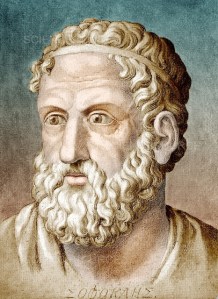
Sophocles Greek c. 497 BC – c. 406 BC
What man is he that yearneth For length unmeasured of days? Folly mine eye discerneth Encompassing all his ways. For years over-running the measure Small change thee in evil wise: Grief draweth nigh thee; and pleasure, Behold it is hid from thine eyes. This to their wage have they Which overlive their day. And He that looseth from labor Doth one with other befriend, Whom bride nor bridesmen attend, Song, nor sound of the tabor, Death, that maketh an end.
Thy portion esteem I highest, Who was not even begot; Thine next, being born who diest And straightway again art not. With follies light as the feather Doth Youth to man befall; Then evils gather together, There wants not one of them all— Wrath, envy, discord, strife, The sword that seeketh life. And sealing the sum of trouble Doth tottering Age draw nigh, Whom friends and kinsfolk fly, Age, upon whom redouble All sorrows under the sky.
This man, as me, even so, Have the evil days overtaken; And like as a cape sea-shaken With tempest at earth’s last verges And shock of all winds that blow, His head the seas of woe, The thunders of awful surges Ruining overflow; Blown from the fall of eve, Blown from the dayspring forth, Blown from the noon in heaven, Blown from night and the North.
Pompey, often led, with me, by Brutus, the head of our army, into great danger, who’s sent you back, as a citizen, to your country’s gods and Italy’s sky,
Pompey, the very dearest of my comrades, with whom I’ve often drawn out the lingering day in wine, my hair wreathed, and glistening with perfumed balsam, of Syrian nard?
I was there at Philippi, with you, in that headlong flight, sadly leaving my shield behind, when shattered Virtue, and what threatened from an ignoble purpose, fell to earth.
While in my fear Mercury dragged me, swiftly, through the hostile ranks in a thickening cloud: the wave was drawing you back to war, carried once more by the troubled waters.
So grant Jupiter the feast he’s owed, and stretch your limbs, wearied by long campaigning, under my laurel boughs, and don’t spare the jars that were destined to be opened by you.
Fill the smooth cups with Massic oblivion, pour out the perfume from generous dishes, Who’ll hurry to weave the wreathes for us of dew-wet parsley or pliant myrtle?
Who’ll throw high Venus at dice and so become the master of drink? I’ll rage as insanely as any Thracian: It’s sweet to me to revel when a friend is home again.
Cythera saw Adonis And knew that he was dead; She marked the brow, all grisly now, The cheek no longer red; And “Bring the boar before me” Unto her Loves she said.
Forthwith her winged attendants Ranged all the woodland o’er, And found and bound in fetters Threefold the grisly boar: One dragged him at a rope’s end E’en as a vanquished foe; One went behind and drave him And smote him with his bow: On paced the creature feebly; He feared Cythera so.
To him said Aphrodite: “So, worst of beasts, ‘twas you Who rent that thigh asunder, Who him that loved me slew?” And thus the beast made answer: “Cythera, hear me swear By thee, by him that loved thee, And by these bonds I wear, And them before whose hounds I ran— I meant no mischief to the man Who seemed to thee so fair.
“As on a carven statue Men gaze, I gazed on him; I seemed on fire with mad desire To kiss that offered limb: My ruin, Aphrodite, Thus followed from my whim.
“Now therefore take and punish And fairly cut away These all unruly tusks of mine; For to what end serve they? And if thine indignation Be not content with this, Cut off the mouth that ventured To offer him a kiss”—
But Aphrodite pitied And bade them loose his chain. The boar from that day forward Still followed in her train; Nor ever to the wildwood Attempted to return, But in the focus of Desire Preferred to burn and burn.






 Poets Corner