This land like a mirror turns you inward
And you become a forest in a furtive lake;
The dark pines of your mind reach downward,
You dream in the green of your time,
Your memory is a row of sinking pines.
Explorer, you tell yourself, this is not what you came for
Although it is good here, and green;
You had meant to move with a kind of largeness,
You had planned a heavy grace, an anguished dream.
But the dark pines of your mind dip deeper
And you are sinking, sinking, sleeper
In an elementary world;
There is something down there and you want it told.
They were coming across the prairie, they were galloping hard and fast;
For the eyes of those desperate riders had sighted their man at last—
Sighted him off to Eastward, where the Cree encampment lay,
Where the cotton woods fringed the river, miles and miles away.
Mistake him? Never! Mistake him? the famous Eagle Chief!
That terror to all the settlers, that desperate Cattle Thief—
That monstrous, fearless Indian, who lorded it over the plain,
Who thieved and raided, and scouted, who rode like a hurricane!
But they’ve tracked him across the prairie; they’ve followed him hard and fast;
For those desperate English settlers have sighted their man at last.
Up they wheeled to the tepees, all their British blood aflame,
Bent on bullets and bloodshed, bent on bringing down their game;
But they searched in vain for the Cattle Thief: that lion had left his lair,
And they cursed like a troop of demons—for the women alone were there.
“The sneaking Indian coward,” they hissed; “he hides while yet he can;
He’ll come in the night for cattle, but he’s scared to face a man.”
“Never!” and up from the cotton woods rang the voice of Eagle Chief;
And right out into the open stepped, unarmed, the Cattle Thief.
Was that the game they had coveted? Scarce fifty years had rolled
Over that fleshless, hungry frame, starved to the bone and old;
Over that wrinkled, tawny skin, unfed by the warmth of blood.
Over those hungry, hollow eyes that glared for the sight of food.
He turned, like a hunted lion: “I know not fear,” said he;
And the words outleapt from his shrunken lips in the language of the Cree.
“I’ll fight you, white-skins, one by one, till I kill you all,” he said;
But the threat was scarcely uttered, ere a dozen balls of lead
Whizzed through the air about him like a shower of metal rain,
And the gaunt old Indian Cattle Thief dropped dead on the open plain.
And that band of cursing settlers gave one triumphant yell,
And rushed like a pack of demons on the body that writhed and fell.
“Cut the fiend up into inches, throw his carcass on the plain;
Let the wolves eat the cursed Indian, he’d have treated us the same.”
A dozen hands responded, a dozen knives gleamed high,
But the first stroke was arrested by a woman’s strange, wild cry.
And out into the open, with a courage past belief,
She dashed, and spread her blanket o’er the corpse of the Cattle Thief;
And the words outleapt from her shrunken lips in the language of the Cree,
“If you mean to touch that body, you must cut your way through me.”
And that band of cursing settlers dropped backward one by one,
For they knew that an Indian woman roused, was a woman to let alone.
And then she raved in a frenzy that they scarcely understood,
Raved of the wrongs she had suffered since her earliest babyhood:
“Stand back, stand back, you white-skins, touch that dead man to your shame;
You have stolen my father’s spirit, but his body I only claim.
You have killed him, but you shall not dare to touch him now he’s dead.
You have cursed, and called him a Cattle Thief, though you robbed him first of bread—
Robbed him and robbed my people—look there, at that shrunken face,
Starved with a hollow hunger, we owe to you and your race.
What have you left to us of land, what have you left of game,
What have you brought but evil, and curses since you came?
How have you paid us for our game? how paid us for our land?
By a book, to save our souls from the sins you brought in your other hand.
Go back with your new religion, we never have understood
Your robbing an Indian’s body, and mocking his soul with food.
Go back with your new religion, and find—if find you can—
The honest man you have ever made from out a starving man.
You say your cattle are not ours, your meat is not our meat;
When you pay for the land you live in, we’ll pay for the meat we eat.
Give back our land and our country, give back our herds of game;
Give back the furs and the forests that were ours before you came;
Give back the peace and the plenty. Then come with your new belief,
And blame, if you dare, the hunger that drove him to be a thief.”
Even this late it happens:
the coming of love, the coming of light.
You wake and the candles are lit as if by themselves,
stars gather, dreams pour into your pillows,
sending up warm bouquets of air.
Even this late the bones of the body shine
and tomorrow’s dust flares into breath.
When the grey lake-water rushes
Past the dripping alder-bushes,
And the bodeful autumn wind
In the fir-tree weeps and hushes, —
When the air is sharply damp
Round the solitary camp,
And the moose-bush in the thicket
Glimmers like a scarlet lamp, —
When the birches twinkle yellow,
And the cornel bunches mellow,
And the owl across the twilight
Trumpets to his downy fellow, —
When the nut-fed chipmunks romp
Through the maples’ crimson pomp,
And the slim viburnum flushes
In the darkness of the swamp, —
When the blueberries are dead,
When the rowan clusters red,
And the shy bear, summer-sleekened,
In the bracken makes his bed, —
On a day there comes once more
To the latched and lonely door,
Down the wood-road striding silent,
One who has been here before.
Green spruce branches for his head,
Here he makes his simple bed,
Crouching with the sun, and rising
When the dawn is frosty red.
All day long he wanders wide
With the grey moss for his guide,
And his lonely axe-stroke startles
The expectant forest-side.
Toward the quiet close of day
Back to camp he takes his way,
And about his sober footsteps
Unafraid the squirrels play.
On his roof the red leaf falls,
At his door the bluejay calls,
And he hears the wood-mice hurry
Up and down his rough log walls;
Hears the laughter of the loon
Thrill the dying afternoon;
Hears the calling of the moose
Echo to the early moon.
And he hears the partridge drumming,
The belated hornet humming, —
All the faint, prophetic sounds
That foretell the winter’s coming.
And the wind about his eaves
Through the chilly night-wet grieves,
And the earth’s dumb patience fills him,
Fellow to the falling leaves.
Work! for the night is coming;
Work! through the morning hours;
Work! while the dew is sparkling;
Work! ‘mid the springing flowers;
Work! while the day grows brighter,
Under the glowing sun;
Work! for the night is coming,—
Night, when man’s work is done.
Work! for the night is coming;
Work! through the sunny noon;
Fill the bright hours with labour,
Rest cometh sure and soon.
Give to each flying minute
Something to keep in store;
Work! for the night is coming,—
Night, when man works no more.
Work! for the night is coming;
Under the sunset skies,
While their bright tints are glowing,
Work! for the daylight flies;
Work! till the last beam fadeth,
Fadeth to shine no more;
Work! while the night is darkening,—
Night, when man’s work is o’er.
When yellow-lock’d and crystal ey’d
I dream’d green woods among;
Where tall trees wav’d from side to side,
And in their green breasts deep and wide,
I saw the building blue jay hide,
O, then the earth was young!
The winds were fresh and brave and bold,
The red sun round and strong;
No prophet voice chill, loud and cold,
Across my woodland dreamings roll’d,
‘The green earth waxeth sere and old,
That once was fair and young!’
I saw in scarr’d and knotty bole,
The fresh’ning of the sap;
When timid spring gave first small dole,
Of sunbeams thro’ bare boughs that stole,
I saw the bright’ning blossoms roll,
From summer’s high pil’d lap.
And where an ancient oak tree lay
The forest stream across,
I mus’d above the sweet shrill spray,
I watch’d the speckl’d trout at play,
I saw the shadows dance and sway
On ripple and on moss.
I pull’d the chestnut branches low,
As o’er the stream they hung,
To see their bursting buds of snow—
I heard the sweet spring waters flow—
My heart and I we did not know
But that the earth was young!
I joy’d in solemn woods to see,
Where sudden sunbeams clung,
On open space of mossy lea,
The violet and anemone,
Wave their frail heads and beckon me—
Sure then the earth was young!
I heard the fresh wild breezes birr,
New budded boughs among,
I saw the deeper tinting stir
In the green tassels of the fir,
I heard the pheasant rise and whirr,
Above her callow young.
I saw the tall fresh ferns prest,
By scudding doe and fawn;
I say the grey dove’s swelling breast,
Above the margin of her nest;
When north and south and east and west
Roll’d all the red of dawn.
At eventide at length I lay,
On grassy pillow flung;
I saw the parting bark of day,
With crimson sails and shrouds all gay,
With golden fires drift away,
The billowy clouds among.
I saw the stately planets sail
On that blue ocean wide;
I saw blown by some mystic gale,
Like silver ship in elfin tale,
That bore some damsel rare and pale,
The moon’s slim crescent glide.
And ev’ry throb of spring
The rust’ling boughs among,
That filled the silver vein of brook,
That lit with bloom the mossy nook,
Cried to my boyish bosom: ‘Look!
How fresh the earth and young!’
The winds were fresh, the days as clear
As crystals set in gold.
No shape, with prophet-mantle drear,
Thro’ those old woods came drifting near,
To whisper in my wond’ring ear,
‘The green earth waxeth old.’
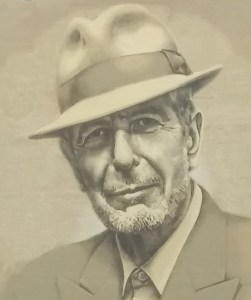
We present this work in honor of the poet’s 85th birthday.
Leonard Cohen Canadian 1934 – 2016
The door it opened slowly
My father he came in
I was nine years old
And he stood so tall above me
His blue eyes they were shining
And his voice was very cold
He said, “I’ve had a vision
And you know I’m strong and holy
I must do what I’ve been told”
So he started up the mountain
I was running, he was walking
And his axe was made of gold
Well, the trees they got much smaller
The lake, a lady’s mirror
We stopped to drink some wine
Then he threw the bottle over
Broke a minute later
And he put his hand on mine
Thought I saw an eagle
But it might have been a vulture
I never could decide
Then my father built an altar
He looked once behind his shoulder
He knew I would not hide
You who build these altars now
To sacrifice these children
You must not do it anymore
A scheme is not a vision
And you never have been tempted
By a demon or a God
You who stand above them now
Your hatchets blunt and bloody
You were not there before
When I lay upon a mountain
And my father’s hand was trembling
With the beauty of the word
And if you call me brother now
Forgive me if I inquire
“Just according to whose plan?”
When it all comes down to dust
I will kill you if I must
I will help you if I can
When it all comes down to dust
I will help you if I must
I will kill you if I can
And mercy on our uniform
Man of peace or man of war
The peacock spreads his fan



 Poets Corner