Autumn

We present this work in honor of the poet’s 315th birthday.

Samuel Johnson
English
1709 – 1784


Alas! with swift and silent pace,
Impatient time rolls on the year;
The Seasons change, and Nature’s face
Now sweetly smiles, now frowns severe.

‘Twas Spring, ‘twas Summer, all was gay,
Now Autumn bends a cloudy brow;
The flowers of Spring are swept away,
And Summer fruits desert the bough.

The verdant leaves that play’d on high,
And wanton’d on the western breeze,
Now trod in dust neglected lie,
As Boreas strips the bending trees.

The fields that waved with golden grain,
As russet heaths are wild and bare;
Not moist with dew, but drench’d in rain,
Nor health nor pleasure wanders there.

No more, while through the midnight shade
Beneath the moon’s pale orb I stray,
Soft pleasing woes my heart invade,
As Progne pours the melting lay.

From this capricious clime she soars,
O! would some god but wings supply!
To where each morn the Spring restores,
Companion of her flight I’d try.

Vain wish! me fate compels to bear
The downward season’s iron reign,
Compels to breathe the polluted air,
And shiver on a blasted plain.

What bliss to life can Autumn yield,
If glooms, and showers,and storms prevail;
And Ceres flies the naked field,
And flowers and fruits, and Phoebus fail.

Oh! what remains, what lingers yet,
To cheer me in the darkening hour!
The grape remains! the friend of wit,
In love, and mirth, of mighty power.

Haste – press the clusters, fill the bowl;
Apollo! shoot thy parting ray:
This gives the sunshine of the soul,
This god of health, and verse, and day.

Still – still the jocund train shall flow,
The pulse with vigorous rapture beat;
My Stella with new charms shall glow,
And every bliss in wine shall meet.

Invictus

We present this work in honor of the poet’s 175th birthday.

William Ernest Henley
English
1849 – 1903


Out of the night that covers me
Black as the pit from pole to pole,
I thank whatever gods may be
For my unconquerable soul.

In the fell clutch of circumstance,
I have not winced nor cried aloud.
Under the bludgeonings of chance
My head is bloody, but unbowed.

Beyond this place of wrath and tears
Looms but the Horror of the shade,
And yet the menace of the years
Finds, and shall find, me unafraid.

It matters not how strait the gate,
How charged with punishments the scroll,
I am the master of my fate
I am the captain of my soul.

Break, Break, Break

We present this work in honor of the poet’s 215th birthday.

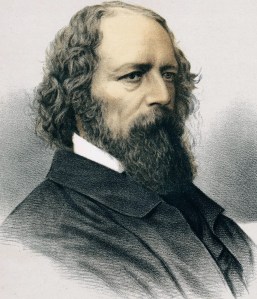
Alfred Lord Tennyson
English
1809 – 1892


Break, break, break,
On thy cold gray stones, O Sea!
And I would that my tongue could utter
The thoughts that arise in me.

O, well for the fisherman’s boy,
That he shouts with his sister at play!
O, well for the sailor lad,
That he sings in his boat on the bay!

And the stately ships go on
To their haven under the hill;
But O for the touch of a vanished hand,
And the sound of a voice that is still!

Break, break, break,
At the foot of thy crags, O Sea!
But the tender grace of a day that is dead

Will never come back to me.

Cædmon’s Hymn

Cædmon
English
c. 657 – 684


Now let me praise the keeper of Heaven’s kingdom,
The might of the Creator, and his thought,
The work of the Father of glory, how each of wonders
The Eternal Lord established in the beginning.
He first created for the sons of men
Heaven as a roof, the holy Creator,
Then Middle-earth the keeper of mankind,
The Eternal Lord, afterwards made,
The earth for men, the Almighty Lord.

Upon a Spider Catching a Fly

We present this work in honor of the 295th anniversary of the poet’s death.

Edward Taylor
English
1642 – 1729


Thou sorrow, venom Elfe:
Is this thy play,
To spin a web out of thyselfe
To Catch a Fly?
For Why?

I saw a pettish wasp
Fall foule therein:
Whom yet thy Whorle pins did not clasp
Lest he should fling
His sting.

But as affraid, remote
Didst stand hereat,
And with thy little fingers stroke
And gently tap
His back.

Thus gently him didst treate
Lest he should pet,
And in a froppish, aspish heate
Should greatly fret
Thy net.

Whereas the silly Fly,
Caught by its leg
Thou by the throate tookst hastily
And ‘hinde the head
Bite Dead.

This goes to pot, that not
Nature doth call.
Strive not above what strength hath got,
Lest in the brawle
Thou fall.

This Frey seems thus to us.
Hells Spider gets
His intrails spun to whip Cords thus
And wove to nets
And sets.

To tangle Adams race
In’s stratigems
To their Destructions, spoil’d, made base
By venom things,
Damn’d Sins.

But mighty, Gracious Lord
Communicate
Thy Grace to breake the Cord, afford
Us Glorys Gate
And State.

We’l Nightingaile sing like
When pearcht on high
In Glories Cage, thy glory, bright,
And thankfully,
For joy.

Martini Sonnet

We present this work in honor of National Dry Martini Day.

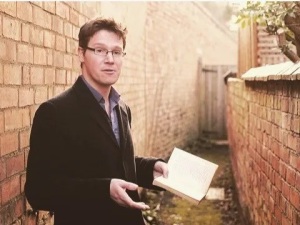
Oliver Tearle
English
21st Century


Long dream of summer in short skirt of glass.
The glass as prism: multiplying all
colours that meet it, sunshine, a right eyeful,
rendering all beyond it meaningless

at least for now, for this moment, more or less.
The eye is blind to what the mouth will feel:
the space where light meets water in the pool,
the driest water you will ever kiss.

Now turn to the vermouth. Just enough
to vault the drink into another region:
wave towards Italy, home of Petrarch. Give
a minute or so for things to settle down.
Stir (not shake) until distinction’s gone.
Try not to mistake this for a new religion.

A Reminiscence

We present this work in honor of the 175th anniversary of the poet’s death.

Anne Brontë
English
1820 – 1849


Yes, thou art gone! and never more
Thy sunny smile shall gladden me;
But I may pass the old church door,
And pace the floor that covers thee,
May stand upon the cold, damp stone,
And think that, frozen, lies below
The lightest heart that I have known,
The kindest I shall ever know.
Yet, though I cannot see thee more,
‘Tis still a comfort to have seen;
And though thy transient life is o’er,
‘Tis sweet to think that thou hast been;
To think a soul so near divine,
Within a form so angel fair,
United to a heart like thine,
Has gladdened once our humble sphere.

Bridge of Sighs

We present this work in honor of the poet’s 225th birthday.

Thomas Hood
English
1799 – 1845


One more Unfortunate
Weary of breath
Rashly importunate,
Gone to her death!

Take her up tenderly;
Lift her with care;
Fashion’d so slenderly,
Young, and so fair!

Look at her garments
Clinging like cerements;
Whilst the wave constantly
Drips from her clothing;
Take her up instantly,
Loving, not loathing.

Touch her not scornfully;
Think of her mournfully,
Gently and humanly;
Not of the stains of her —
All that remains of her
Now is pure womanly.

Make no deep scrutiny
Into her mutiny
Rash and undutiful:
Past all dishonour,
Death has left on her
Only the beautiful.

Still, for all slips of hers,
One of Eve’s family—
Wipe those poor lips of hers
Oozing so clammily.

Loop up her tresses
Escaped from the comb,
Her fair auburn tresses;
Whilst wonderment guesses
Where was her home?

Who was her father?
Who was her mother?
Had she a sister?
Had she a brother?
Or was there a dearer one
Still, and a nearer one
Yet, than all other?

Alas! for the rarity
Of Christian charity
Under the Sun!
O! it was pitiful!
Near a whole city full,
Home she had none.

Sisterly, brotherly,
Fatherly, motherly
Feelings had changed:
Love, by harsh evidence,
Thrown from its eminence;
Even God’s providence
Seemed estranged.

Where the lamps quiver
So far in the river,
With many a light
From window and casement,
From garret to basement,
She stood, with amazement,
Houseless by night.

The bleak wind of March
Made her tremble and shiver;
But not the dark arch,
Or the black flowing river:
Mad from life’s history,
Glad to death’s mystery
Swift to be hurl’d—
Anywhere, anywhere
Out of the world!

In she plunged boldly,
No matter how coldly
The rough river ran,
Over the brink of it,—
Picture it, think of it,
Dissolute Man!
Lave in it, drink in it,
Then, if you can!

Ere her limbs frigidly
Stiffen too rigidly,
Decently, kindly,
Smooth and compose them;
And her eyes, close them,
Staring so blindly!

Dreadfully staring
Thro’ muddy impurity,
As when with the daring
Last look of despairing
Fix’d on futurity.

Perishing gloomily,
Spurr’d by contumely,
Cold inhumanity,
Burning insanity,
Into her rest.
—Cross her hands humbly
As if praying dumbly,
Over her breast!

Owning her weakness,
Her evil behaviour,
And leaving, with meekness,
Her sins to her Saviour!

The Friend of Humanity, and the Knife-Grinder

We present this work in honor of the poet’s 255th birthday.

John Hookham Frere
English
1769 – 1846


FRIEND OF HUMANITY.

“Needy Knife-grinder! whether are you going?
Rough is the road, your wheel is out of order—
Bleak blows the Blast;—your hat has got a hole in’t,
So have your breeches!

“Weary Knife-grinder! little think the proud ones
Who in their coaches roll along the turnpike-
-road, what hard work ‘tis crying all day, ‘Knives and
‘Scissars to grind O!’

“Tell me Knife-grinder, how came you to grind knives?
Did some rich man tyrannically use you?
Was it the squire? or parson of the parish;
Or the attorney?

“Was it the squire, for killing of his game? or
Covetous parson, for his tithes distraining?
Or roguish lawyer, made you lose your little
All in a lawsuit?

“(Have you not read the Rights of Man, by Tom Paine?)
Drops of compassion tremble on my eyelids,
Ready to fall, as soon as you have told your
Pitiful story.”

KNIFE-GRINDER.

“Story! God bless you! I have none to tell, Sir,
Only last night a-drinking at the Chequers,
This poor old hat and breeches, as you see, were
Torn in a scuffle.

“Constables came up for to take me into
Custody; they took me before the justice;
Justice Oldmixon put me in the parish-
stocks for a vagrant.

“I should be glad to drink your Honor’s health in
A pot of beer, if you will give me sixpence;
But for my part, I never love to meddle
With Politics, Sir.”

FRIEND OF HUMANITY.

“I give thee sixpence! I will see thee damn’d first—
Wretch! whom no sense of wrongs can rouse to vengeance—
Sordid, unfeeling, reprobate, degraded,
Spiritless outcast!”

Kicks the Knife-grinder, overturns his wheel, and exit in a transport of Republican enthusiasm and universal philanthropy.