Snake

We present this work in honor of the 90th anniversary of the poet’s death.
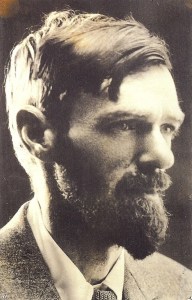
D.H. Lawrence
English
1885 – 1930


A snake came to my water-trough
On a hot, hot day, and I in pyjamas for the heat,
To drink there.
In the deep, strange-scented shade of the great dark carob-tree
I came down the steps with my pitcher
And must wait, must stand and wait, for there he was at the trough before me.

He reached down from a fissure in the earth-wall in the gloom
And trailed his yellow-brown slackness soft-bellied down, over the edge of the stone trough
And rested his throat upon the stone bottom,
And where the water had dripped from the tap, in a small clearness,
He sipped with his straight mouth,
Softly drank through his straight gums, into his slack long body,
Silently.

Someone was before me at my water-trough,
And I, like a second comer, waiting.

He lifted his head from his drinking, as cattle do,
And looked at me vaguely, as drinking cattle do,
And flickered his two-forked tongue from his lips, and mused a moment,
And stooped and drank a little more,
Being earth-brown, earth-golden from the burning bowels of the earth
On the day of Sicilian July, with Etna smoking.
The voice of my education said to me
He must be killed,
For in Sicily the black, black snakes are innocent, the gold are venomous.

And voices in me said, If you were a man
You would take a stick and break him now, and finish him off.

But must I confess how I liked him,
How glad I was he had come like a guest in quiet, to drink at my water-trough
And depart peaceful, pacified, and thankless,
Into the burning bowels of this earth?

Was it cowardice, that I dared not kill him? Was it perversity, that I longed to talk to him?
Was it humility, to feel so honoured?
I felt so honoured.

And yet those voices:
If you were not afraid, you would kill him!

And truly I was afraid, I was most afraid, But even so, honoured still more
That he should seek my hospitality
From out the dark door of the secret earth.

He drank enough
And lifted his head, dreamily, as one who has drunken,
And flickered his tongue like a forked night on the air, so black,
Seeming to lick his lips,
And looked around like a god, unseeing, into the air,
And slowly turned his head,
And slowly, very slowly, as if thrice adream,
Proceeded to draw his slow length curving round
And climb again the broken bank of my wall-face.

And as he put his head into that dreadful hole,
And as he slowly drew up, snake-easing his shoulders, and entered farther,
A sort of horror, a sort of protest against his withdrawing into that horrid black hole,
Deliberately going into the blackness, and slowly drawing himself after,
Overcame me now his back was turned.

I looked round, I put down my pitcher,
I picked up a clumsy log
And threw it at the water-trough with a clatter.

I think it did not hit him,
But suddenly that part of him that was left behind convulsed in undignified haste.
Writhed like lightning, and was gone
Into the black hole, the earth-lipped fissure in the wall-front,
At which, in the intense still noon, I stared with fascination.

And immediately I regretted it.
I thought how paltry, how vulgar, what a mean act!
I despised myself and the voices of my accursed human education.

And I thought of the albatross
And I wished he would come back, my snake.

For he seemed to me again like a king,
Like a king in exile, uncrowned in the underworld,
Now due to be crowned again.

And so, I missed my chance with one of the lords
Of life.
And I have something to expiate:
A pettiness.
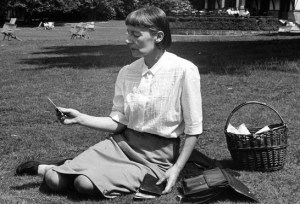

Pad, Pad

Stevie Smith
English
1902 – 1971


I always remember your beautiful flowers
And the beautiful kimono you wore
When you sat on the couch
With that tigerish crouch
And told me you loved me no more.

What I cannot remember is how I felt when you were unkind
All I know is, if you were unkind now I should not mind.
Ah me, the power to feel exaggerated, angry and sad
The years have taken from me. Softly I go now, pad pad.

from Doctor Faustus

Christopher Marlowe
English
1564 – 1593


Was this the face that launch’d a thousand ships,
And burnt the topless towers of Ilium?
Sweet Helen, make me immortal with a kiss.
Her lips suck forth my soul: see where it flies!
Come, Helen, come, give me my soul again.
Here will I dwell, for heaven is in these lips,
And all is dross that is not Helena.
I will be Paris, and for love of thee,
Instead of Troy, shall Wittenberg be sack’d;
And I will combat with weak Menelaus,
And wear thy colours on my plumed crest;
Yea, I will wound Achilles in the heel,
And then return to Helen for a kiss.
O, thou art fairer than the evening air
Clad in the beauty of a thousand stars;
Brighter art thou than flaming Jupiter
When he appear’d to hapless Semele;
More lovely than the monarch of the sky
In wanton Arethusa’s azur’d arms;
And none but thou shalt be my paramour!

Oh, They Have Robbed Me of the Hope

We present this work in honor of the poet’s 200th birthday.

Anne Brontë
English
1820 – 1849


Oh, they have robbed me of the hope
My spirit held so dear;
They will not let me hear that voice
My soul delights to hear.
They will not let me see that face
I so delight to see;
And they have taken all thy smiles,
And all thy love from me.

Well, let them seize on all they can:—
One treasure still is mine,—
A heart that loves to think on thee,
And feels the worth of thine.

Talking to Grieve

Denise Levertov
English
1923 – 1997


Ah, Grief, I should not treat you
like a homeless dog
who comes to the back door
for a crust, for a meatless bone.
I should trust you.

I should coax you
into the house and give you
your own corner,
a worn mat to lie on,
your own water dish.

You think I don’t know you’ve been living
under my porch.
You long for your real place to be readied
before winter comes. You need
your name,
your collar and tag. You need
the right to warn off intruders,
to consider
my house your own
and me your person
and yourself
my own dog.

Winter: My Secret

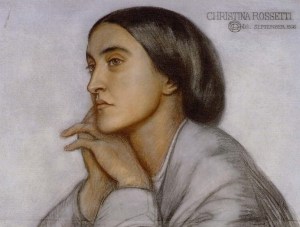
We present this work in honor of the 125th anniversary of the poet’s death.

Christina Rossetti
English
1830 – 1894


I tell my secret? No indeed, not I:
Perhaps some day, who knows?
But not today; it froze, and blows, and snows,
And you’re too curious: fie!
You want to hear it? well:
Only, my secret’s mine, and I won’t tell.

Or, after all, perhaps there’s none:
Suppose there is no secret after all,
But only just my fun.
Today’s a nipping day, a biting day;
In which one wants a shawl,
A veil, a cloak, and other wraps:
I cannot ope to everyone who taps,
And let the draughts come whistling thro’ my hall;
Come bounding and surrounding me,
Come buffeting, astounding me,
Nipping and clipping thro’ my wraps and all.
I wear my mask for warmth: who ever shows
His nose to Russian snows
To be pecked at by every wind that blows?
You would not peck? I thank you for good will,
Believe, but leave the truth untested still.

Spring’s an expansive time: yet I don’t trust
March with its peck of dust,
Nor April with its rainbow-crowned brief showers,
Nor even May, whose flowers
One frost may wither thro’ the sunless hours.

Perhaps some languid summer day,
When drowsy birds sing less and less,
And golden fruit is ripening to excess,
If there’s not too much sun nor too much cloud,
And the warm wind is neither still nor loud,
Perhaps my secret I may say,
Or you may guess.

Verses to Rhyme with Rose

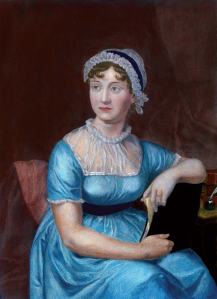
Jane Austen
English
1775 – 1817


Love, they say, is like a rose;
I’m sure ‘tis like the wind that blows,
For not a human creature knows
How it comes or where it goes.
It is the cause of many woes:
It swells the eyes and reds the nose,
And very often changes those
Who once were friends to bitter foes.
But let us now the scene transpose
And think no more of tears and throes.
Why may we not as well suppose
A smiling face the urchin shows?
And when with joy the bosom glows,
And when the heart has full repose,
‘Tis mutual love the gift bestows.

Sonnet 43

Elizabeth Barrett Browning
English
1806 – 1861


How do I love thee? Let me count the ways.
I love thee to the depth and breadth and height
My soul can reach, when feeling out of sight
For the ends of Being and ideal Grace.
I love thee to the level of every day’s
Most quiet need, by sun and candlelight.
I love thee freely, as men strive for Right;
I love thee purely, as they turn from Praise.
I love with a passion put to use
In my old griefs, and with my childhood’s faith.
I love thee with a love I seemed to lose
With my lost saints, — I love thee with the breath,
Smiles, tears, of all my life! — and, if God choose,
I shall but love thee better after death.

November, 1806

William Wordsworth
English
1770 – 1850


Another year!—another deadly blow!
Another mighty Empire overthrown!
And We are left, or shall be left, alone;
The last that dare to struggle with the Foe.
‘Tis well! from this day forward we shall know
That in ourselves our safety must be sought;
That by our own right hands it must be wrought;
That we must stand unpropped, or be laid low.
O dastard whom such foretaste doth not cheer!
We shall exult, if they who rule the land
Be men who hold its many blessings dear,
Wise, upright, valiant; not a servile band,
Who are to judge of danger which they fear,
And honour which they do not understand.

The Martyrdom of Bishop Farrar

Ted Hughes
English
1930 – 1998


Burned by Bloody Mary’s men at Caermarthon

If I flinch from the pain of the burning, believe not the doctrine that I have preached. — His words at the stake.

Bloody Mary’s venomous flames can curl;
They can shrivel sinew and char bone
Of foot, ankle, knee and thigh, and boil
Bowels, and drop his heart a cinder down;
And her soldiers can cry, as they hurl
Logs in the red rush: “This is her sermon.”

The sullen-jowled watching Welsh townspeople
Hear him crack in the fire’s mouth: they see what
Black oozing twist of stuff bubbles the smell
That tars and retches their lungs: no pulpit
Of his ever held their eyes so still,
Never, as now his agony, his wit.

An ignorant means to establish ownership
Of his flock! Thus their shepherd she seized
And knotted him into this blazing shape
In their eyes, as if such could have cauterized
The trust they turned towards him, and branded on
Its stump her claim, to outlaw question.

So it might have been: seeing their exemplar
And teacher burned for his lessons to black bits,
Their silence might have disowned him to her,
And hung up what he had taught with their Welsh hats:
Who sees his blasphemous father struck by fire
From heaven, might well be heard to speak no oaths.

But the fire that struck here, come from Hell even,
Kindled little heavens in his words
As he fed his body to the flame alive.
Words which, before they will be dumbly spared,
Will burn their body and be tongued with fire
Make paltry folly of flesh and this world’s air.

When they saw what annuities of hours
And comfortable blood he burned to get
His words a bare honouring in their ears,
The shrewd townsfolk pocketed them hot:
Stamp was not current but they rang and shone
As good gold as any queen’s crown.

Gave all he had, and yet the bargain struck
To a merest farthing his whole agony,
His body’s cold-kept miserdom on shrieks
He gave uncounted, while out of his eyes,
Out of his mouth, fire like a glory broke,
And smoke burned his sermon into the skies.