Advancing years may bring about
A rather sweet nostalgia
In spite of rheumatism and gout
And, certainly, neuralgia.
And so, when we have churned our way
Through luncheon and a matinée,
We gratefully to bed retire
To rest our aching, creaking vertebrae
And have a little something on a tray.
Some ageing ladies with a groan
Renounce all beauty lotions,
They dab their brows with eau-de-Cologne
And turn to their devotions,
We face the process of decay
Attired in a négligé
And with hot bottles at our toes
We cosily in bed repose
Enjoying, in a rather languid way,
A little ‘eggy’ something on a tray.
Advancing years that many dread
Still have their compensations,
We turn when youth and passion have fled
To more sedate sensations,
And when we’ve fought our weary way
Through some exhausting social day
We thankfully to bed retire
With pleasant book and crackling fire
And, like Salome in a bygone day,
Enjoy a little something on a tray.
When weary from the fray
Something on a tray
Sends weariness away,
Something on a tray,
Thank God, thank God we say,
For something on a tray.
We present this work in honor of the poet’s 100th birthday.
Rosamund Stanhope English 1919 – 2005
Never here the risk of
the missed catch, the lost
‘bus, the possibility of the
bottom falling out of the
lotus-market; the certainty that
the face we love will be no longer
there; that one day all this Noddy stuff will dissolve
and Andy Pandy suffocate in his dream-box.
On this island the sun casts no
shadows; amaranth survives without
rain; no fly in the
appointments, chloramine in the
water; no valley in our
alley.
And therefore no
pungent hush as the shower comes down
to rescue the fifth
Test; no final poignant kiss
on the cold cheek of the
dead; just the usual boring
immortelles, the assurance of
helichrysum, the illimitable Tithonus dawns.
That’s my last Duchess painted on the wall,
Looking as if she were alive. I call
That piece a wonder, now: Frà Pandolf’s hands
Worked busily a day, and there she stands.
Will ‘t please you sit and look at her? I said
‘Frà Pandolf’ by design, for never read
Strangers like you that pictured countenance,
The depth and passion of its earnest glance,
But to myself they turned (since none puts by
The curtain I have drawn for you, but I)
And seemed as they would ask me, if they durst,
How such a glance came there; so, not the first
Are you to turn and ask thus. Sir, ‘t was not
Her husband’s presence only, called that spot
Of joy into the Duchess’ cheek: perhaps
Frà Pandolf chanced to say, ‘Her mantle laps
Over my lady’s wrist too much,’ or ‘Paint
Must never hope to reproduce the faint
Half-flush that dies along her throat:’ such stuff
Was courtesy, she thought, and cause enough
For calling up that spot of joy. She had
A heart—how shall I say?—too soon made glad,
Too easily impressed; she liked whate’er
She looked on, and her looks went everywhere.
Sir, ‘t was all one! My favour at her breast,
The dropping of the daylight in the West,
The bough of cherries some officious fool
Broke in the orchard for her, the white mule
She rode with round the terrace—all and each
Would draw from her alike the approving speech,
Or blush, at least. She thanked men,—good! but thanked
Somehow—I know not how—as if she ranked
My gift of a nine-hundred-years-old name
With anybody’s gift. Who’d stoop to blame
This sort of trifling? Even had you skill
In speech—(which I have not)—to make your will
Quite clear to such an one, and say, ‘Just this
Or that in you disgusts me; here you miss,
Or there exceed the mark’—and if she let
Herself be lessoned so, nor plainly set
Her wits to yours, forsooth, and made excuse,
—E’en then would be some stooping; and I choose
Never to stoop. Oh, sir, she smiled, no doubt,
Whene’er I passed her; but who passed without
Much the same smile? This grew; I gave commands;
Then all smiles stopped together. There she stands
As if alive. Will ‘t please you rise? We’ll meet
The company below then. I repeat,
The Count your master’s known munificence
Is ample warrant that no just pretence
Of mine for dowry will be disallowed;
Though his fair daughter’s self, as I avowed
At starting, is my object. Nay, we’ll go
Together down, sir. Notice Neptune, though,
Taming a sea-horse, thought a rarity,
Which Claus of Innsbruck cast in bronze for me!
I met a traveller from an antique land
Who said: “Two vast and trunkless legs of stone
Stand in the desert . . . Near them, on the sand,
Half sunk, a shattered visage lies, whose frown,
And wrinkled lip, and sneer of cold command,
Tell that its sculptor well those passions read
Which yet survive, stamped on these lifeless things,
The hand that mocked them, and the heart that fed:
And on the pedestal these words appear:
‘My name is Ozymandias, king of kings:
Look on my works, ye Mighty, and despair!’
Nothing beside remains. Round the decay
Of that colossal wreck, boundless and bare
The lone and level sands stretch far away.”
I leant upon a coppice gate
When Frost was spectre-grey,
And Winter’s dregs made desolate
The weakening eye of day.
The tangled bine-stems scored the sky
Like strings of broken lyres,
And all mankind that haunted nigh
Had sought their household fires.
The land’s sharp features seemed to be
The Century’s corpse outleant,
His crypt the cloudy canopy,
The wind his death-lament.
The ancient pulse of germ and birth
Was shrunken hard and dry,
And every spirit upon earth
Seemed fervourless as I.
At once a voice arose among
The bleak twigs overhead
In a full-hearted evensong
Of joy illimited;
An aged thrush, frail, gaunt, and small,
In blast-beruffled plume,
Had chosen thus to fling his soul
Upon the growing gloom.
So little cause for carolings
Of such ecstatic sound
Was written on terrestrial things
Afar or nigh around,
That I could think there trembled through
His happy good-night air
Some blessed Hope, whereof he knew
And I was unaware.
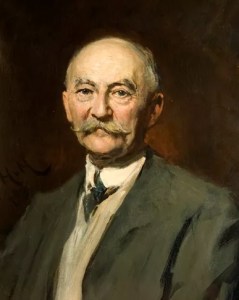
 Poets Corner