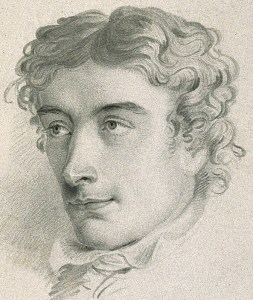
Bright Star

We present this work in honor of the 200th anniversary of the poet’s death.

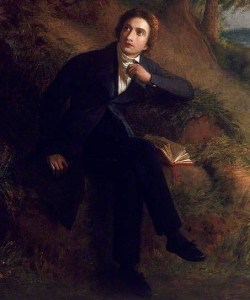
John Keats
English
1795 –1821


Bright star, would I were stedfast as thou art—
Not in lone splendour hung aloft the night
And watching, with eternal lids apart,
Like nature’s patient, sleepless Eremite,

The moving waters at their priestlike task
Of pure ablution round earth’s human shores,
Or gazing on the new soft-fallen mask
Of snow upon the mountains and the moors—

No—yet still stedfast, still unchangeable,
Pillow’d upon my fair love’s ripening breast,
To feel for ever its soft fall and swell,
Awake for ever in a sweet unrest,

Still, still to hear her tender-taken breath,
And so live ever—or else swoon to death.

Against Constancy

Earl of Rochester
English
1647 – 1680


Tell me no more of constancy,
The frivolous pretense
Of cold age, narrow jealousy,
Disease, and want of sense.

Let duller fools, on whom kind chance
Some easy heart has thrown,
Despairing higher to advance,
Be kind to one alone.

Old men and weak, whose idle flame
Their own defects discovers,
Since changing can but spread their shame,
Ought to be constant lovers.

But we, whose hearts do justly swell
With no vainglorious pride,
Who know how we in love excel,
Long to be often tried.

Then bring my bath, and strew my bed,
As each kind night returns;
I’ll change a mistress till I’m dead—
And fate change me to worms.

The Ballad of Fisher’s Boarding House

We present this work in honor of the 85th anniversary of the poet’s death.

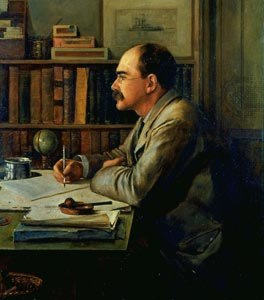
Rudyard Kipling
English
1865 – 1936


That night, when through the mooring-chains
The wide-eyed corpse rolled free,
To blunder down by Garden Reach
And rot at Kedgeree,
The tale the Hughli told the shoal
The lean shoal told to me.

‘Twas Fultah Fisher’s boarding-house,
Where sailor-men reside,
And there were men of all the ports
From Mississip to Clyde,
And regally they spat and smoked,
And fearsomely they lied.

They lied about the purple Sea
That gave them scanty bread,
They lied about the Earth beneath,
The Heavens overhead,
For they had looked too often on
Black rum when that was red.

They told their tales of wreck and wrong,
Of shame and lust and fraud,
They backed their toughest statements with
The Brimstone of the Lord,
And crackling oaths went to and fro
Across the fist-banged board.

And there was Hans the blue-eyed Dane,
Bull-throated, bare of arm,
Who carried on his hairy chest
The maid Ultruda’s charm—
The little silver crucifix
That keeps a man from harm.

And there was Jake Without-the-Ears,
And Pamba the Malay,
And Carboy Gin the Guinea cook,
And Luz from Vigo Bay,
And Honest Jack who sold them slops
And harvested their pay.

And there was Salem Hardieker,
A lean Bostonian he—
Russ, German, English, Halfbreed, Finn,
Yank, Dane, and Portuguee,
At Fultah Fisher’s boarding-house
The rested from the sea.

Now Anne of Austria shared their drinks,
Collinga knew her fame,
From Tarnau in Galicia
To Jaun Bazaar she came,
To eat the bread of infamy
And take the wage of shame.

She held a dozen men to heel—
Rich spoil of war was hers,
In hose and gown and ring and chain,
From twenty mariners,
And, by Port Law, that week, men called
Her Salem Hardieker’s.

But seamen learnt—what landsmen know—
That neither gifts nor gain
Can hold a winking Light o’ Love
Or Fancy’s flight restrain,
When Anne of Austria rolled her eyes
On Hans the blue-eyed Dane.

Since Life is strife, and strife means knife,
From Howrah to the Bay,
And he may die before the dawn
Who liquored out the day,
In Fultah Fisher’s boarding-house
We woo while yet we may.

But cold was Hans the blue-eyed Dane,
Bull-throated, bare of arm,
And laughter shook the chest beneath
The maid Ultruda’s charm—
The little silver crucifix
That keeps a man from harm.

“You speak to Salem Hardieker;
“You was his girl, I know.
“I ship mineselfs to-morrow, see,
“Und round the Skaw we go,
“South, down the Cattegat, by Hjelm,
“To Besser in Saro.”

When love rejected turns to hate,
All ill betide the man.
“You speak to Salem Hardieker”—
She spoke as woman can.
A scream—a sob—“He called me—names!”
And then the fray began.

An oath from Salem Hardieker,
A shriek upon the stairs,
A dance of shadows on the wall,
A knife-thrust unawares—
And Hans came down, as cattle drop,
Across the broken chairs.

…In Anne of Austria’s trembling hands
The weary head fell low:—
“I ship mineselfs to-morrow, straight
“For Besser in Saro;
“Und there Ultruda comes to me
“At Easter, und I go

“South, down the Cattegat—What’s here?
“There—are—no—lights—to guide!”
The mutter ceased, the spirit passed,
And Anne of Austria cried
In Fultah Fisher’s boarding-house
When Hans the mighty died.

Thus slew they Hans the blue-eyed Dane,
Bull-throated, bare of arm,
But Anne of Austria looted first
The maid Ultruda’s charm—
The little silver crucifix
That keeps a man from harm.

The Three Kings

We present this work in honor of Three Kings Day.

Edith Nesbit
English
1858 – 1924


When the star in the East was lit to shine
The three kings journeyed to Palestine;

They came from the uttermost parts of earth
With long trains laden with gifts of worth.

The first king rode on a camel’s back,
He came from the land where the kings are black,

Bringing treasures desired of kings,
Rubies and ivory and precious things.

An elephant carried the second king,
He came from the land of the sun-rising,

And gems and gold and spices he bare
With broidered raiment for kings to wear.

The third king came without steed or train
From the misty land where the white kings reign.

He bore no gifts save the myrrh in his hand,
For he came on foot from a far-off land.

Now when they had travelled a-many days
Through tangled forests and desert ways,

By angry seas and by paths thorn-set
On Christmas Vigil the three kings met.

And over their meeting a shrouded sky
Made dark the star they had travelled by.

Then the first king spake and he frowned and said:
‘By some ill spell have our feet been led,

‘Now I see in the darkness the fools we are
To follow the light of a lying star.

‘Let us fool no more, but like kings and men
Each get him home to his land again!’

Then the second king with the weary face,
Gold-tinct as the sun of his reigning place,

Lifted sad eyes to the clouds and said,
‘It was but a dream and the dream is sped.

‘We dreamed of a star that rose new and fair,
But it sets in the night of the old despair.

‘Yet night is faithful though stars betray,
It will lead to our kingdoms far away.’

Then spake the king who had fared alone
From the far-off kingdom, the white-hung throne:

‘O brothers, brothers, so very far
Ye have followed the light of the radiant star,

‘And because for a while ye see it not
Shall its faithful shining be all forgot?

‘On the spirit’s pathway the light still lies
Though the star be hid from our longing eyes.

‘To-morrow our star will be bright once more
The little pin-hole in heaven’s floor–

‘The Angels pricked it to let it bring
Our feet to the throne of the new-born King!’

And the first king heard and the second heard
And their hearts grew humble before the third.

And they laid them down beside bale and beast
and their sleeping eyes saw light in the East.

For the Angels fanned them with starry wings
And the waft of visions of unseen things.

And the next gold day waned trembling and white
And the star was born of the waxing night.

And the three kings came where the Great King lay,
A little baby among the hay,

The ox and the ass were standing near
And Mary Mother beside her Dear.

Then low in the litter the kings bowed down,
They gave Him gold for a kingly crown,

And frankincense for a great God’s breath
and Myrrh to sweeten the day of death.

The Maiden Mother she stood and smiled
And she took from the manger her little child.

On the dark king’s head she laid His hand
And anger died at that dear command.

She laid His hand on the gold king’s head
And despair itself was comforted.

But when the pale king knelt in the stall
She heard on the straw his tears down fall.

And she stooped where he knelt beside her feet
And laid on his bosom her baby sweet.

And the king in the holy stable-place
Felt the little lips through the tears on his face.

Christ! lay Thy hand on the angry king
Who reigns in my breast to my undoing,

And lay thy hands on the king who lays
The spell of sadness on all my days,

And give the white king my soul, Thy soul,
Of these other kings the high control.

That soul and spirit and sense may meet
In adoration before Thy feet!

Now Glory to God the Father Most High,
And the Star, the Spirit, He leads us by.

And to God’s dear Son, the Babe who was born
And laid in the manger on Christmas morn!

I’ve a Pain in My Head

We present this work in honor of the poet’s 245th birthday.

Jane Austen
English
1775 – 1817


‘I’ve a pain in my head’
Said the suffering Beckford;
To her Doctor so dread.
‘Oh! what shall I take for’t?’

Said this Doctor so dread
Whose name it was Newnham.
‘For this pain in your head
Ah! What can you do Ma’am?’

Said Miss Beckford, ‘Suppose
If you think there’s no risk,
I take a good Dose
Of calomel brisk.’—

‘What a praise worthy Notion.’
Replied Mr. Newnham.
‘You shall have such a potion
And so will I too Ma’am.’

Kubla Khan

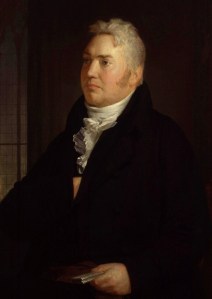
Samuel Taylor Coleridge
English
1772 – 1834


In Xanadu did Kubla Khan
A stately pleasure-dome decree:
Where Alph, the sacred river, ran
Through caverns measureless to man
Down to a sunless sea.
So twice five miles of fertile ground
With walls and towers were girdled round:
And there were gardens bright with sinuous rills,
Where blossomed many an incense-bearing tree;
And here were forests ancient as the hills,
Enfolding sunny spots of greenery.

But oh! that deep romantic chasm which slanted
Down the green hill athwart a cedarn cover!
A savage place! as holy and enchanted
As e’er beneath a waning moon was haunted
By woman wailing for her demon-lover!
And from this chasm, with ceaseless turmoil seething,
As if this earth in fast thick pants were breathing,
A mighty fountain momently was forced:
Amid whose swift half-intermitted burst
Huge fragments vaulted like rebounding hail,
Or chaffy grain beneath the thresher’s flail:
And ‘mid these dancing rocks at once and ever
It flung up momently the sacred river.
Five miles meandering with a mazy motion
Through wood and dale the sacred river ran,
Then reached the caverns measureless to man,
And sank in tumult to a lifeless ocean:
And ‘mid this tumult Kubla heard from far
Ancestral voices prophesying war!
The shadow of the dome of pleasure
Floated midway on the waves;
Where was heard the mingled measure
From the fountain and the caves.
It was a miracle of rare device,
A sunny pleasure-dome with caves of ice!

A damsel with a dulcimer
In a vision once I saw:
It was an Abyssinian maid,
And on her dulcimer she played,
Singing of Mount Abora.
Could I revive within me
Her symphony and song,
To such a deep delight ‘twould win me,
That with music loud and long,
I would build that dome in air,
That sunny dome! those caves of ice!
And all who heard should see them there,
And all should cry, Beware! Beware!
His flashing eyes, his floating hair!
Weave a circle round him thrice,
And close your eyes with holy dread,
For he on honey-dew hath fed,
And drunk the milk of Paradise.

Last Day of Leave

We present this work in honor of Veterans’ Day.

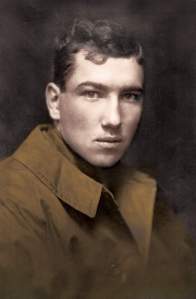
Robert Graves
English
1895 – 1985


We five looked out over the moor
At rough hills blurred with haze, and a still sea:
Our tragic day, bountiful from the first.

We would spend it by the lily lake
(High in a fold beyond the farthest ridge),
Following the cart-track till it faded out.

The time of berries and bell-heather;
Yet all that morning nobody went by
But shepherds and one old man carting turfs.

We were in love: he with her, she with him,
And I, the youngest one, the odd man out,
As deep in love with a yet nameless muse.

No cloud; larks and heath-butterflies,
And herons undisturbed fishing the streams;
A slow cool breeze that hardly stirred the grass.

When we hurried down the rocky slope,
A flock of ewes galloping off in terror,
There shone the waterlilies, yellow and white.

Deep water and a shelving bank.
Off went our clothes and in we went, all five,
Diving like trout between the lily groves.

The basket had been nobly filled:
Wine and fresh rolls, chicken and pineapple—
Our braggadocio under threat of war.

The fire on which we boiled our kettle
We fed with ling and rotten blackthorn root;
And the coffee tasted memorably of peat.

Two of us might stray off together
But never less than three kept by the fire,
Focus of our uncertain destinies.

We spoke little, our minds in tune—
A sigh or laugh would settle any theme;
The sun so hot it made the rocks quiver.

But when it rolled down level with us,
Four pairs of eyes sought mine as if appealing
For a blind-fate-aversive afterword:—

‘Do you remember the lily lake?
We were all there, all five of us in love,
Not one yet killed, widowed or broken-hearted.’

To the Virgins, to Make Much of Time

In honor of Guy Fawkes Night, we present this work by one of 17th century England’s most beloved poets.

Robert Herrick
English
1591 – 1674


Gather ye Rose-buds while ye may,
Old Time is still a-flying:
And this same flower that smiles to day,
To morrow will be dying.

The glorious Lamp of Heaven, the Sun,
The higher he’s a getting;
The sooner will his Race be run,
And neerer he’s to Setting.

That Age is best, which is the first,
When Youth and Blood are warmer;
But being spent, the worse, and worst
Times, still succeed the former.

Then be not coy, but use your time;
And while ye may, go marry:
For having lost but once your prime,
You may forever tarry.

La Belle Dame Sans Merci

We present this work in honor of the poet’s 225th birthday.

John Keats
English
1795 – 1821


Ah, what can ail thee, wretched wight,
Alone and palely loitering?
The sedge is withered from the lake,
And no birds sing.

Ah, what can ail thee, wretched wight,
So haggard and so woe-begone
The squirrel’s granary is full,
And the harvest’s done.

I see a lily on thy brow
With anguish moist and fever dew,
And on thy cheek a fading rose
Fast withereth too.

I met a lady in the meads,
Full beautiful, a faery’s child:
Her hair was long, her foot was light,
And her eyes were wild.

I set her on my pacing steed,
And nothing else saw all day long;
For sideways would she lean, and sing
A faery’s song.

I made a garland for her head,
And bracelets too, and fragrant zone;
She looked at me as she did love,
And made sweet moan.

She found me roots of relish sweet,
And honey wild, and manna dew,
And sure in language strange she said,
“I love thee true!”

She took me to her elfin grot,
And there she gazed and sighed deep,
And there I shut her wild, sad eyes—
So kissed to sleep.

And there we slumbered on the moss,
And there I dreamed, ah! woe betide,
The latest dream I ever dreamed
On the cold hill side.

I saw pale kings, and princes too,
Pale warriors, death-pale were they all;
Who cried—“La belle Dame sans merci
Hath thee in thrall!”

I saw their starved lips in the gloam,
With horrid warning gaped wide,
And I awoke and found me here,
On the cold hill side.

And that is why I sojourn here,
Alone and palely loitering,
Though the sedge is withered from the lake,
And no birds sing.