Lines to a Parrot

We present this work in honor of the poet’s 260th birthday.
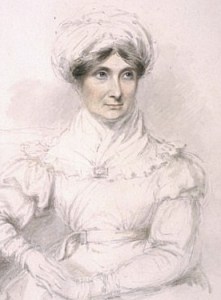
Joanna Baillie
Scots
1762 – 1851


In these our days of sentiment
When youthful poets all lament
Some dear lost joy, some cruel maid;
Old friendship changed and faith betrayed;
The world’s cold frown and every ill
That tender hearts with anguish fill;
Loathing this world and all its folly,
In lays most musical and melancholy,–
Touching a low and homely string,
May poet of a Parrot sing
With dignity uninjured? say!–
No; but a simple rhymester may.
Well then, I see thee calm and sage,
Perched on the summit of thy cage,
With broad, hooked beak and plumage green,
Changing to azure in the light,
Gay pinions tipped with scarlet bright,
And, strong for mischief, use or play,
Thick talons, crisped with silver grey,–
A gallant bird, I ween!
What courtly dame, for ball-room drest–
What gartered lord in silken vest–
On wedding morn what country bride
With groom bedizened by her side–
What youngsters in their fair-day geer,
Did ever half so fine appear?
Alas! at ball, or, church, or fair,
Were ne’er assembled visions rare
Of moving creatures all so gay
As in thy native woods, where day
In blazing torrid brightness played
Through checkered boughs and gently made
A ceaseless morris-dance of sheen and shade!
In those blest woods, removed from man,
Thy early being first began,
‘Mid gay compeers, who, blest as thou,
Hopped busily from bough to bough,
Robbing each loaded branch at pleasure
Of berries, buds and kerneled treasure;
Then rose aloft with outspread wing,
Then stooped on flexile twig to swing,
Then coursed and circled through the air,
Mate chasing mate, full many a pair.
It would have set one’s heart a dancing
To ‘ve seen their varied feathers glancing,
And thought how many happy things
Creative Goodness into being brings.
But now how changed! it is thy doom
Within a walled and windowed room
To hold thy home, and (all forgot
The traces of thy former lot),
Clutching the wires with progress slow,
Still round and round thy cage to go.
Or cross the carpet:–altered case!
This now is all thy daily travel’s space.
Yet here thou art a cherished droll,
Known by the name of Pretty Poll;
Oft fed by lady’s gentle hand
With sops and sugar at command,
And sometimes too a nut or cherry,
Which in thy claws to beak and eye
Thou seemest to raise right daintily,
Turning it oft, as if thou still
Wert scanning it with cautious skill,
Provoking urchins near to laughter loud and merry.
See, gathered round, a rosy band,
With eager upcast eyes they stand,
Marking thy motions and withal
Delighting on thy name to call;
And hear, like human speech, reply
Come from thy beak most curiously.
They shout, they mowe, they grin, they giggle,
Clap hands, hoist arms, and shoulders wriggle;
O here, well may we say or sing,
That learning is a charming thing!
For thou, beneath thy wire-wove dome,
A learned creature hast become;
And hast, by dint of oft repeating,
Got words by rote, the vulgar cheating
Which, once in ten times well applied,
Are to the skies with praises cried.
So lettered dunces oft impose
On simple fools their studied prose.
Aye; o’er thy round though unwigged head,
Full many a circling year has sped,
Since thou kept terms within thy college,
From many tutors, short and tall,
In braid or bonnet, cap or caul,
Imbibing wonderous stores of seeming knowledge.
And rarely Bachelor of Arts
Or Master (dare we say it?) imparts
To others such undoubted pleasure
From all his stores of classic treasure:
And ladies sage, whose learned saws
To cognoscenti friends give laws,
Rarely, I trow, can so excite
A listening circle with delight.
And rarely their acquirements shine
Through such a lengthened course as thine.
The grannums of this group so gay,
Who round thee now their homage pay,
Belike have in such youthful glee,
With admiration gazed on thee;
And yet no wrinkled line betrays
The long course of thy lengthened days,
Thy bark of life has kept afloat
As on a shoreless sea, where not
Or change or progress may be traced;
Time hath with thee been leaden-paced.
But ah! proud beauty, on whose head
Some three-score years no blight hath shed,
Untoward days will come at length,
When thou, of spirit reft and strength,
Wilt mope and pine, year after year,
Which all one moulting-time appear,
And this bright plumage, dull and rusty,
Will seem neglected shrunk and dusty,
And scarce a feather’s rugged stump
Be left to grace thy fretted rump.
Mewed in a corner of thy home,
Having but little heart to roam,
Thou’lt wink and peer–a wayward elf,
And croon and clutter to thyself,
Screaming at visitors with spite,
And opening wide thy beak to bite.
Yet in old age still wilt thou find
Some constant friend thy wants to mind,
Whose voice thou’lt know, whose hand thou’lt seek,
Turning to it thy feathered cheek;
Grateful to her though cross and froward
To all beside, and it will go hard
But she will love thee, even when life’s last goal
Thou’st reached, and call thee still her Pretty Poll.
Now from these lines, young friends, I know
A lesson might be drawn to shew
How, like our bird, on life’s vain stage,
Pass human childhood, prime and age:
But conned comparisons, I doubt,
Might put your patience to the rout,
And all my pains small thanks receive,
So this to wiser folks leave.

Gracefully She Approached

Simin Behbahani
Persian
1927 – 2014


Gracefully she approached,
in a dress of bright blue silk;
With an olive branch in her hand,
and many tales of sorrows in her eyes.
Running to her, I greeted her,
and took her hand in mine:
Pulses could still be felt in her veins;
warm was still her body with life.

“But you are dead, mother”, I said;
“Oh, many years ago you died!”
Neither of embalmment she smelled,
Nor in a shroud was she wrapped.

I gave a glance at the olive branch;
she held it out to me,
And said with a smile,
“It is the sign of peace; take it.”

I took it from her and said,
“Yes, it is the sign of…”, when
My voice and peace were broken
by the violent arrival of a horseman.
He carried a dagger under his tunic
with which he shaped the olive branch
Into a rod and looking at it
he said to himself:
“Not too bad a cane
for punishing the sinners!”
A real image of a hellish pain!
Then, to hide the rod,
He opened his saddlebag.
in there, O God!
I saw a dead dove, with a string tied
round its broken neck.

My mother walked away with anger and sorrow;
my eyes followed her;
Like the mourners she wore
a dress of black silk.

Translation by Mahmud Kianush

The Town

Karen Gershon
German
1923 – 1993


I did not want to feel at home
of what importance was the town
my family were driven from
how could I still have thought it mine
I have four children why should I
expend my love on stones and trees
of what significance were these
to have such power over me

As stones and trees absorb the weather
so these had stored my childhood days
and from a million surfaces
gave back my father and my mother
my presence there was dialogue
how could I have refused to answer
when my own crippled childhood broke
from streets and hillsides like a dancer

Work

We present this work in honor of Labor Day.

Eliza Cook
English
1818 – 1889


Work, work, my boy, be not afraid;
Look labor boldly in the face;
Take up the hammer or the spade,
And blush not for your humble place.

There’s glory in the shuttle’s song;
There’s triumph in the anvil’s stroke;
There’s merit in the brave and strong
Who dig the mine or fell the oak.

The wind disturbs the sleeping lake,
And bids it ripple pure and fresh;
It moves the green boughs till they make
Grand music in their leafy mesh.

And so the active breath of life
Should stir our dull and sluggard wills;
For are we not created rife
With health, that stagnant torpor kills?

I doubt if he who lolls his head
Where idleness and plenty meet,
Enjoys his pillow or his bread
As those who earn the meals they eat.

And man is never half so blest
As when the busy day is spent
So as to make his evening rest
A holiday of glad content.

Dreams

We present this work in honor of the 120th anniversary of the poet’s death.

Mathilde Wesendonck
German
1828 – 1902


Say, what wondrous dreams are these
Embracing all my senses,
That they have not, like bubbles,
Vanished to a barren void?

Dreams, that with every hour
Bloom more lovely every day,
And with their heavenly tidings
Float blissfully through the mind!

Dreams, that with glorious rays
Penetrate the soul,
There to paint an eternal picture:
Forgetting all, remembering one!

Dreams, as when the Spring sun
Kisses blossoms from the snow,
So the new day might welcome them
In unimagined bliss,

So that they grow and flower,
Bestow their scent as in a dream,
Fade softly away on your breast
And sink into their grave.

Translation by Richard Stokes

The Melodies of Forest and Light

We present this work in honor of the Turkish holiday, Victory Day.

Lale Müldür
Turkish
b. 1956


to Ömer

For it is written of them, they will not believe
even a voice from out of the grave
“I, Lazarus, have come from the dead.”
Transfiguration!
The Holy Prophets Adam, Noah, Abraham, and Jesus
As a race that comes from one another!
Those who did not see Elijah in John the Baptist
How could they ever see Muhammed, Moses, Jesus, each Holy Prophet,
A wretch whose every journey begins from the desert
One who suffers, one who is always about to be killed!
Pitiful human being!
Who does not hear the melodies of forest and light
Whose eyes are veiled by arrogance
Who mutters delusions of infinity
Who builds castles and houses,
as though to dwell there to infinity
Even the disciples
Wanting to build a tabernacle of leaves
For Moses, Elijah, and Jesus
meeting on the mountaintop
They were nothing but uncomprehending servants
O those who take themselves seriously!
Integrals of arrogance!
For it is written, they will not
believe even a voice from out of the grave

“I, Lazarus, have come from the dead”
And the disciples saw
Jesus turn to light
His garments transfigure in a weird whiteness.
Jezebel’s hatred and Elijah
Herodias’ hatred and John
The Jews’ hatred and Jesus
Prophets!
Rough drafts of one another!
Melodies of forest and light!
Behold a swan,
For you,
Splitting into particles of light!

from Schweigt Stille, Plaudert Nicht

Christiana Mariana von Ziegler
German
1695 – 1760


Father sir, but do not be so harsh!
If I couldn’t, three times a day,
be allowed to drink my little cup of coffee,
in my anguish I will turn into
a shriveled-up roast goat.

Ah! How sweet coffee tastes,
more delicious than a thousand kisses,
milder than muscatel wine.
Coffee, I have to have coffee,
and, if someone wants to pamper me,
ah, then bring me coffee as a gift!

A Ballad of Religion and Marriage

We present this work in honor of Women’s Equality Day.

Amy Levy
English
1861 – 1889


Swept into limbo is the host
Of heavenly angels, row on row;
The Father, Son, and Holy Ghost,
Pale and defeated, rise and go.
The great Jehovah is laid low,
Vanished his burning bush and rod—
Say, are we doomed to deeper woe?
Shall marriage go the way of God?

Monogamous, still at our post,
Reluctantly we undergo
Domestic round of boiled and roast,
Yet deem the whole proceeding slow.
Daily the secret murmurs grow;
We are no more content to plod
Along the beaten paths—and so
Marriage must go the way of God.

Soon, before all men, each shall toast
The seven strings unto his bow,
Like beacon fires along the coast,
The flame of love shall glance and glow.
Nor let nor hindrance man shall know,
From natal bath to funeral sod;
Perennial shall his pleasures flow
When marriage goes the way of God.

Grant, in a million years at most,
Folk shall be neither pairs nor odd—
Alas! we sha’n’t be there to boast
“Marriage has gone the way of God!”

I Live, I Die, I Burn, I Drown

Louise Labé
French
c. 1524 – 1566


I live, I die, I burn, I drown
I endure at once chill and cold
Life is at once too soft and too hard
I have sore troubles mingled with joys

Suddenly I laugh and at the same time cry
And in pleasure many a grief endure
My happiness wanes and yet it lasts unchanged
All at once I dry up and grow green

Thus I suffer love’s inconstancies
And when I think the pain is most intense
Without thinking, it is gone again.

Then when I feel my joys certain
And my hour of greatest delight arrived
I find my pain beginning all over once again.


Translation by Delmira Agustini