When spring escapes freed from being huddled in winter’s sleep, the birds that had been stilled burst into song. The buds that had been hidden burst into flower. The mountains are so thickly forested that we cannot reach the flowers and the flowers are so tangled with vines that we cannot pick them. When the maple leaves turn scarlet on the autumn hills, it is easy to gather them and enjoy them. We sigh over the green leaves but leave them as they are. That is my only regret– so I prefer the autumn hills.
We present this work in honor of the Japanese holiday, Constitution Memorial Day.
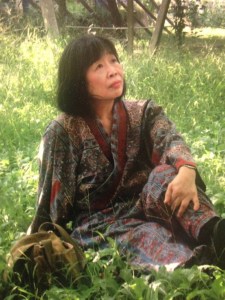
Chimako Tada Japanese 1930 – 2003
Finally after half a century, a clearly observable law has been found: For mankind, all matters proceed Along geometric lines
(If you put one grain of rice on the first intersection of a game board, two grains of rice on the second, four grains of rice on the third, and continue along these lines, what vast quantities will you have by the time the board is covered? When the ancient king was told the answer, how surprised he was…)
By the time I realized what was happening, I was clinging to the earth So I would not be shaken off as it spun with ever greater speed My hair, dyed in two parts with night and day, had come loose (Yet still I toyed with dice in one hand)
As it turns, it is stripped page by page like a calendar pad growing thin A cabbage growing small, shorn of leaves before our eyes Once, this planet had plenty of moisture (But that was in the days when those things that now belong to dead languages – Things such as dawn, looks, and smiles – were still portents of things to come) That’s right, for mankind, all matters proceed along geometric lines
Four and a half more centuries into the future The shriveled brain that revolves Rattling in the cranium’s hollow will grow still Like the pale eye of a hurricane
All will see its resolution in those moments As the rolling dice tumble, turning up their black eyes Then finally coming to a halt
We present this work in honor of the poet’s 320th birthday.
Jean Adam Scots 1704 – 1765
And are ye sure the news is true? And are ye sure he’s weel? Is this a time to talk o’ wark? Ye jades, fling by your wheel! Is this a time to think o’ wark, When Colin’s at the door? Gie me my cloak! I’ll to the quay, And see him come ashore.
For there’s nae luck aboot the hoose, There’s nae luck ava’; There’s little pleasure in the hoose, When our gudeman’s awa’.
Rise up, and mak a clean fire-side, Put on the muckle pot; Gie little Kate her cotton gown, And Jock his Sunday coat; And make their shoon as black as slaes, Their hose as white as snaw; It’s a’ to please my ain gudeman, He likes to see them braw.
For there’s nae luck aboot the hoose, There’s nae luck ava’; There’s little pleasure in the hoose, When our gudeman’s awa’.
There are twa hens upon the bauk, ‘Been fed this month and mair, Make haste and thraw their necks aboot, That Colin weel may fare; And spread the table neat and clean, Gar ilka thing look braw; It’s a’ to pleasure our gudeman, For he’s been lang awa’.
For there’s nae luck aboot the hoose, There’s nae luck ava’; There’s little pleasure in the hoose, When our gudeman’s awa’.
Come gie me down my bigonets, My bishop-satin gown; And rin and tell the Bailie’s wife That Colin’s come to town; My Sunday sheen they maun gae on, My hose o’ pearl blue, It’s a’ to please my ain gudeman, For he’s baith leal and true.
For there’s nae luck aboot the hoose, There’s nae luck ava’; There’s little pleasure in the hoose, When our gudeman’s awa’.
Sae true his words, sae smooth his speech, His breath like caller air, His very foot has music in’t, When he comes up the stair: And will I see his face again? And will I hear him speak? I’m downright dizzie wi’ the thought, In troth I’m like to greet!
For there’s nae luck aboot the hoose, There’s nae luck ava’; There’s little pleasure in the hoose, When our gudeman’s awa’.
The cauld blasts o’ the winter wind, That thrilled through my heart. They’re a’ blawn by; I hae him safe, ‘Till death we’ll never part; But what puts parting in my mind? It may be far awa; The present moment is our ain. The niest we never saw!
For there’s nae luck aboot the hoose, There’s nae luck ava’; There’s little pleasure in the hoose, When our gudeman’s awa’.
Since Colin’s weel, I’m weel content, I hae nae mair to crave; Could I but live to make him blest, I’m blest aboon the lave; And will I see his face again? And will I hear him speak? I’m downright dizzie wi’ the thought, In troth I’m like to greet!
For there’s nae luck aboot the hoose, There’s nae luck ava’; There’s little pleasure in the hoose, When our gudeman’s awa’.
We present this work in honor of the Italian holiday, Liberation Day.
Elisa Biagini Italian b. 1970
You show me your wounds, as a soldier, your battle with another you who’s consuming you the eyes, the bones the skin who cut your tendons a while ago, the thread that keeps you all together, diver who doesn’t surface.
Driving across town she feels plain and botanical.
At a crossing there’s a man with a cake, girl with a tune. Four young people wheel a bed, headed for a house where a young woman might read, love a man/some men, might hold their bodies close and welcome some parts of those bodies into hers.
Years later she might see these men in suits and on television and many years later might pass one, a house painter, as she drives to buy paint, for heaven’s sake.
Now, nearing sixty, this woman loves her husband ferociously. When she turns the compost and finds the flat wrinkled body of a mouse, she remembers the time he rang her in Scotland to say he’d seen one in the pile and what should he do?
She shovels the remains of the mouse with the rest of the compost to beneath the blossom, which bows low and graceful over neglect, which abounds, as it does, wonderfully, in the garden of the southern house they move to for a time.
He’s up to his ears in sadness, both of them aghast at landscape. Being asthmatic he is immediately attractive to animals – at the lake a fox terrier pup takes shelter under his chest as he lies down on a towel after a swim. In the kitchen a mouse bumps into his foot. Drama in the house! Not for the first time. These were rooms of costume, scenery, leading ladies and men on the front terrace, leaning on architect Ernst Plischke’s rail, stone warm underfoot, snowed mountains as backdrop while the deep, broad river passed below them, always on its way.
Soon… Very soon, my friend… We will discover that all the optimists Are insane more than any absurdity. In your dreams… just as in every morning… You arrange your dreams Like precious furniture devices; A bramble vase here… A velvet, dull sofa there… Some fingers missing around. Oh, Farida! Did you have to take the flowers out of the window? Sprinkle the salt all over the place? This heart cannot anymore grumble… The basil in my mother’s garden just withered. Outside the bells toll… For another last Last Supper. You arrange your dreams… Again Here… There. Again It is the wandering spirit Since the blooming of first spring flowers
when will we live like that again? first there was a city with its moons and cars lawless comets and such discontinuous delight that even going for a walk around the galaxy was icecream in the park, sweet momentum like a scattering of stars arriving to read the book of tears to a crowd expecting opera what next but the caduceus, dazed imperatives wrapped about a talking stick face to face and turn by turn reared back to flap the wings of vision overhead after this the lily with its open mouth and ribbon spathes bumpy erogeny bespeaking the immaculate shape of things to come
We present this work in honor of the 165th anniversary of the poet’s death.
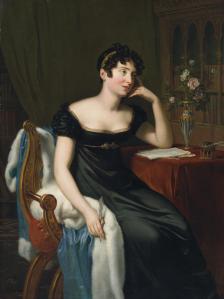
Sydney, Lady Morgan Irish 1781 – 1859
I.
And must I, ghastly guest of this dark dwelling, Pale, senseless tenant must I come to this; And shall this heart congeal, now warmly swelling To woe’s soft langour, rapture’s melting bliss!
II.
And must this pulse that beats to joy’s gay measure, Throbbing with bloomy health, this pulse lie still; And must each sense alive to guileless pleasure, Torpid resist the touch of transport’s thrill?
III.
And must each sensate feeling too decay, (Each feeling anguished by another’s sorrow,) This from that blushes youth and health to-day, Lie cold and senseless thus, like thee, to-morrow?
IV.
Terrific Death! to shun thy dreaded pow’r, Who would not brave existence’ direst strife? But that beyond thy dark shade’s gloomy low’r, Faith points her vista to eternal life!





 Poets Corner