Long-felt desires, hopes as long as vain—
sad sighs—slow tears accustomed to run sad
into as many rivers as two eyes could add,
pouring like fountains, endless as the rain—
cruelty beyond humanity, a pain
so hard it makes compassionate stars go mad
with pity: these are the first passions I’ve had.
Do you think love could root in my soul again?
If it arched the great bow back again at me,
licked me again with fire, and stabbed me deep
with the violent worst, as awful as before,
the wounds that cut me everywhere would keep
me shielded, so there would be no place free
for love. It covers me. It can pierce no more.
In honor of the Turkish holiday, Victory Day, we present this work by one of modern Turkey’s most poignant authors.
Nilgun Marmara Turkish 1958 – 1987
My bird and I are fast asleep
reflected in a mirror, our cage our bed
our visages reflecting that of one another
we sleep beneath the eternally falling snow
my bird and I.
A crimson ribbon binds us – my mate and I
indelibly together.
Destitution would delight in its severance.
In our mirror there’s naught beyond this bond…
This crimson tie between us – my mate my bird and I…
“I’ve come to take you home –
home, remember the veld?
the lush green grass beneath the big oak trees
the air is cool there and the sun does not burn.
I have made your bed at the foot of the hill,
your blankets are covered in buchu and mint,
the proteas stand in yellow and white
and the water in the stream chuckle sing-songs
as it hobbles along over little stones.
I have come to wretch you away –
away from the poking eyes
of the man-made monster
who lives in the dark
with his clutches of imperialism
who dissects your body bit by bit
who likens your soul to that of Satan
and declares himself the ultimate god!
I have come to soothe your heavy heart
I offer my bosom to your weary soul
I will cover your face with the palms of my hands
I will run my lips over lines in your neck
I will feast my eyes on the beauty of you
and I will sing for you
for I have come to bring you peace.
I have come to take you home
where the ancient mountains shout your name.
I have made your bed at the foot of the hill,
your blankets are covered in buchu and mint,
the proteas stand in yellow and white –
I have come to take you home
where I will sing for you
for you have brought me peace.”
The first decade – I learnt to wipe my nose
Wipe my feet before entering the house
After a walk in the rain or on snow
The second decade – I learned to put on lipstick
Look in the mirror before
Leaving the house
Look at a boy without letting him know
I was looking
Look like a lady without letting Mama know
I felt all womanish inside
The third decade – I learned to wipe other people’s noses
And love it
I learned to put another’s interest before mine
Love and duty were but two sides of the same coin
Complain?
Me?
What did I have to complain about?
I was fulfilled! Grown up, married, with children and all,
A roof over my head. A boiling pot on the stove
And a man who told me, at least twice a day,
He worshipped the ground I walked on!
Yes, sometimes, very late at night, he reminded me
How much he loved me –
Very, very, very late at night; when the children were
Fast asleep.
When all the dishes were sparkling clean
When the floor was swept free of all toys,
Dusted, and wiped free of meddlesome footprints
Yes, sometimes, late at night, he reminded me
For the third time that day, how much
He loved me.
The fourth decade – I watched my own children,
My daughters, make goo-goo eyes at boys
When they thought my eyes were closed
My ears deaf as stone
They whispered tingly secrets; made subtly suggestive
Gestures. Amused, I watched it all – thought, inside,
I sighed; amused to see the pattern repeat itself. Oh, my
God!
Embarrassed, I remembered my own naïve assumption of
My mother’s blindness
The fifth decade – there was no denying it – my children
Were grown. Yes, they were my children; but they,
Definitely, were no longer children!
Did this mean I was old?
How could it be – when had that happened?
I was just discovering my essence!
Discovering joyful living sans fear of pregnancy,
Sin or ridicule! It was in such ecstatic sensuousness
I entered
The sixth decade – let no one misguide you,
The fifties are for fleshly fulfillment, sinful
Delight, and sprightly goings on. Now, at last,
I knew all there was to know about life.
I’d even made it, from scratch, myself
Gave it flesh, blood, and bone
Knit and bled it into being,
Nurtured it to healthy maturity.
The seventh decade – I learned to live with loss
A huge hole came to live in my heart
But I learned to understand this:
The loss is as big as the love. I suffer
Greatly for I have greatly loved
I am grateful for the love that was mine.
I suffer, but I could not have asked for less.
The eighth decade – I learned to live with
Fewer and fewer friends
Fewer and fewer visits from my children
As their own lives grew fuller and fuller
I love the four walls I call home
I love the skin that houses the bones I call my body
I love the people who, a long time ago,
Were my children
I look at their clean noses and know
I have lived a good life. Look. Just look!
How they truly no longer need me!
The ninth decade – I will learn the meaning of hours
For time is short, each hour more precious, therefore!
The journey is definitely longer behind me
The road ahead lifts with joy as I see
Footsteps painted a bright and
Joyful gold!
Without a doubt, I know, those are the footsteps
Love has made.
Mine has been a long life – rich in experience.
But now, looking back, I see all those brilliant
Moments in my life are moments of loving,
Of giving to others. These are moments
When I transcended the self and its
Imperious demands. When I was for
Another – whatever it was they needed
To go one step forward: wife, friend;
Mother; neighbour; daughter; sister ; or
Stranger!
Yes, I can see: I have been a good citizen, a decent
Human being.
Now, I am eighty years old – I hope I still have
Time enough to catch up!
Pass me that damn bottle of wine, will you?
We present this work in honor of Women’s Equality Day.
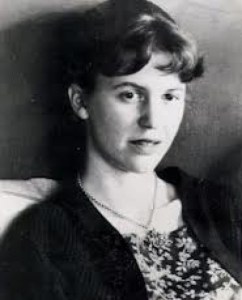
Sylvia Plath American 1932 – 1963
All day she plays at chess with the bones of the world:
Favored (while suddenly the rains begin
Beyond the window) she lies on cushions curled
And nibbles an occasional bonbon of sin.
Prim, pink-breasted, feminine, she nurses
Chocolate fancies in rose-papered rooms
Where polished highboys whisper creaking curses
And hothouse roses shed immortal blooms.
The garnets on her fingers twinkle quick
And blood reflects across the manuscript;
She muses on the odor, sweet and sick,
Of festering gardenias in a crypt,
And lost in subtle metaphor, retreats
From gray child faces crying in the streets.
In honor of Janmashtami, we present this work by one of contemporary India’s great poets.
Ashitha Indian 1956 – 2019
Blue is not the colour, nor is snowy- white or sun-licked grey.
I paint the sky with water.
The tear.
The colour of solitude brewing in the eyes of a half-dead widow
The outcast.
The color of fear stuck in the eyes of fish lings abandoned by the oceans
The homeless.
The color of quivering silence screaming in the veins of trees uprooted
The wingless.
The color of screams rolling down from the eyes of new-borns denied air
The neglected.
The color of fear boiling under the nerves of those who venture out in the dark
The powerless.
I paint the earth too with water.
The color is tear.
Mind you
If love has a hue, it’s not rose-pink or blood-red
If hope has a hue, it’s not lemon-yellow or chilli-red
If happiness has a hue, it’s not leaf-green or sea-blue If grief has a hue, it’s not black as you
thought
Let me tell you, everything in the world is tinted with a tear-hue
The watery hue
For, rain is a painting perfect for a world soaked in sorrow.
For, sky is a canvas
Painted with grief.
I grow time, beans, the colour gray
And stitch the shadows of a dying day
They make a woman, rather a girl
Lost in the ocean like a grain of pearl
The swans of Coole fly over me
Will they rest for a while by me!
Maybe it’s my turn now.
Deep in the frost where my eyes shall never go
The leopard will print his paw
And with a sudden leap break free
All the chimes of poetry
Maybe it’s my turn now.
The rough beast was never born
Though we devised a cage for his morn
Maybe it’s my turn now.
I have a tale to tell I shall also ring the bell
When you start believing
When you start hearing
Maybe it’s my turn now.
2.
These days I don’t think of you
But after the soot covers me
I begin to wonder where those
Evenings have gone, those wanderings
In the spacious lawns of enchantment
That smacked of no design, though
We were bent on making a sense
The early birds get their worms
I lie in the tireless ticking of my old watch
Counting the bits of frozen blood,
Listening to the worms
That are in all of us
Then I begin to crawl towards the womb
That threw me off a long way back
And look for the dark, the black hole
To suck me up.
3.
I was nice to him
He was nice to me
Only
Our doors, our windows
Kept closed
Lest we smell each other.
We present this work in honor of the poet’s 115th birthday.
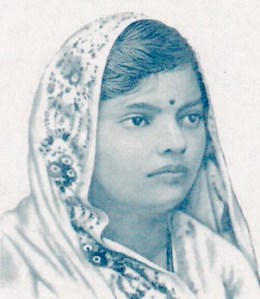
Subhadra Kumari Chauhan Indian 1904 – 1948
The throne was shaken and tensions rose among the Raajvanshs, the royal heirs,
In aged India, new ideas were taking hold,
The people of all India lamented their lost freedom,
And decided to cast off British rule,
Old swords glittered anew as the freedom movement of 1857 started.
The Bandelas and Harbolas sang once again of the courage of the Queen of Jhansi,
How she fought like a man against the British intruders
So was the Queen of Jhansi.
She was as dear to the Nana (Nana Ghunghupant) of Kanpur as his real sister,
Laxmibai was her name, her parents only daughter
She’d been with Nana since her schoolgirl days
The spear, knife, sword, and axe were her constant companions.
She knew by heart the tales of valor of Shivaji
The Bandelas and Harbolas sang once again of the courage of the Queen of Jhansi,
How she fought like a man against the British intruders
So was the Queen of Jhansi.
None were sure, was she Laxmi or Durga devi or Devi durga reincarnate?
The people of Marathward were awed by her (expertise) skill with the sword,
They learned from her how to fight, the strategy of war,
To attack and humiliate the enemy were her favorite sports.
Her love for Maharashatra-kul-Devi was equaled only by her love for Bhavani.
The Bandelas and Harbolas sang once again of the courage of the Queen of Jhansi,
How she fought like a man against the British intruders,
So was the Queen of Jhansi.
Laxmibai was married in Jhansi, with great jubilation
Entering the joyous city as Queen,
Grand celebrations were held in the palace in Jhansi, in honor of her coming.
Just as when Chitra met Arjun or Shiv had found his beloved Bhavani.
The Bandelas and Harbolas sang once again of the courage of the Queen of Jhansi,
How she fought like a man against the British intruders,
So was the Queen of Jhansi.
Her presence was a blessing at the palace of Jhansi and candles of celebration burned long
But as days passed the dark clouds of misfortune overshadowed the royal palace.
She put aside her bangles and prepared for battle
For fate was unkind and made her a widow
Grief stricken she was, with no heir for her king,
The Bandelas and Harbolas sang once again of the courage of the Queen of Jhansi,
How she fought like a man against the British intruders,
So was the Queen of Jhansi.
The candlelit hope of Jhansi had died and Dalhousie was overjoyed at his luck.
He’d long awaited the time to usurp this kingdom
He sent his solders to Citadel and raised the flag of Britain on the royal palace,
British rule came to Jhansi as a guardian comes to an orphan,
While with tear filled eyes the Rani watched as her city became deserted.
The Bandelas and Harbolas sang once again of the courage of the Queen of Jhansi,
How she fought like a man against the British intruders,
So was the Queen of Jhansi.
Despotic kings used flattery and lies
And came to India disguised as poor merchants
Dalhousi exerted his power, ill-gotten, and changed the fate of India,
Insulting all of India’s leaders, without exception.
The Queen played the part of a maidservant, but truly she was still the Queen,
The Bandelas and Harbolas sang once again of the courage of the Queen of Jhansi,
How she fought like a man against the British intruders,
So was the Queen of Jhansi.
The capital Delhi fell, followed by the fall of Lucknow,
Peshwa was imprisoned in Bithur and the Nagpur tragedy occurred.
And after the fall of Nagpur, Udaipur, Tanjore satara, and Karnatak fell quickly at the hands of the intruders.
The British already had control of Sindh, Punjab and Assam.
It was the same sad tale for Bengal,Madras and many other states.
The Bandelas and Harbolas sang once again of the courage of the Queen of Jhansi,
How she fought like a man against the British intruders
So was the Queen of Jhansi.
Feeling sick with helplessness the Rani wept bitterly for her beloved India.
Her royal ornaments and clothes were being sold in the markets of Calcutta.
This humiliation was published in the British daily papers:
“Buy the ornaments of Nagpur, buy the Naulakha locket of Lucknow” were the highlights of this loss of honor.
This is how the honor of the royal ladies of India was sold to foreigners.
The Bandelas and Harbolas sang once again of the courage of the Queen of Jhansi,
How she fought like a man against the British intruders
So was the Queen of Jhansi.
Both the poor and the royals suffered insult and atrocity at the hands of the British rulers.
Brave soldiers of India recalled the honor of their ancestors,
The lost treasures, the names and titles of great warriors and leaders, like Ghunghupant, and Nana,
The beloved sister of Nana, Rani, the Queen, invited him to Ran-Chandi,
To awaken the sleeping, divine spirit of the Indian people, the holy war had already begun.
The Bandelas and Harbolas sang once again of the courage of the Queen od Jhnasi,
How she fought like a man against the British intruders
So was the Queen of Jhansi.
The desire for freedom was as a burning fire of revolt, from the royal palace to the poor and common folk,
This spark, which was born in the inner soul of the people.
It consumed Jhansi first, then spread in Delhi and engulfed even Lucknow,
In Merat, Kanpur and Patna, the struggle for freedom raged strong,
Which inspired the peoples of Jabalpur and Kolhapur
The Bandelas and Harbolas sang once again of the courage of the Queen of Jhansi,
How she fought like a man against the British intruders
So was the Queen of Jhansi.
In that great freedom struggle, many brave brothers lost their lives.
Among them: Nana Ghunghupant, Tantya, great Azeemullah,
And many more: Ahmedshah Moulvi, Thakur Kunwar singh, Sainik Abhiram.
Though by the British, they were considered rebels and their sacrifices a crime,
Their names will always shine in the heavens of the ancient history of India.
The Bandelas and Harbolas sang once again of the courage of the Queen of Jhansi,
How she fought like a man against the British intruders
So was the Queen of Jhansi.
Well, leave the tale of the bravery of those great men, and back to the battlefield of Jhansi
Where Laxmibai stands boldly like a man among other brave men,
Lt. Walker met her in battle, and pushed back this brave army of men,
But as Rani drew her sword, drums thundered in Heaven,
Walker retreated after Rani wounded him, astonished at her skill and agility.
The Bandelas and Harbolas sang once again of the courage of the Queen of Jhansi,
How she fought like a man against the British intruders,
So was the Queen of Jhansi.
Rani pursued Walker for hundreds of miles to the (city) of Kalpi,
Where his horse was exhausted and fell to the ground, Walker was thrown off as well.
In the field of Yamuna, Rani was defeating the British once more,
Rani pushed back the British and took control of the state of Gawalior,
The British soon left and ended their rule of Vsindia of Gawalior,
The Bandelas and Harbolas sang once again of the courage of the Queen of Jhansi,
How she fought like a man against the British intruders
So was the Queen of Jhansi.
The British army reorganized, under the command of General Smith,
And still the freedom fighters prevailed.
Rani was joined in the battle by Kaana and Mandra, and all together they fought furiously,
But, alas, when Commander Hughrose came with reinforcements,
The Rani was completely surrounded on the field.
The Bandelas and Harbolas sang once again of the courage of the Queen of Jhansi,
How she fought like a man against the British intruders,
So was the Queen of Jhansi.
Though deeply wounded, Rani still fought her way through the British army,
But alas! Rani’s horse became mired in a canal at the edge of the field of battle,
And while she struggled with the untrained animal, the British caught up with her there,
Like a lioness she fought, all alone while being attacked from all sides,
She fell mortally wounded, the glorious death of a martyr.
The Bandelas and Harbolas sang once again of the courage of the Queen of Jhansi,
How she fought like a man against the British intruders,
So was the Queen of Jhansi.
A battlefield martyr was Rani. Her departed soul was then riding a divine vehicle, moving towards heavens
Her light enjoined to the Divine, as a true heir of divinity
Only 30 years of age, she was a superhuman, she was a holy being.
In the form of a freedom fighter, she came to give us light and a noble life,
She showed us the path of freedom and taught us the lesson of courage
The Bandelas and Harbolas sang once agina of the courage of the Queen of Jhansi,
How she fought like a man against the British intruders,
So was the Queen of Jhansi.
Oh Rani Laxmibai, India will remember you forever, Blessed Rani,
Your life’s sacrifice awakens an Eternal freedom in the soul of India’s people,
History may forget, Jhansi may be destroyed,
But your name Rani, Queen of Jhansi, will be an eternal memorial of courage
The Bandelas and Harbolas sang once again of the courage of the Queen of Jhansi,
How she fought like a man against the British intruders,
So was the Queen of Jhansi.
In honor of the Moroccan holiday, Allegiance Day, we present this work by one of Morocco’s great contemporary writers.
Amina El Bakouri Moroccan b. 1969
Oswaldo
It happens that my soul quivers before your wavelike presence
So in evenings not like these evenings
My mature blossoms start budding…
It happens that towards you
Sweeping nostalgia transports me
So to your lantern-lit boulevards I rush
Seeking, amid daybreak variegations,
My grief-stricken voice…
When it laid for your veins’ itinerary,
Plans from erring poems
And moons
Oswaldo
I am no object of desire of yours…
The blades of my soul
Are overladen with racemes of light.
Smeared with the mysterious darkness from the glow of words
My hands confiscate my days
glaring with ink
that flows painfully opaque
on the breast of dreams…
Horror-stricken, I drink at the lofty heights
Whose marine dew blessings surround me
With vows of nothingness
And wild goats of whiteness…
The sky’s fibres testify
To my disobedience
And my disengagement from the sin of original disclosure…
From the pain that lurks
Behind the white sun
And the musical minaret of speech.
Oswaldo
Remember I was obedient to your deep kisses
My nights were not only ash
I would gaze at your mysterious face
preoccupied as it was with the stars’ movement
And embellished with strange songs
And poems.
Let me for a while
Comb the night’s chest
With the cooing of words…
I soar as high as the swings of your wild soul
To secretly overview the splendor of distant lands
And light a moon in the universal ink-pot
Let me, from your large, beautiful eyes, extract
The honey of the stars
And sip the nectar of your lisp
Secretly filling the carafe
Like the virgin of the dormant tribes!
Oswaldo
Suppose you are a mutilated idea
Floating in the kingdom of Air
Arranged by coincidence
To redeem yourself from hell fire…
Suppose your dreams have, forever, forsaken you
When, all at once you dreamed them
With no prior notice or time limit…
Suppose Lorca offered you
The wild mint of paper
On a furious civil war night
Will the wild mint then
Have the self-same malice of beautiful roses
On the coffin of jasmin?
Suppose Al Khanssa’
Tore up grievously the bosom of her femininty
And the eagles of her anguish fell to pieces as did Sakhr, her brother.
Will the distressed bands of sand
Send forth the same inevitable wailing
When the pigeon coos in tears
mending the patches of pain?
Oswaldo
Rarely did I whisper my erotic poems to you…
A single eyelash twitch suffices
To awaken the soul from its slumber…
To distress a flock of sand-grouses in their nests
To open the gate of probability
Towards a mutilated poem
That might wail, but never come…
Or thus whoop the falling nights!
My own night was not enough
As I stared at the same glare fading slowly into
The blossoms of speech…
Perplexed larvae ripped up on the loom of
My own killing letters.
Marble thirst beat me
With a feeble whip.
I aimed thus the spark of nostagia at your secret water…
O disdainful passer-by
Let our words fall like hail
On the jujube trees of time
Let us by means of water
Pay allegiance to the metaphor therein
So that poetry exalts in us…
Let us see the dead sea off towards its own exile
Let us wait a little…
Tell me
Why are poets first to die?
Oswaldo
Do not torture me anymore
I do not carry Diogenes’ lamp in daylight
But I may come to you
On the morrow of a dark windy day
To present a succulent laudation
That makes you shake all over
I may, with true intuition, trap you into a dilemma
And stir the fire of your open wakefulness
Or in my transparent boudoir
Shield you from the straits
Of extreme redolence
When the female
Of awesome,
Terrible,
Erring fields
Clothes herself in Sheba’s stars.
Believe me. The glass sheets
And the dew of poetry may tell lies
Amid the uproar of slammed doors.
The dazzle of glass may fool us
Like the body’s intuition
When an illusory vision
Blinds eyesight!
O passer-by
The words’ encounter has long been rare
The heat has fallen
You have long enough deceived my pain
Do not cure me with feverish silence…
The echo of water has reached the shelter of the soul
And this very night, screened by my surmise,
Adorned by my insomnia
Has sailed far away into the distance
I have but on very rare occasions whispered my repulsion.
So tell me
Why does poetry not come smoothly anymore…
Why does it not resemble truth and light anymore?
Oswaldo
A fire fiercer than the glow
Of passionate hearts
Erupts volcano-like into the ribs of words
Awakening the ecstacy of quickly receding
Rhymes!
I am no inexperienced marine woman
To be fooled by a water poem…
Or am I to blame for feeling thirsty?
So why does the choke betray
The water drinker?
Or am I to blame for profound fascination?
So why does water flow downwards
All the time?
Oswaldo
“The only good that looks like gold is… the road”
So said uncle Boulos
Once, one fleeting dawn.
Verses are ablaze on your pernicious head.
Trees now border your long foggy path.
I am not yours through any kind of belonging
And I have but unwillingly
Appointed you a guardian of my solemn pledges.
So… proceed in your visions.
The way of poetry is rather long…
Proceed adventurously… opening your arms to the wind
To the virginity of the land
The road will not mistake you
When it sees you coming far away like a cross or a martyr
The road will not mistake you
The road will not mistake you!
Busy with his ropes and gears,
tides and currents,
he didn’t know and never
will how he came to appear
scowling in our
family snapshot.
We brought him home
by accident
on a film showing
part of a holiday,
children in jerseys on the dock,
grinning, puddled in sun,
and at the edge,
the ferryman’s dark image.
Well, that’s one way
to survive,
to be captured alive
by someone, caught
by a click and locked
in a box held by an unknown
hand at an unknown hour.
Later to rise from
a chemical bath imprinted on
a glossy three-by-five
to glare
out forever,
unknowing.







 Poets Corner