Where Are We Going

We present this work in honor of International Day of the World’s Indigenous Peoples.

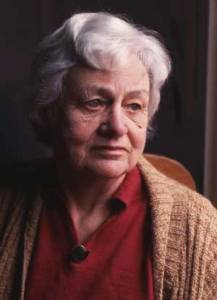
Oodgeroo Noonuccal
Australian
1920 – 1993


They came in to the little town
A semi-naked band subdued and silent
All that remained of their tribe.
They came here to the place of their old bora ground
Where now the many white men hurry about like ants.
Notice of the estate agent reads: ‘Rubbish May Be Tipped Here’.
Now it half covers the traces of the old bora ring.
‘We are as strangers here now, but the white tribe are the strangers.
We belong here, we are of the old ways.
We are the corroboree and the bora ground,
We are the old ceremonies, the laws of the elders.
We are the wonder tales of Dream Time, the tribal legends told.
We are the past, the hunts and the laughing games, the wandering camp fires.
We are the lightening bolt over Gaphembah Hill
Quick and terrible,
And the Thunderer after him, that loud fellow.
We are the quiet daybreak paling the dark lagoon.
We are the shadow-ghosts creeping back as the camp fires burn low.
We are nature and the past, all the old ways
Gone now and scattered.
The scrubs are gone, the hunting and the laughter.
The eagle is gone, the emu and the kangaroo are gone from this place.
The bora ring is gone.
The corroboree is gone.
And we are going.’

Union Square

We present this work in honor of the poet’s 135th birthday.

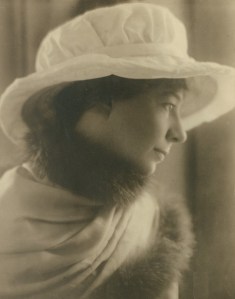
Sara Teasdale
American
1884 – 1933


With the man I love who loves me not,
I walked in the street-lamps’ flare;
We watched the world go home that night
In a flood through Union Square.

I leaned to catch the words he said
That were light as a snowflake falling;
Ah well that he never leaned to hear
The words my heart was calling.

And on we walked and on we walked
Past the fiery lights of the picture shows —
Where the girls with thirsty eyes go by
On the errand each man knows.

And on we walked and on we walked,
At the door at last we said good-bye;
I knew by his smile he had not heard
My heart’s unuttered cry.

With the man I love who loves me not
I walked in the street-lamps’ flare —
But oh, the girls who can ask for love
In the lights of Union Square.

Destiny

We present this work in honor of the 45th anniversary of the poet’s death.

Rosario Castellanos
Mexican
1925 – 1974


We kill what we love. What’s left
Was never alive.
No one else is close. What is forgotten,
What else is absent or less, hurts no one else.
We kill what we love. Enough of drawing a choked breath
Through someone else’s lung!
There is not air enough for both of us. And the earth will not hold
Both our bodies
And our ration of hope is small
And pain cannot be shared.
Man is an animal of solitudes,
A deer that bleeds as it flees
With an arrow in its side.
Ah, but hatred with its insomniac
Glass eyes; its attitude
Of menace and repose.
The deer goes to drink and a tiger
Is reflected in the water.
The deer drinks the water and the image. And becomes
-before he is devoured – (accomplice, fascinated)
his enemy.
We give life only to what we hate.

The Willing Mistress

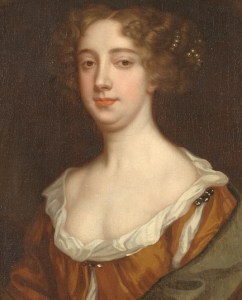
Aphra Behn
English
1640 – 1689


Amyntas led me to a Grove,
Where all the Trees did shade us;
The Sun it self, though it had Strove,
It could not have betray’d us:
The place secur’d from humane Eyes,
No other fear allows.
But when the Winds that gently rise,
Doe Kiss the yielding Boughs.

Down there we satt upon the Moss,
And id begin to play
A Thousand Amorous Tricks, to pass
The heat of all the day.
A many Kisses he did give:
And I return’d the same
Which made me willing to receive
That which I dare not name.

His Charming Eyes no Aid requir’d
To tell their softning Tale;
On her that was already fir’d
‘Twas easy to prevaile.
He did but Kiss and Clasp me round,
Whilst those his thoughts Exprest:
And lay’d me gently on the Ground;
Ah who can guess the rest?

The Crazy Woman

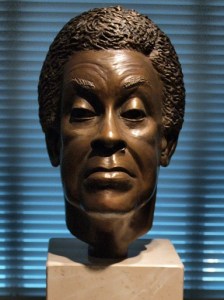
Gwendolyn Brooks
American
1917 – 2000


I shall not sing a May song.
A May song should be gay.
I’ll wait until November
And sing a song of gray.

I’ll wait until November
That is the time for me.
I’ll go out in the frosty dark
And sing most terribly.

And all the little people
Will stare at me and say,
“That is the Crazy Woman
Who would not sing in May.”

With Pure Virtue’s Hand

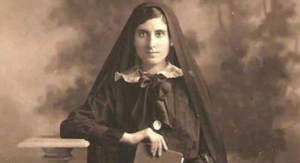
Aisha Taymur
Egyptian
1840 – 1902


With pure virtue’s hand I guard the might of my hijāb
and with faultless self-shielding, among my peers I rise
With my thoughts taking fire and my gift for sharp critique
I have brought my poet’s skills to new and perfect highs
I composed poetry expressing an assemblage:
before me, women sheltered, most noble, esteemed, wise
I uttered my verses just as light and playful speech
yet the eloquence of books and logic I much prize
Mahdī’s daughter, Laylā—these are my choice models
as with innate acuity my best thoughts I poetize
How superb these ladies are! A noble weave indeed
in women and in maidens the men do recognize
Given precious pearls of mind, a poet like Khansa’
wanders rocky paths and for a brother, frantic, cries
From the brow of my notebooks I fashioned my mirror
and of ink’s jet-black traces I created my dyes
How often my fingertip adorns my paper’s cheeks
with script’s downy touch or the skin of my youth’s sighs
The candles of my intellect sent their brilliance far,
as the scent of my words perfumed dear ones’ garden skies
Women of great splendor wrapped in shawls of logic fine:
and their envy my presence or my absence defies
In sentiment’s assembly my tresses I undid:
those of goodly lineage their symbols will surmise
The arts of my eloquence, my mind I protected:
talisman dear, hijab’s amulet: danger denies
My literature and my learning did me no harm
save in making me the finest flower of minds wise
Solitary bower, scarf’s knot, are no affliction
nor my gown’s cut nor proud and strong guarded paradise
My bashfulness, no blockade to keep me from the heights
nor could the veil’s lowering o’er my ringlets disguise
the wager’s arena though the horsemen’s ambitions
from the hardships of the race suffered demise
No! my might is my repose, my knightly prowess lies
in the beauty of my striving: finest goals I prize
Not to mention a secret whose essence is sheltered
though word spread far to strangers of its rarity and size
Like musk it is sealed in the drawers of treasuries:
but the fragrance of its sweetness spreads in saffron sighs
Or like the seas as they embraced hidden gemlike pearls:
when the hands of seekers touch, the touch will paralyze
Desiring to obtain and to have those lovely pearls,
what troubling trials these divers brave, deeds that sense defies!
World-renowned amber agreed to give pearls protection:
its nature is recited in every book one buys
So I touch my fire to the wick in the lamp of skills
granted me by holy God, gifts of the Giver Wise

Mririda

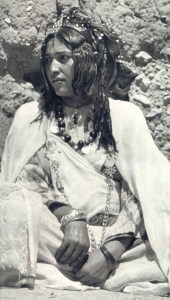
In honor of the Moroccan holiday, Enthronement, we present this work by one of the great Berber poets.

Mririda n’Ait Attik
Moroccan
c. 1900 – c. 1940’s


People called me Mririda, Mririda,
Mririda, the gaile rennet of meadows…
With eyes of gold…
But the rennet’s white chest I do not have
Nor do I have her green tunic.
Yet, like her, I have my ‘zrarit’, my ‘zrarit’
Which reach the sheep-folds
My ‘zrarit’, my ‘zrarit’
Of which people talk in the entire valley
And even on the other sides of the mountains.
My “zrarit” which marvel, which arouse desire…
Because ever since my first steps in the fields,
I slowly took the agile rennet in my hands,
And long pressed her white chest onto mine,
And then onto my maiden lips.
That is how the rennet gave me the marvelous virtue
Of the baraka which makes her sing
A song so clear, so vibrant, so pure
In the Summer nights bathed by the moon,
A song like crystal,
Like the clear noise of an anvil
In the resonant air that precedes rain…
And thanks to the gift that Mririda gave me
They call me: Mririda, Mririda…
He who takes me will feel
My heart beating in his hand
As I often felt under my fingers
The crazy heart-beats of the rennet.
In the nights bathed by the moon
He will call me Mririda, Mririda,
The soft nickname that is so dear to me
For him I will release my sharp ‘zrarit’,
My strident, prolonged ‘zrarit’,
That men admire and women envy,
And such that the valley has never witnessed…

Preoccupation

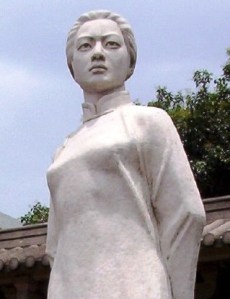
Qiu Jin
Chinese
1875 – 1907


Sun and moon have no light left, earth is dark;
Our women’s world is sunk so deep, who can help us?
Jewelry sold to pay this trip across the seas,
Cut off from my family I leave my native land.
Unbinding my feet I clean out a thousand years of poison,
With heated heart arouse all women’s spirits.
Alas, this delicate kerchief here
Is half stained with blood, and half with tears.

Magpies

Judith Wright
Australian
1915 – 2000


Along the road the magpies walk
with hands in pockets, left and right.
They tilt their heads, and stroll and talk.
In their well-fitted black and white.

They look like certain gentlemen
who seem most nonchalant and wise
until their meal is served – and then
what clashing beaks, what greedy eyes!

But not one man that I have heard
throws back his head in such a song
of grace and praise – no man nor bird.
Their greed is brief; their joy is long.
For each is born with such a throat
as thanks his God with every note.

News of Your Death

In honor of the Egyptian holiday, Revolution Day, we present this work by one of Egypt’s greatest living poets.

Iman Mersal
Egyptian
b. 1966


I will receive your death
as the last wrong you committed against me.
I will not feel relief as you’d hoped.
And I will firmly believe
that you have denied me the opportunity
to diagnose the tumors
that lay dormant between us.
In the morning
I may be surprised by my puffed eyelids
and that the stoop in my back

has gotten sharper.