How dreadful it is to go over the moor
When it is teeming with will o’ the wisps
And mists are whirling like phantoms
As brambles are hooking on bushes.
A pool springs up below each of his steps
When from the cleft it hisses and sings
How dreadful it is to go over the moor
When the reed beds are rustling in wind!
The child all atremble holds fast to his books
And runs as if he were hunted;
Hollowly whistles the wind o’er the plain-
What’s rustling there in the bushes?
The ghostly ditch digger it is
Who steals the best peat from the master;
Hu, hu, it sounds like a cow that is mad
As the boy ducks low in his fear.
From the bank, the stumps stare forth
The pines are eerily nodding
The boy runs on, pricking his ears,
Through gigantic grasses like spears;
And how it crumbles and crushes in there!
That is the unfortunate spinner
That is Leonore who is spinning enchanted
Winding her distaff there in the reeds.
Onwards, onwards, but always at speed
Onwards, as if it wanted to catch him;
By his feet it’s swirling and seething
It’s whistling under his soles
Like a tune set to haunt him;
That is the treacherous violinist;
That is the thieving fiddler, Knauf,
Who stole the marriage farthing.
The moor is breaking asunder, a sigh
Rises up from the cavernous gap;
Woe, woe, it is damned Margret who calls:
‘Ho, ho, my poor little soul’!
The boy leaps on like a wounded deer:
Were protecting angels not near him,
His whitened bones would later be found
By a digger in a dried up peat ditch.
Gradually, the ground becomes firmer
And there, next to the meadow,
The lamp flickers so homely.
The boy stands at the border;
Deeply he breathes, and back to the moor
Casts yet another horror struck look:
Yes, in the reeds, it was a terror,
How dreadful it was on the heath!
Authors and actors and artists and such
Never know nothing, and never know much.
Sculptors and singers and those of their kidney
Tell their affairs from Seattle to Sydney.
Playwrights and poets and such horses’ necks
Start off from anywhere, end up at sex.
Diarists, critics, and similar roe
Never say nothing, and never say no.
People Who Do Things exceed my endurance;
God, for a man that solicits insurance!
When the sheep are in the fauld, and the kye at hame,
And a’ the warld to rest are gane,
The waes o’ my heart fa’ in showers frae my e’e,
While my gudeman lies sound by me.
Young Jamie lo’ed me weel, and sought me for his bride;
But saving a croun he had naething else beside:
To make the croun a pund, young Jamie gaed to sea;
And the croun and the pund were baith for me.
He hadna been awa’ a week but only twa,
When my father brak his arm, and the kye was stown awa’;
My mother she fell sick, – and my Jamie at the sea –
And auld Robin Gray came a-courtin’ me.
My father couldna work, and my mother couldna spin;
I toiled day and night, but their bread I couldna win;
Auld Rob maintained them baith, and wi’ tears in his e’e
Said, ‘Jennie, for their sakes, O, marry me!’
My heart it said nay; I looked for Jamie back;
But the wind it blew high, and the ship it was a wrack;
His ship it was a wrack – Why didna Jamie dee?
Or why do I live to cry, Wae’s me!
My father urged me sair: my mother didna speak;
But she looked in my face till my heart was like to break:
They gi’ed him my hand, though my heart was in the sea;
Sae auld Robin Gray he was gudeman to me.
I hadna been a wife a week but only four,
When mournfu’ as I sat on the stane at the door,
I saw my Jamie’s wraith, – for I couldna think it he,
Till he said, ‘I’m come hame to marry thee.’
O, sair, sair did we greet, and muckle did we say;
We took but ae kiss, and we tore ourselves away:
I wish that I were dead, but I’m no like to dee;
And why was I born to say, Wae’s me!
I gang like a ghaist, and I carena to spin;
I daurna think on Jamie, for that wad be a sin;
But I’ll do my best a gude wife aye to be,
For auld Robin Gray he is kind unto me.
In honor of Dragon Boat Day, we present his work from one of the genius poets of modern China.
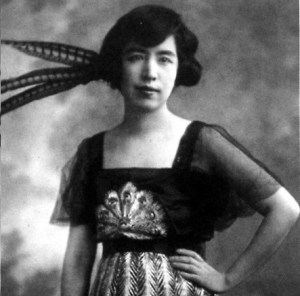
Lü Bicheng Chinese 1883 – 1943
Dark is our country—
I rejoice in the ray of dawn shooting up in the distance.
Who will sing loudly of women’s rights?
Joan of Arc.
Eight thousand feet of snow-capped waves—I am saddened by a sea of sin,
I look at East Asia in the stormy tide of the twentieth century.
If you hear mad words and weeping coming from my boudoir,
Don’t be surprised.
Isolated and confined,
Like the eternity of night.
Fettered and bound,
With no end in sight.
Knocking on Heaven’s door—no response,
How can I pour out my angry feelings?
Far and wide I summon the departed souls to no avail,
Nowhere to let out my hot-blooded zeal.
Alas, a frog at the bottom of a well; my wish always denied.
In vain emotions are stirred.
Hafsa Bint al-Hajj al-Rukuniyya Arab Andalusian 1135 – 1191
Do not suppose it pleased the dell
That we should there together dwell
In happy union; truth to tell,
It showed us naught but petty spite.
The river did not clap, I fear,
For pleasure that we were so near,
The dove raised not his song of cheer
Save for his personal delight.
Think not such noble thoughts as you
Are worthy of; for if you do
You’ll very quickly find, and rue,
High thinking is not always wise.
I scarce suppose that yonder sky
Displayed its wealth of stars on high
For any reason, but to spy
On our romance with jealous eyes.
See, cold island, we stand
Here to-night on your shore.
To-night, but never again;
Lingering a moment more.
See, beneath us our boat
Tugs at its tightening chain.
Holds out its sail to the breeze.
Pants to be gone again.
Off then with shouts and mirth,
Off with laughter and jests.
Mirth and song on our lips.
Hearts like lead in our breasts.
Death and the grave behind,
Death and a traitor’s bier;
Honour and fame before,
Why do we linger here?
Why do we stand and gaze,
Fools, whom fools despise,
Fools untaught by the years.
Fools renounced by the wise?
Heartsick, a moment more.
Heartsick, sorry, fierce.
Lingering, lingering on.
Dreaming the dreams of yore
Dreaming the dreams of our youth,
Dreaming the days when we stood
Joyous, expectant, serene,
Glad, exultant of mood.
Singing with hearts afire.
Singing with joyous strain.
Singing aloud in our pride,
We shall redeem her again
Ah, not to-night that strain,
Silent to-night we stand,
A scanty, a toil-worn crew.
Strangers, foes in the land
Gone the light of our youth.
Gone for ever, and gone
Hope with the beautiful eyes.
Who laughed as she lured us on
Lured us to danger and death.
To honour, perchance to fame,
Empty fame at the best,
Glory half dimmed with shame.
War-battered dogs are we.
Fighters in every clime.
Fillers of trench and of grave.
Mockers, bemocked by time.
War-dogs, hungry and grey,
Gnawing a naked bone,
Fighters in every clime.
Every cause but our own.
See us, cold isle of our love
Coldest, saddest of isles
Cold as the hopes of our youth.
Cold as your own wan smiles.
Coldly your streams outpour.
Each apart on the height.
Trickling, indifferent, slow,
Lost in the hush of the night.
Colder, sadder the clouds,
Comfortless bringers of rain;
Desolate daughters of air,
Sweep o’er your sad grey plain
Hiding the form of your hills.
Hiding your low sand duns;
But coldest, saddest, oh isle
Are the homeless hearts of your sons.
Coldest, and saddest there.
In yon sun-lit land of the south.
Where we sicken, and sorrow, and pine,
And the jest flies from mouth to mouth.
And the church bells crash overhead,
And the idle hours flit by.
And the beaded wine-cups clink.
And the sun burns fierce in the sky;
And your exiles, the merry of heart.
Laugh and boast with the best,
Boast, and extol their part.
Boast, till some lifted brow,
Crossed with a line severe.
Seems with displeasure to ask.
Are these loud braggarts we hear,
Are they the sons of the West,
The wept-for, the theme of songs.
The exiled, the injured, the banned.
The men of a thousand wrongs?
Fool, did you never hear
Of sunshine which broke through rain?
Sunshine which came with storm?
Laughter that rang of pain?
Boastings begotten of grief,
Vauntings to hide a smart.
Braggings with trembling lip.
Tricks of a broken heart?
Sudden some wayward gleam,
Sudden some passing sound,
The careless splash of an oar.
The idle bark of a hound,
A shadow crossing the sun,
An unknown step in the hall,
A nothing, a folly, a straw!
Back it returns all all
Back with the rush of a storm,
Back the old anguish and ill.
The sad, green landscape of home.
The small grey house by the hill.
The wide grey shores of the lake.
The low sky, seeming to weave
Its tender pitiful arms
Round the sick lone landscape at eve.
Back with its pains and its wrongs.
Back with its toils and its strife.
Back with its struggle and woe.
Back flows the stream of our life.
Darkened with treason and wrong.
Darkened with anguish and ruth,
Bitter, tumultuous, fierce,
Yet glad in the light of our youth.
So, cold island, we stand
Here to-night on your shore,
To-night, but never again,
Lingering a moment more.
See, beneath us our boat
Tugs at its tightening chain.
Holds out its sail to the breeze.
Pants to be gone again.
OfF then with shouts and mirth.
Off with laughter and jests.
Jests and song on our lips,
Hearts like lead in our breasts.
As the sweetest diversion that I could ever choose,
Frequently, after dinner, for fear of getting bored,
I take his neck in hand, I touch him, and I stroke,
Till he’s in such a state as to give me delight.
I fall upon my bed and, without letting go,
I grasp him in my arms, I press him to my breast,
And moving hard and fast, all ravished with pleasure,
Amidst a thousand delights I fulfill my desire.
If he sometimes unfortunately happens to slacken,
I erect him with my hand, and right away I strive
To enjoy the delight of such a tender stroking.
Thus my beloved, so long as I pull on his sinew,
Contents and pleases me. Then away from me, softly,
Tired and not sated, I finally withdraw him.
Where does such tenderness come from?
These aren’t the first curls
I’ve wound around my finger—
I’ve kissed lips darker than yours.
The sky is washed and dark
(Where does such tenderness come from?)
Other eyes have known
and shifted away from my eyes.
But I’ve never heard words like this
in the night
(Where does such tenderness come from?)
with my head on your chest, rest.
Where does this tenderness come from?
And what will I do with it? Young
stranger, poet, wandering through town,
you and your eyelashes—longer than anyone’s.




 Poets Corner