Above all, after climaxes the most intense
In our close-knit uniting, frenzied, barbarous,
Reclining side by side, gasping for breath, I sense
The abyss that severs us;
In silence we recline, not understanding why,
After such pent-up fury, longed-for, deep, insane,
So suddenly we find ourselves apart and lie
As separate selves again;
You are beside me but your gaze does not reveal
That eagerness I answered with a fire unknown,
You are a helpless beast gorged with its meal,
A corpse sculpted in stone;
You sleep and do not stir — how can another know
What dream has quieted your restless mind?
But through me yet great gusts of yearning blow
Leaving their mark behind;
I cannot cease from living, O my dearest love!
My warlike frenzy underneath its peaceful air
In desperation searches round me and above
To find a passage there!
And still you lie content! The throbbing ecstasy
Of sadness coursing through my limbs, and that profound
Confusion, nothing of all this in you I see.
My love, my only love! Between yourself and me
There is no common ground.
The angels the angels in the sky
One’s dressed as an officer
One’s dressed as a chef today
And the others sing
Fine sky-coloured officer
Sweet Spring when Christmas is long gone
Will deck you with a lovely sun
A lovely sun
The chef plucks geese
Ah! Snowfalls hiss
Fall and how I miss
My beloved in my arms
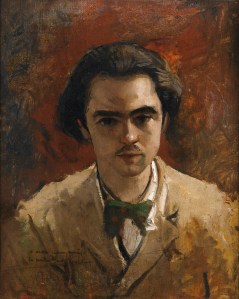
We present this work in honor of the poet’s 175th birthday.
Paul Verlaine French 1844 – 1896
Their long skirts and high heels battled away:
Depending on the ground’s and breezes’ whim,
At times some stocking shone, low on the limb—
Too soon concealed!—tickling our naïveté.
At times, as well, an envious bug would bite
Our lovelies’ necks beneath the boughs, and we
Would glimpse a flash—white flash, ah! ecstasy!—
And glut our mad young eyes on sheer delight.
Evening would fall, the autumn day would draw
To its uncertain close: our belles would cling
Dreamingly to us, cooing, whispering
Lies that still set our souls trembling with awe.
I love you, and I want it known
O disinherited, o mocked,
You whom the fickle public scorns,
You whom they like to call the failed.
For in this hour I throw myself
Into the fight – to strike and break
My lance, perhaps, and others too,
And be struck wickedly in turn.
For now desire within me burns,
My rivals I must face head-on,
Though I do not know who I am,
And though still less know I the score,
And though perhaps I am unfit
To mingle with the likes of you,
Or tread the battlefield today
Where I’ll pour out my twenty years.
I think of you, the dearly failed
With whom I may soon share a meal
In misery tonight. If so
I hope you’ll save a place for me.
From far away I ponder you;
To test myself, to know my heart,
I weigh my courage on the scale
Of sadnesses that you have borne.
If moved I was by japes they heaped
I feel I could move back, deny,
And make my way back home.
I’m sure I’d have an easy walk.
But no, I want the fight; I find
Your lot does not disgust, does not
Repel. I shrink not from your fate,
For it’s the one that I prefer.
The Philistines, I hear, have joys
That do outrun your own. But I
Will take the meager rations of
Your dreams, and not their splendid feasts.
A fall may come; it did for you,
But if the saddle throws me out
Well then, I land with you and take
A place among beloved friends.
To you the mocked, the booed, the heaped
With scorn, the countless outcast mob,
The would have beens, the never weres,
The throngs whom no one understands.
The ghost called Perfect haunted you,
The specter of the master-stroke
Until for want of pleasing him,
At last you pleased no one at all.
To you who carried in your head
Ideals too lovely to be wrought;
To you the poets of the verse
That never will be written down.
To you who filled your idle days
With projects proud and never done;
To you who chased ambitions grand,
In matters that were grander still.
To you whose sweeping thoughts could not
Abide within a narrow mold
Or fit a frame or take a shape
Without a break or overflow.
To you the painters in despair
Who found before a play of light
That colors always fled your grasp,
Who hurled your brushes in dismay.
To you composers who grew pale
At harmonies within your soul
And who for want of notes on page
Filled up your eyes with tears instead.
To you, whose art could not bring out
The subtleties you felt within
And chose therefore not to create,
O delicate, exquisite wastes!
To you, the egotists of sloth
Who keep your works within yourselves
To you, the true, the great, the grand
To you, the ruined; you, the fools.
To you who do not hear the scorn
Who triumph in the shabby nights
Who wave your madness on the streets
And hope to catch indifferent eyes.
You acrobatic characters;
You ugly, scruffy, grimacing,
You grotesque Don Quixotes, yes,
Are those who win my heart still more,
For Dulcinea is your muse
You errant knights of artistry
Whom chance alone perhaps denied
A moment in the sun of fame.
I am your brother and your friend,
A dreamer and a scatterbrain,
And I may know your misery
Before today is done, and so –
I dedicate these lines to you
The first that I have ever made,
O shock troops of Bohemia,
My friends, the lost; my friends, the failed!
Since you wish it, Sir, I will tell you frankly
that you are the laughing-stock of everybody;
that they taunt us everywhere by a thousand
jokes on your account, and that nothing
delights people more than to make sport of
you, and to tell stories without end about
your stinginess. One says that you have
special almanacs printed, where you double
the ember days and vigils, so that you may
profit by the fasts to which you bind all your
house; another, that you always have a ready-
made quarrel for your servants at Christmas
time or when they leave you, so that you may
give them nothing. One tells a story how not
long since you prosecuted a neighbor’s cat
because it had eaten up the remainder of a leg
of mutton; another says that one night you
were caught stealing your horses’ oats, and
that your coachman–that is the man who was
before me–gave you, in the dark, a good
sound drubbing, of which you said nothing.
In short, what is the use of going on? We can
go nowhere but we are sure to hear you
pulled to pieces. You are the butt and jest and
byword of everybody; and never does anyone
mention you but under the names of miser,
stingy, mean fellow and userer.
A furrier once, as one reports,
Espoused a lady young and fair
Who craved that best of indoor sports
And made him run the gamut there,
Who, though he blamed her not, could bear
Only a little, so ‘twas said,
And loved a jug of wine to share
Better than any woman’s bed.
A curate, seeing how things stood,
Of the said wife grew amorous,
And thought that to his house he would
Invite this beggar of Bacchus.
Wherefore he sought him, all joyous,
Because he’d found the way to tup her,
Saying: “Neighbor, I am desirous
Of having you this night to supper.”
The furrier liked this well enough,
Who always liked a fine free feast,
And took his belly there to stuff
And make good cheer with this said priest,
Who, using compliments for yeast,
Said: “Since the lining’s worn away,
I wish you’d mend my robe—at least
Tell me what I shall have to pay.”
“Ah well,” replied the furrier,
“I’ll do so since you wish it done;
Provided that you pay me, sir,
I’m yours: I never work for fun.”
With bargain made the work’s begun,
It being agreed, as you may think,
That, more than ten sous, such a one
Would ask sufficient wine to drink.
In order there be no delay,
Because he needed it to wear,
It was arranged he’d start straightaway,
The priest’s clerk for his fellow there.
He was content of this affair,
And master curate locked them up
(To drink and labour, not for prayer),
Then left the house and went to tup.
The curate to the furrier’s house
Came thus by way of sterling debts,
And found so fine a chance to chouse
He sang right well in love’s duets.
In all shirts do with chemisettes
He bore his part well, so it seems,
And parting then without regrets,
Went out and home to pleasant dreams.
And thus the furrier, for his feed,
Was made a cuckold, as was meant;
And his good wife, who’d found her need,
Begged curate be not indolent,
And charged him, by the Sacrament,
That he remember her and do
As much again, expedient,
Whenever he’d a fancy to.
Nevertheless, a man should guard,
Who’s got a wife that’s young and fair,
Lest he acquire some plumage hard
For a free feed: they’re ill to wear:
The scandal’s gossiped everywhere
And shames a man through all his days.
Remember and avoid the snare,
For feeds are found in divers ways.




 Poets Corner