We present this work in honor of the poet’s 110th birthday.
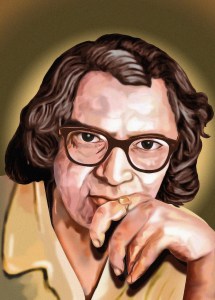
Nagarjun Indian 1911 – 1998
Bhado, glistening The night of the new moon
What is this sapphire gleam Scattering its blessings in the jungle How wondrous is this gift That, too, in the auspicious rainy season It seems that they, alone, will triumph In the arena where power flaunts itself There are thousands, hundreds of thousands Who can count them, innumerable are they Together they glow and shine Who can say – they burn and perish Living out their lives in the jungle
These fireflies are lit from within One moment shining, the next extinguished How wondrous is this gift That, too, in the auspicious rainy season Their triumph is certain In the arena of the final pilgrimage Do not call them ‘wretched’ Listen, these are creatures of light Living out their lives in the jungle
The night is black and the forest has no end; a million people thread it in a million ways. We have trysts to keep in the darkness, but where or with whom – of that we are unaware. But we have this faith – that a lifetime’s bliss will appear any minute, with a smile upon its lips. Scents, touches, sounds, snatches of songs brush us, pass us, give us delightful shocks. Then peradventure there’s a flash of lightning: whomever I see that instant I fall in love with. I call that person and cry: `This life is blest! for your sake such miles have I traversed!’ All those others who came close and moved off in the darkness – I don’t know if they exist or not.
When the world itself looked exhausted, revolving round the sun; when a bumble-bee sounded tired of humming round a ternate leaf; when a few fishermen were venting their rage on their net – they looked fed up of mending their net off and on – and when the fish were leaping and playing in the river, sure as they were the net won t be thrown over them, yonder on a field a serpent was shedding its slough, indifferent to a group of women wending their way across the field and to a pedlar crying his wares along the road that ran parallel to the field At this moment, as usual, a boat rowed in disgorged two men onto the bank. A music strummed on a violin floated in the air for a while, then rose up and disappeared into the sky. Presently the men returned empty-handed to the boat and winked at the boatmen to row the boat away. Suddenly the sky got covered over with pitch-dark clouds. The fishermen looked up and thought there would be festivities of lightning and the river would dance to the rumblings . They prayed for the safety of the men on the boat. In response to their prayer the clouds went away across the sky. The fishermen resumed mending their net; the world continued revolving round the sun; the bumble-bee went on round the ternate leaf and the fish were still leaping and playing in the river . But the serpent had shed its slough and slid into its hole.
In honor of the First Day of Passover, we present this work by one of India’s greatest Jewish poets.
Nissim Ezekiel Indian 1924 – 2004
I remember the night my mother
was stung by a scorpion. Ten hours of steady rain had driven him to crawl beneath a sack of rice.
Parting with his poison – flash of diabolic tail in the dark room – he risked the rain again.
The peasants came like swarms of flies and buzzed the name of God a hundred times to paralyse the Evil One.
With candles and with lanterns throwing giant scorpion shadows on the mud-baked walls they searched for him: he was not found. They clicked their tongues. With every movement that the scorpion made his poison moved in Mother’s blood, they said.
May he sit still, they said May the sins of your previous birth be burned away tonight, they said. May your suffering decrease the misfortunes of your next birth, they said. May the sum of all evil balanced in this unreal world
against the sum of good become diminished by your pain. May the poison purify your flesh
of desire, and your spirit of ambition, they said, and they sat around on the floor with my mother in the centre, the peace of understanding on each face. More candles, more lanterns, more neighbours, more insects, and the endless rain. My mother twisted through and through, groaning on a mat. My father, sceptic, rationalist, trying every curse and blessing, powder, mixture, herb and hybrid. He even poured a little paraffin upon the bitten toe and put a match to it. I watched the flame feeding on my mother. I watched the holy man perform his rites to tame the poison with an incantation. After twenty hours it lost its sting.
My mother only said Thank God the scorpion picked on me And spared my children.
We present this work in honor of the poet’s 125th birthday.
Suryakant Tripathi Nirala Indian 1896 – 1961
On a vine in a lonely grove
Slept a fortune-filled Jasmine Blossom—
A pure, tender-bodied lass
Lost in dreams of love,
Eye closed, lax—in a leaf-bed
On a spring night;
In some far off land
Was the wind called Malaya
Who left this pining lover.
With grieving came the memory of sweet touch,
A memory of a moonlight-laved midnight,
A memory of his beloved’s trembling, tender form—
What then? The wind
Crossed lakes, rivers, groves,
Bush-creeper masses, deep mountain-woods,
Arrived where he had played
With the budding bloom.
She was sleeping,
How could she know of her lover’s coming?
The Nayak kissed her cheeks,
Cradel-like the vine-strand began to swing.
Even then she didn’t awaken,
Asked no pardon,
Wide slumber-curved eyes stayed shut,
Perhaps drunk with youth’s wine—
Who can say?
Brutal, the Nayak
Worked sheer barbarity—
With gusty blasts
Jerked the lovely, tender body around,
Crushed the round white cheeks;
The damsel started—
Turned a startled glance all around,
Spied her lover by her bed,
Smiled shyly—blossomed—
Having played the game of love
With the wooer.
Fire-lit
half silhouette and half myth
the wolf circles my past
treading the leaves into a bed
till he sleeps, black snout
on extended paws.
Black snout on sulphur body
he nudged his way
into my consciousness.
Prowler, wind-sniffer, throat-catcher,
his cries drew a ring
around my night;
a child’s night is a village
on the forest edge.
My mother said
his ears stand up
at the fall of dew
he can sense a shadow
move across a hedge
on a dark night;
he can sniff out
your approaching dreams;
there is nothing
that won’t be lit up
by the dark torch of his eyes.
The wolves have been slaughtered now.
A hedge of smoking gun-barrels
rings my daughter’s dreams.
We present this work in honor of Thiruvalluvar Day.
Ashitha Indian 1956 – 2019
So clandestinely does
the night sketch the night,
like the fingers of darkness
entwining those of the shadows
caressing so intimately that
one becomes the other.
some stealthy lines
drawn on the inner paths
forking in separation
touching or un-touching.
some specks of light
perceived or un-perceived.
some dark forebodings
of a fall or of death.
mining the secrets of the dark
should be a meditative act
like all robes unravelled
from the body which then
weaves itself on its nude self.
night should be made love to
so intensely as a couple
raining by themselves
kissing again and again
the drops of sweat
dripping from the bodies
seized by ecstasy.
night is a poem
written by a woman
with her head bowed
while black serpents
slither along her tresses
to be read only by those homes
that have turned insomniac.
We present this work in honor of Vikram Samvat New Year.
Sumitranandan Pant Indian 1900 – 1977
Youth’s splendor is on her limbs,
on her face the sweat of toil
and the sun’s red burning;
a basket of golden grain upon her head,
she comes and goes along the boundary dikes:
her waist supple
and thighs that shimmer—
eternal child of rain and heat and frost,
this agile-footed
dark-skinned girl,
with a sprig of wheat between her lips.
Heigh ho, two days—
That’s all her youth!—
dream of a moment
not long remembered.
Ground down with sorrow,
worn out by troubled times,
her body withers,
its wealth of youth untimely spent;
a blad of grass adrift from shore,
that laughed and played a few brief moments with the waves.





 Poets Corner