For many days, the hearth wept – the millstone lay, forlorn
For many days, the one-eyed dog slept beside them
For many days, the lizards kept vigil on the wall
For many days, even the mice were as if defeated
For many days, even the mice were as if defeated
Smoke billowed above the courtyard, after many days
The eyes of the household shone again, after many days
The black crow cleaned its feathers, after many days.
We present this work in honor of St. Nicholas’ Day.
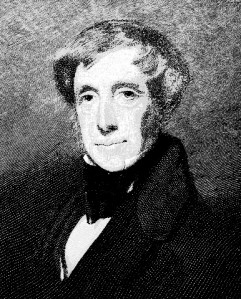
Clement Clarke Moore American 1779 – 1863
‘Twas the night before Christmas, when all through the house
Not a creature was stirring, not even a mouse;
The stockings were hung by the chimney with care,
In hopes that St. Nicholas soon would be there;
The children were nestled all snug in their beds,
While visions of sugar-plums danced in their heads;
And mamma in her ‘kerchief, and I in my cap,
Had just settled down for a long winter’s nap,
When out on the lawn there arose such a clatter,
I sprang from the bed to see what was the matter.
Away to the window I flew like a flash,
Tore open the shutters and threw up the sash.
The moon on the breast of the new-fallen snow
Gave the lustre of mid-day to objects below,
When, what to my wondering eyes should appear,
But a miniature sleigh, and eight tiny reindeer,
With a little old driver, so lively and quick,
I knew in a moment it must be St. Nick.
More rapid than eagles his coursers they came,
And he whistled, and shouted, and called them by name;
“Now, Dasher! Now, Dancer! Now, Prancer and Vixen!
On, Comet! On Cupid! On, Donder and Blitzen!
To the top of the porch! to the top of the wall!
Now dash away! dash away! dash away all!”
As dry leaves that before the wild hurricane fly,
When they meet with an obstacle, mount to the sky,
So up to the house-top the coursers they flew,
With the sleigh full of toys, and St. Nicholas too.
And then, in a twinkling, I heard on the roof
The prancing and pawing of each little hoof.
As I drew in my hand, and was turning around,
Down the chimney St. Nicholas came with a bound.
He was dressed all in fur, from his head to his foot,
And his clothes were all tarnished with ashes and soot;
A bundle of toys he had flung on his back,
And he looked like a peddler just opening his pack.
His eyes — how they twinkled! his dimples how merry!
His cheeks were like roses, his nose like a cherry!
His droll little mouth was drawn up like a bow,
And the beard of his chin was as white as the snow;
The stump of a pipe he held tight in his teeth,
And the smoke it encircled his head like a wreath;
He had a broad face and a little round belly,
That shook, when he laughed like a bowlful of jelly.
He was chubby and plump, a right jolly old elf,
And I laughed when I saw him, in spite of myself;
A wink of his eye and a twist of his head,
Soon gave me to know I had nothing to dread;
He spoke not a word, but went straight to his work,
And filled all the stockings; then turned with a jerk,
And laying his finger aside of his nose,
And giving a nod, up the chimney he rose;
He sprang to his sleigh, to his team gave a whistle,
And away they all flew like the down of a thistle.
But I heard him exclaim, ere he drove out of sight,
“Happy Christmas to all, and to all a good-night.”
If the sun drowns in a sea of clouds
And extends a wave of darkness onto the world
And vision dies in the eyes of the vigilant
And the road is lost in lines and circles
O shrewd traveler in straight lines and in circles,
You have no guide but the eyes of speech
In honor of St. Andrew’s Day, we present this work by one of Scotland’s most pious poets.
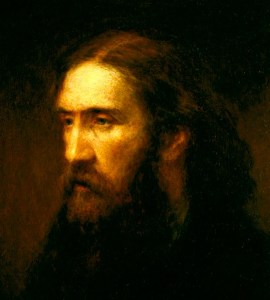
George Macdonald Scots 1824 – 1905
The miser lay on his lonely bed;
Life’s candle was burning dim.
His heart in an iron chest was hid
Under heaps of gold and an iron lid;
And whether it were alive or dead
It never troubled him.
Slowly out of his body he crept.
He said, ‘I am just the same!
Only I want my heart in my breast;
I will go and fetch it out of my chest!’
Through the dark a darker shadow he leapt,
Saying ‘Hell is a fabled flame!’
He opened the lid. Oh, Hell’s own night!
His ghost-eyes saw no gold!-
Empty and swept! Not a gleam was there!
In goes his hand, but the chest is bare!
Ghost-fingers, aha! have only might
To close, not to clasp and hold!
But his heart he saw, and he made a clutch
At the fungous puff-ball of sin:
Eaten with moths, and fretted with rust,
He grasped a handful of rotten dust,
And shrieked, as ghosts may, at the crumbling touch,
But hid it his breast within.
And some there are who see him sit
Under the church, apart,
Counting out coins and coins of gold
Heap by heap on the dank death-mould:
Alas poor ghost and his sore lack of wit-
They breed in the dust of his heart!
Another miser has now his chest,
And it hoards wealth more and more;
Like ferrets his hands go in and out,
Burrowing, tossing the gold about-
Nor heed the heart that, gone from his breast,
Is the cold heap’s bloodless core.
Now wherein differ old ghosts that sit
Counting ghost-coins all day
From the man who clings with spirit prone
To whatever can never be his own?
Who will leave the world with not one whit
But a heart all eaten away?
Even this late it happens:
the coming of love, the coming of light.
You wake and the candles are lit as if by themselves,
stars gather, dreams pour into your pillows,
sending up warm bouquets of air.
Even this late the bones of the body shine
and tomorrow’s dust flares into breath.
I look for life in death,
for health in sickness,
for freedom in prison,
a way out from the impasse,
and loyalty in the Judas.
But my destiny, from which I would
never expect anything good,
has decreed with the Gods
that, since I ask for the impossible,
they won’t even give me the possible.
Would I the lofty spirit melt
Of that proud dame who dwells so high,
Kind heaven must aid me, or unfelt
By her will be its agony.
Joy in my soul no place can find:
As well might I a suitor be
To thunderbolts, as hope her mind
Will turn in softer mood to me.
Those cheeks are beautiful, are bright
As the red rose with dewdrops grac’d;
And faultless is the lovely light
Of those dear eyes, that, on me plac’d,
Pierce to my very heart, and fill
My soul with love’s consuming fires,
While passion burns and reigns at will;
So deep the love that fair inspires!
But joy upon her beauteous form
Attends, her hues so bright to shed
O’er those red lips, before whose warm
And beaming smile all care is fled.
She is to me all light and joy,
I faint, I die, before her frown;
Even Venus, liv’d she yet on earth,
A fairer goddess here must own…
While many mourn the vanish’d light
Of summer, and the sweet sun’s face
I mourn that these, however bright,
No anguish from the soul can chase
By love inflicted: all around,
Nor song of birds, nor ladies’ bloom,
Nor flowers upspringing from the ground,
Can chase or cheer the spirits’ gloom…
Yet still thine aid, belov’d! impart,
Of all thy power, thy love, make trial;
Bid joy revive in thise sad heart,
Joy that expires at thy denial:
Well may I pour my prayer to thee,
Beloved lady, since ‘tis thine
Alone to send such care on me;
Alone for thee I ceaseless pine.



 Poets Corner