Before I cast anchor in the treasure
Of my last love, I have need
To course the world, fevered as a racer —
In my pockets, youth
And a golden seed
And to embrace a serpent of the Nile
Such as the chlamys of Cleopatra hid,
And to hearken to the quiet soliloquy
Of the Virgin Mary in the pyramid
To disembark in my native land,
To make myself a child and childlike trace
On my old school slate, in crayon,
The profile of a Guadalupean face —
To kiss like the Hindoos or the Polynesians,
Like the striped wood beasts or shaggy bears.
And to cast anchor by a countrywoman of mine,
Wearing long earrings in her small ears.
And to say to Love — of all my sins
Even the blackest were passionate lovers.
Out of my cloisters a miserere rises up
And moves toward you with the steps of a baby,
Or as the white island of bubble hovers
On the surface of a coffee cup.
And, since my five fierce fingers of sense
Grasp the five great continents,
I can, O last love and ultimate goal,
Place my hand upon your Guadalupean soul.
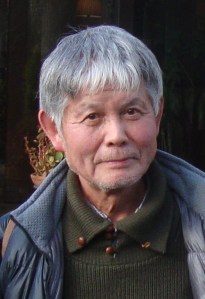
In honor of the Japanese holiday, Labor Thanksgiving Day, we present this work by one of the nation’s most prolific poets.
Mutsuo Takahashi Japanese b. 1937
The shade of sooty quince
The bloom of dusty roses
——And beyond that
A fence of metal wire entwined with vines
Of spiderwort or knotgrass perhaps?
There tossed among the plants
Reclining in a weather-worn wooden armchair
Hands folded at his abdomen like a dead man
Who could he be this man who looks as if
He was washed here from some distant world?
This man is a decrepit adolescent a broken angel
Swept here by the ark of dreams a boat in the shape of a box
When was that? Yesterday or a hundred years ago?
The world to which this man really belongs is not here
The world to which this man really belongs
Is far away through the fissures of dream
Guarded by sensible, steadfast parents
This man wearing a starched collar is a clever boy
He has two beautiful younger sisters
And a younger brother with an upright spirit
This family of angels with wings hidden under their fancy dress
Is enveloped in golden happiness
That world of distant memories
Is like a box floating in a galaxy of tears
One morning suddenly that box-shaped boat ran ashore
In the doorway to that timeless world of happiness
When was that? A second or a hundred million years ago?
Dreams are always nightmares interlopers with foul intent
Drawn by death the father was pulled backward
And the rest of the family were dragged quickly away
It was here they disembarked the backyard of a sickly city
Here not even angels could escape human fate
The mother grew ill from anxiety the sisters grew thin
And wrinkles spread across the brother’s spotless soul
In this false world perched atop the scales
This man was the quiet, noble head of the household
Working harder growing old faster than everyone else
But that was not the reality of who he was
His real self is hidden under the disguise of an old man
Strewn across his chair seated like a corpse
He inhales the blue-green seas of his own world of reality
Watches clouds trailing behind airplanes over the sea
And pricks up his ears to overhear the daytime dialogue of the stars
This man suddenly stands from his chair
And slowly descends through the fallen leaves
Underground he finds his own private box-like world
With objects neatly stored in shelves and drawers
Candy boxes pill boxes candle boxes
Cut-outs from old images musical scores lost wooden blocks
Shells brass rings sky blue marbles
Cracked glasses soap bubble sets——
These too are fragments of the real world
Drifted here through the fissures of dream
This man gives himself plenty of time
How long? One week or thirty years?
He chooses the fragments then puts them together
In just the right place in just the right box
While the faint reflection of the golden happiness
Belonging to the real world so far away
Turns into pale afternoon sunlight and falls
Upon his deftly moving fingers
Is this man no longer at his chair in the garden?
Is he no longer at his basement table?
If he is nowhere to be found
This man must never have been here at all
What we thought we saw was nothing more
Than the shadow of his real self
His shadowy eyelashes drawing the bow of vision toward the real world
His shadowy hands caressing the flotsam from the real world
It is not for us to lament his absence
Like little birds we should descend into the garden to bathe as usual
And play on his basement window like light
Then what about these boxes?
The objects captured inside the princesses
The ballerinas the rabbit princes
The parrots the honeybees the butterflies
Does this man lodge inside them
Borrowing the forms of these ephemeral creatures?
Like the garden and basement these boxes are also
Cheap hotel rooms inhabited briefly by this man’s shadow
It swings upon the roost pours some sand
Creates nimble cracks across the panes of glass
And then vanishes
The destination for his shadow is the real world
These wistfully nostalgic boxes before us are
The frames around the well through which
We peer into that world and are drawn in
I have a white rose to tend
In July as in January;
I give it to the true friend
Who offers his frank hand to me.
And for the cruel one whose blows
Break the heart by which I live,
Thistle nor thorn do I give:
For him, too, I have a white rose.
When the grey lake-water rushes
Past the dripping alder-bushes,
And the bodeful autumn wind
In the fir-tree weeps and hushes, —
When the air is sharply damp
Round the solitary camp,
And the moose-bush in the thicket
Glimmers like a scarlet lamp, —
When the birches twinkle yellow,
And the cornel bunches mellow,
And the owl across the twilight
Trumpets to his downy fellow, —
When the nut-fed chipmunks romp
Through the maples’ crimson pomp,
And the slim viburnum flushes
In the darkness of the swamp, —
When the blueberries are dead,
When the rowan clusters red,
And the shy bear, summer-sleekened,
In the bracken makes his bed, —
On a day there comes once more
To the latched and lonely door,
Down the wood-road striding silent,
One who has been here before.
Green spruce branches for his head,
Here he makes his simple bed,
Crouching with the sun, and rising
When the dawn is frosty red.
All day long he wanders wide
With the grey moss for his guide,
And his lonely axe-stroke startles
The expectant forest-side.
Toward the quiet close of day
Back to camp he takes his way,
And about his sober footsteps
Unafraid the squirrels play.
On his roof the red leaf falls,
At his door the bluejay calls,
And he hears the wood-mice hurry
Up and down his rough log walls;
Hears the laughter of the loon
Thrill the dying afternoon;
Hears the calling of the moose
Echo to the early moon.
And he hears the partridge drumming,
The belated hornet humming, —
All the faint, prophetic sounds
That foretell the winter’s coming.
And the wind about his eaves
Through the chilly night-wet grieves,
And the earth’s dumb patience fills him,
Fellow to the falling leaves.
We present this work in honor of the poet’s 205th birthday.
José Jacinto Milanés Cuban 1814 – 1863
I can but pity him, the one
Who lingers in dull Slumber’s thralls,
While on his roof, unnoticed, fall
The effulgence of the rising sun.
Is there a purer, rarer treat
Than to leap off the wrinkled bed,
And, in the country, lightly tread
Of dewy grass the carpet neat?
I say the country, for I ween
Sweet Morning loses half her smile
Without there be soft winds the while,
And much of blue, and much of green.
These are not had in town, where gray,
And cold and damp, the misty gloom,
As in a suffocating tomb,
Shuts out the morning smile of day.
And then, those rows of houses tall,
With their grim faces, rigid, even,
Weary the soul: the light of heaven
By fragments seems on them to fall.
No! I must stray with footsteps free,
In some delightful rustic place
Without a blur the virgin face
Of life-restoring Morn to see.
To see her in her robe of light,
Far in the crimson Orient shine, —
Like a pure maid, whose smile divine
Elates the soul with chaste delight.
Oh! is there one so poor of thought,
And with a heart so dead and cold,
Who can at the break of day behold
Sweet Nature’s charms, and love her not?
See her with life and beauty new
Roll with the ever murm’ring river;
With the lithe branches dance and quiver;
Sparkle in the resplendent dew.
Low in the reptile on the ground;
Erect and nimble in the brute;
Delicious in the hanging fruit;
Smiling in all the flowers around!
Ah me! I do remember well
When but a simple, beardless boy,
How oft, and with what eager joy,
Came I upon such scenes to dwell!
Now would a butterfly’s light wings
Entrance me with their gaudy hues;
Then would I set myself to muse
Upon a rose, — and dream such things!
And always gay! ‘Twas natural:
Care had not yet impress’d its furrow
Upon my brow, nor had of sorrow
Tasted my lips the bitter gall!
Those days of boyhood vanish’d soon;
Anon, I felt Love’s burning sting;
And then I deemed a foolish thing
To doat on hill, and sun, and moon.
Ungrateful that I was! But how
Severely, Nature, did I pay
For my neglect! She who for aye
Had vowed to love, — forgot her vow!
Most bitterly I wept, and yearned
For her dear presence; and my strength
I fear’d me would have failed… At length
Peace to my shatter’d heart returned.
Oh! what an anguish most sublime
‘Tis to forget! But ah! at last
The iron chain that bound me fast
Fell ‘neath the steady strokes of Time.
Time! Who with hand unseen and noiseless
Pours on our raven locks his snow;
Quenches the light in eyes that glow,
And Beauty’s lips makes pale and voiceless!
And now, once more, I love to stroll
And view sweet Nature at this hour;
For, then, her freshness has the pow’r
To soothe the fever of my soul.
But still I feel deep in my breast
The old wounds bleeding, and I sigh
Whene’er I happen to pass by,
Hand clasp’ed in hand, two lovers blest.
And even sometimes, if I hear
The tender whisp’rings, fraught with meaning,
Of two palms to each other leaning,
I feel a loneliness most dreer!…
If, on a bough, I see, alone,
Two birds exchange delightful lays;
If two stars blend their am’rous rays;
If two waves rolling into one;
If two clouds in the heavens glide,
And on their way their shadows mingle;
If two paths, meeting, form a single;
If two hills standing side by side;
I linger; and with gloomy mood
Remember that I’m loved by none;
That while so many a mated one
There be, I weep in solitude!
hope fails us often
grief never.
that’s why some think
that known grief is better
than unknown grief.
they believe that hope is an illusion.
they are deluded by grief.
The pipie is dozie, the pipie is fey,
He winna come roon’ for his vino the day.
The sky ow’r Messina is unco an’ grey,
An ’a’ the bricht chaulmers are eerie.
Then fare weel ye banks o’ Sicily,
Fare ye weel ye valley and shaw.
There’s nae Jock will mourn the kyles o’ ye,
Puir bliddy swaddies are wearie.
Fare weel, ye banks o’ Sicily,
Fare ye weel, ye valley and shaw.
There’s nae hame can smoor the wiles o’ ye,
Puir bliddy swaddies are wearie.
Then doon the stair and line the waterside,
Wait your turn, the ferry’s awa’.
Then doon the stair and line the waterside,
A’ the bricht chaulmers are eerie.
The drummie is polisht, the drummie is braw
He cannae be seen for his webbin’ ava.
He’s beezed himsel’ up for a photy an a’
Tae leave wi’ his Lola, his dearie.
Sae fare weel, ye dives o’ Sicily
(Fare ye weel, ye shieling an’ ha’),
We’ll a’ mind shebeens and bothies
Whaur kind signorinas were cheerie.
Fare weel, ye banks o’ Sicily
(Fare ye weel, ye shielings an’ ha’);
We’ll a’ mind shebeens and bothies
Whaur Jock made a date wi’ his dearie.
Then tune the pipes and drub the tenor drum
(Leave your kit this side o’ the wa’).
Then tune the pipes and drub the tenor drum
A’ the bricht chaulmers are eerie.
In honor of the Prophet’s Birthday, we present this work by one of Persia’s greatest Muslim poets.
Attar of Nishapur Persian 1145 – 1220
And as His Essence all the world pervades
Naught in Creation is, save this alone.
Upon the waters has He fixed His Throne,
This earth suspended in the starry space,
Yet what are seas and what is air? For all
Is God, and but a talisman are heaven and earth
To veil Divinity. For heaven and earth,
Did He not permeate them, were but names;
Know then, that both this visible world and that
Which unseen is, alike are God Himself,
Naught is, save God: and all that is, is God.
And yet, alas! by how few is He seen,
Blind are men’s eyes, though all resplendent shines
The world by Deity’s own light illumined,
O Thou whom man perceiveth not, although
To him Thou deignest to make known Thyself;
Thou all Creation art, all we behold, but Thou,
The soul within the body lies concealed,
And Thou dost hide Thyself within the soul,
O soul in soul! Myst’ry in myst’ry hid!
Before all wert Thou, and are more than all!
We present this work in honor of the poet’s 1,025th birthday.
Ibn Hazm Arab Andalusian 994 – 1064
I would split open my heart
with a knife, place you
within and seal my would,
that you might dwell there
and never inhabit another
until the resurrection and
judgment day — thus you
would stay in my heart
while I lived, and at my death
you too would die in the
entrails of my core, in
the shadow of my tomb.



 Poets Corner