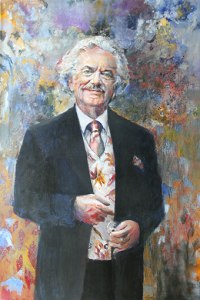
We present this work in honor of the poet’s 710th birthday.
Ibn al-Khatib Arab Andalusian 1313 – 1374
With my jewels and with my crown I surpass the most beautiful, And before me the stars of the zodiac all bow down … It is as though I had received the gift of that bounty which Flows from the hand of my lord Abu al-Hajjaj
When you were a kid we celebrated your graces and ups and downs; as a little man your ingenious good taste and daring. Now that you use your Cervantes, your French, your Péguy, everything you previously learned, heard and wrote in praise of tyranny, let us celebrate your crime.
Under the sky born after the rain, I hear the quiet slap of oars against the water and I’m thinking: happiness is nothing but the quiet slap of oars against the water. Or maybe it’s nothing but the light on a small boat, appearing and disappearing on the dark swell of years slow as a funeral supper. Or the light of a house discovered behind the hill when we’d thought nothing remained but to walk and walk. Or the gulf of silence between my voice and the voice of someone revealing to me the true names of things simply by calling them up: poplars, roofs. The distance between the clinking of a bell on a sheep’s neck at dawn and the thud of a door closing after a party. The space between the cry of a wounded bird out on the marsh and the folded wings of a butterfly just over the crest of a wind-swept ridge. That was happiness: drawing random figures in the frost, fully aware they’d hardly last at all, breaking off a pine bough on the spur of the moment to write our names in the damp ground, catching a piece of thistledown to try and stop the flight of a whole season. That’s what happiness was like: brief as the dream of a felled sweet acacia tree or the dance of a crazy old woman in front of a broken mirror. Happy days pass as quickly as the journey of a star cut loose from the sky, but it doesn’t matter. We can always reconstruct them from memory, just as the boy sent out to the courtyard for punishment collects pebbles to form resplendent armies. We can always be in the day that’s neither yesterday nor tomorrow, gazing up at a sky born after the rain and listening from afar to a quiet slap of oars against the water.
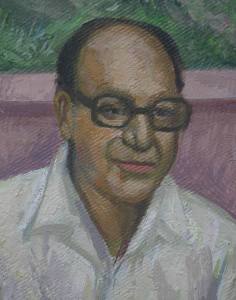
We present this work in honor of the poet’s 100th birthday.
Rubén Bonifaz Nuño Mexican 1923 – 2013
Because I was alone I want to think of you as alone. That you didn’t go, that you slept. That you left me without leaving, and that you needed me to be able to be happy.
Anyway, I’ve recovered my place in the world: you came back, you became reachable
You give me back the time, the pain, the ways, happiness, the voice, the body, the soul, life, and death, and what lives beyond death.
You give me back everything locked up in the appearance of a woman, your self, the one I love.
You came back little by little, you woke and weren’t surprised to find me beside you.
And I could almost see the last step of the secret you climbed while sleeping, as you opened —slowly, quietly—your eyes inside my eyes that kept the deathwatch over you.
We present this work in honor of the 150th anniversary of the poet’s death.
Manuel Bretón de los Herreros Spanish 1796 – 1873
Whene’er Don Juan has a feast at home, I am forgotten as if at Rome; But he will for funerals me invite, To kill me with the annoyance quite: Well, so be it!
Celeste, with thousand coy excuses, Will sing the song that set she chooses, And all about that her environ, Though like an owl, call her a Siren: Well, so be it!
A hundred bees, without reposing, Work their sweet combs, with skill enclosing; Alas! for an idle drone they strive, Who soon will come to devour the hive: Well, so be it!
Man to his like moves furious war, As if were not too numerous far Alone the medical squadrons straight The world itself to depopulate! Well, so be it!
There are of usurers heaps in Spain, Of catchpoles, hucksterers, heaps again, And of vintners too, yet people still Are talking of robbers on the hill: Well, so be it!
In vain may the poor, O Conde! try Thy door, for the dog makes sole reply; And yet to spend thou hast extollers, Over a ball two thousand dollars: Well, so be it!
Enough today, my pen, this preaching; A better time we wait for teaching: If vices in vain I try to brand, And find I only write upon sand, Well, so be it!
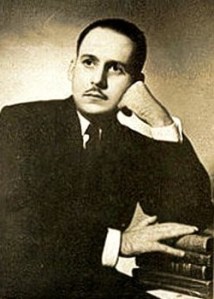
We present this work in honor of the 60th anniversary of the poet’s death.
Luis Cernuda Spanish 1902 – 1963
Body of stone, morose body In woolens like the walls of the universe, Body like the birthdays of the races, Like edifices overwhelmingly innocent, Like the shyest waterfalls White as the night, while the mountain Rips up manic shapes, Pains like fingers And pleasures like fingernails.
Not knowing where to go, where to go back to, Seeking those merciful winds That wear away the wrinkles in the earth, That bless those desires cut out at the roots Before flowering. Their great blossom, like a child.
Lips want that flower Whose fist, kissed by the night, Opens the doors of oblivion lip by lip.
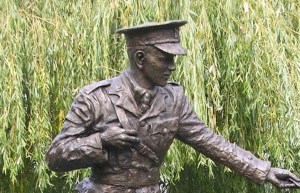
We present this work in honor of the 105th anniversary of the poet’s death.
Wilfred Owen English 1893 – 1918
Bent double, like old beggars under sacks, Knock-kneed, coughing like hags, we cursed through sludge, Till on the haunting flares we turned our backs, And towards our distant rest began to trudge. Men marched asleep. Many had lost their boots, But limped on, blood-shod. All went lame; all blind; Drunk with fatigue; deaf even to the hoots Of gas-shells dropping softly behind.
Gas! GAS! Quick, boys!—An ecstasy of fumbling Fitting the clumsy helmets just in time, But someone still was yelling out and stumbling And flound’ring like a man in fire or lime.— Dim through the misty panes and thick green light, As under a green sea, I saw him drowning.
In all my dreams before my helpless sight, He plunges at me, guttering, choking, drowning.
If in some smothering dreams, you too could pace Behind the wagon that we flung him in, And watch the white eyes writhing in his face, His hanging face, like a devil’s sick of sin; If you could hear, at every jolt, the blood Come gargling from the froth-corrupted lungs, Obscene as cancer, bitter as the cud Of vile, incurable sores on innocent tongues,— My friend, you would not tell with such high zest To children ardent for some desperate glory, The old Lie: Dulce et decorum est Pro patria mori.






 Poets Corner