Newfoundland

We present this work in honor of Canada Day.
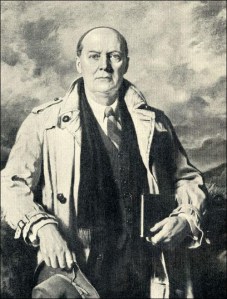
E.J. Pratt
Canadian
1882 – 1964


Here the tides flow,
And here they ebb;
Not with that dull, unsinewed tread of waters
Held under bonds to move
Around unpeopled shores—
Moon-driven through a timeless circuit
Of invasion and retreat;
But with a lusty stroke of life
Pounding at stubborn gates,
That they might run
Within the sluices of men’s hearts,
Leap under throb of pulse and nerve,
And teach the sea’s strong voice
To learn the harmonies of new floods,
The peal of cataract,
And the soft wash of currents
Against resilient banks,
Or the broken rhythms from old chords
Along dark passages
That once were pathways of authentic fires.

Red is the sea-kelp on the beach,
Red as the heart’s blood,
Nor is there power in tide or sun
To bleach its stain.
It lies there piled thick
Above the gulch-line.
It is rooted in the joints of rocks,
It is tangled around a spar,
It covers a broken rudder,
It is red as the heart’s blood,
And salt as tears.

Here the winds blow,
And here they die,
Not with that wild, exotic rage
That vainly sweeps untrodden shores,
But with familiar breath
Holding a partnership with life,
Resonant with the hopes of spring,
Pungent with the airs of harvest.
They call with the silver fifes of the sea,
They breathe with the lungs of men,
They are one with the tides of the sea,
They are one with the tides of the heart,
They blow with the rising octaves of dawn,
They die with the largo of dusk,
Their hands are full to the overflow,
In their right is the bread of life,
In their left are the waters of death.

Scattered on boom
And rudder and weed
Are tangles of shells;
Some with backs of crusted bronze,
And faces of porcelain blue,
Some crushed by the beach stones
To chips of jade;
And some are spiral-cleft
Spreading their tracery on the sand
In the rich veining of an agate’s heart;
And others remain unscarred,
To babble of the passing of the winds.

Here the crags
Meet with winds and tides—
Not with that blind interchange
Of blow for blow
That spills the thunder of insentient seas;
But with the mind that reads assault
In crouch and leap and the quick stealth,
Stiffening the muscles of the waves.
Here they flank the harbours,
Keeping watch
On thresholds, altars and the fires of home,
Or, like mastiffs,
Over-zealous,
Guard too well.

Tide and wind and crag,
Sea-weed and sea-shell
And broken rudder—
And the story is told
Of human veins and pulses,
Of eternal pathways of fire,
Of dreams that survive the night,
Of doors held ajar in storms.
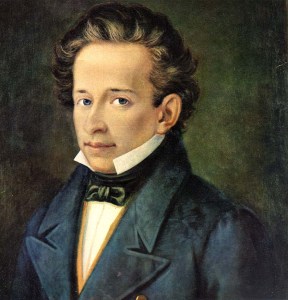
The Infinite

We present this work in honor of the poet’s 225th birthday.

Giacomo Leopardi
Italian
1798 – 1837


This solitary hill has always been dear to me
And this hedge, which prevents me from seeing most of
The endless horizon.
But when I sit and gaze, I imagine, in my thoughts
Endless spaces beyond the hedge,
An all encompassing silence and a deeply profound quiet,
To the point that my heart is almost overwhelmed.
And when I hear the wind rustling through the trees
I compare its voice to the infinite silence.
And eternity occurs to me, and all the ages past,
And the present time, and its sound.
Amidst this immensity my thought drowns:
And to flounder in this sea is sweet to me.

Translation by Kenneth David West

useless, useless for all slavery

We present this work in honor of the 25th anniversary of the poet’s death.

Mario Romero
Argentine
1943 – 1998


Thank you
for showing me this woman’s body
while the branches, you remember, shook the roof
and I went after the mystery.

And it was a great scare that
in the Casa della Pazzia
from where we came out terrified by so much nothingness;
to the open air, to the pure images;
nourishment for the mind of those who want a new world
and the feeling that shines
and the body relieved.

Because when you take my hand I take fire
but your smile is this light
and I wait in peace for the dark to bite me
with its mouth of fury
so that once and for all those on the shore
they can hear the scream.

Translation by Calendaria Romero and Rocio Bolanos

My City

We present this work in honor of the 85th anniversary of the poet’s death.

James Weldon Johnson
American
1871 – 1938


When I come down to sleep death’s endless night,
The threshold of the unknown dark to cross,
What to me then will be the keenest loss,
When this bright world blurs on my fading sight?
Will it be that no more I shall see the trees
Or smell the flowers or hear the singing birds
Or watch the flashing streams or patient herds?
No, I am sure it will be none of these.

But, ah! Manhattan’s sights and sounds, her smells,
Her crowds, her throbbing force, the thrill that comes
From being of her a part, her subtle spells,
Her shining towers, her avenues, her slums—
O God! the stark, unutterable pity,
To be dead, and never again behold my city!

Kenza

We present this work in honor of the 25th anniversary of the poet’s death.

Lounès Matoub
Algerian
1956 – 1998


The sky is heavy and has fissured
Rain has washed the tomb
Turbulent waters are pouring out
Creating new water paths
From the tomb, a striking call came
To warn the people

Oh Kenza my daughter
Do not weep
We have been sacrificed
For a new Algeria
Kenza, Oh my daughter
Do not weep

Even if the body wilts
The idea lives
Even if the times are hard
We will overcome weariness
Even if they shoot many stars,
The sky will never be stripped of all of its stars

Oh Kenza my daughter
Endure life’s burden
We have been sacrificed
For a new Algeria
Kenza, Oh my daughter
Do not weep

They have decided on our fate
Well before today
The hunters of intelligence
Who have turned the country into a death zone
They have killed Rashid Tigziri
And did not miss Smail
They have killed Liabes and Flici
Boucebsi and many others

Oh Kenza my daughter
Endure life’s burden
We have been sacrificed
For a new Algeria
Kenza, Oh my daughter
Do not weep

At least one of us will survive
He will be our memory tomorrow
The wounds will heal
Our country will be peaceful again
Our children will grow
Even amidst the violence and pain

Oh Kenza my daughter
Do not weep
We have been sacrificed
For a new Algeria
Kenza, Oh my daughter
Do not weep

They Spoke to Me

We present this work in honor of the poet’s 100th birthday.

Yves Bonnefoy
French
1923 – 2016


They said to me no, don’t take any, no, don’t touch, that is burning
hot. No, don’t try to touch, to hold, that weighs too much, that
hurts.

They said to me: Read, write. And I tried, I took up a word, but it
struggled, it clucked like a frightened hen, wounded, in a cage of
black straw, spotted with old traces of   blood.

Translation by Mary Ann Caws

The Broken Pitcher

We present this work in honor of the poet’s 210th birthday.

William Edmondstoune Aytoun
Scots
1813 – 1865


It was a Moorish maiden was sitting by a well,
And what the maiden thought of, I cannot, cannot, tell,
When by there rode a valiant knight from the town of Oviedo,
Alphonso Guzman was he hight, the Count of Tololedo.

‘Oh, maiden, Moorish maiden! why sitt’st thou by the spring?
Say, dost thou seek a lover, or any other thing?
Why dost thou look upon me, with eyes so dark and wide,
And wherefore doth the pitcher lie broken by thy side?’

‘I do not seek a lover, thou Christian knight so gay,
Because an article like that hath never come my way;
And why I gaze upon you, I cannot, cannot tell,
Except that in your iron hose you look uncommon swell.

‘My pitcher it is broken, and this the reason is –
A shepherd came behind me, and tried to snatch a kiss;
I would not stand his nonsense, so ne’er a word I spoke,
But scored him on the costard, and so the jug was broke.

‘My uncle, the Alcaydé, he waits for me at home,
And will not take his tumbler, until Zorayda come:
I cannot bring him water – the pitcher is in pieces –
And so I’m sure to catch it, ‘cos he wallops all his nieces’

‘Oh maiden, Moorish maiden! Wilt thou be ruled by me?
Then wipe thine eyes and rosy lips, and give me kisses three;
And I’ll give thee my helmet, thou kind and courteous lady,
To carry home the water to thy Uncle, the Alcaydé.’

He lighted down from off his steed line – he tied him to a tree –
He bent him to the maiden, and he took his kisses three;
‘To wrong thee, sweet Zorayda, I swear would be a sin!’
And he knelt him at the fountain, and he dipped his helmet in.

Up rose the Moorish maiden – behind the Knight she steals,
And caught Alphonso Guzman in a twinkling by the heels:
She tipped him in and held him down beneath the bubbling water –
‘Now, take thou that for venturing to kiss Al Hamet’s daughter!’

A Christian maid is waiting in the town of Oviedo;
She waits the coming of her love, the Count of Tololedo;
I pray you all in charity, that you will never tell,
How he met the Moorish maiden beside the lonely well.

Father

We present this work in honor of Father’s Day.

Edgar Albert Guest
American
1881 – 1959


My father knows the proper way
The nation should be run;
He tells us children every day
Just what should now be done.
He knows the way to fix the trusts,
He has a simple plan;
But if the furnace needs repairs,
We have to hire a man.

My father, in a day or two
Could land big thieves in jail;
There’s nothing that he cannot do,
He knows no word like “fail.”
“Our confidence” he would restore,
Of that there is no doubt;
But if there is a chair to mend,
We have to send it out.

All public questions that arise,
He settles on the spot;
He waits not till the tumult dies,
But grabs it while it’s hot.
In matters of finance he can
Tell Congress what to do;
But, O, he finds it hard to meet
His bills as they fall due.

It almost makes him sick to read
The things law-makers say;
Why, father’s just the man they need,
He never goes astray.
All wars he’d very quickly end,
As fast as I can write it;
But when a neighbor starts a fuss,
‘Tis mother has to fight it.

In conversation father can
Do many wondrous things;
He’s built upon a wiser plan
Than presidents or kings.
He knows the ins and outs of each
And every deep transaction;
We look to him for theories,
But look to ma for action.