Elegy III

z 06-18-22
Maximianus
Italian
6th century


It is now worthwhile to recall some of my youth
and say a bit regarding my old age,

from which a reader may uplift a mind undone
by change and try to grasp a sad affair.

Seduced by love for you, I went mad, Aquilina,
morose and pale, seduced by love for you.

I did not know what love or fiery lust was yet;
instead I suffered from my awkwardness.

She, smoldering, not any less love-struck than me,
would wander unrestrained all through the house.

Beloved carding combs, raw wool were tossed aside,
and love alone became her heart’s obsession.

She found no method that would feed the hidden fire,
no guidance for response with two-way signals.

She showed so much affection in her foolish gaze
with just one glance reliving anxious feelings.

Her tutor chased me. Her grim mother guarded her,
a second punishment for such misfortune.

Throughout it all they scrutinized our eyes and nods—
and coloring that tends to signal thoughts.

When possible, in silence we both stifled longing
and hid our sweet deceits in different ways,

though after modesty emerged on her young face,
deep hidden passion failed to be concealed.

Soon both of us began to seek out times and places,
to converse with eyebrows and our eyes,

to dupe the guards, to put a foot down gingerly,
and in the night to run without a sound.

But not for long! Her mother sensed our secret love
and, getting set to treat the wounds with wounds,

she nagged and slapped; the blaze was kindled by her slaps
like tinder tossed on pyres to stoke the flames.

Our fiery hearts ignite a doubled frenzied passion,
and so an anguish mixed with love is raging,

then, with a panting heart, she looks around for me,
who she believes her purchase through her pleas.

She’s shameless rolling back stained clothes to recollect;
joyful, she even credits them to me.

She says, “I’m glad to suffer pains endured for you.
You’ll be the sweet return on so much blood.

Just let your faith be certain and your will unbroken;
passion that ruined nothing never was.”

I constantly endured these goads, and while in love
I languished, and I had no hope of rescue.

Unthreatened, I was bothered by a silent wound,
though shock and wasting took the place of words.

Boethius, great searcher of important things,
only you, showing pity, bring assistance,

for while you often saw me focused on my worries,
you could not know the reasons for my woes.

Sensing at last that I am gripped by violent sickness,
you softly order opening what’s closed:

“Speak! From whom did you catch this new ignited fever?
Speak! And accept the cure for your claimed pain!

There is no treatment for undiagnosed disease,
and caverns bellow more with smothered flames.”

When it was shameful to confess and talk of sin,
He recognized clear signs of silent pain.

He quickly said, “The matter’s cause is clear enough.
Don’t fret; great strength will give you much forgiveness.”

I broke my shamefaced silence, prostrate at his feet,
while through tears sharing everything in sequence.

“Do it,” he said, “Or could a ‘gift’ of beauty please you?”
“Honor avoids such wishing,” I replied.

He broke up laughing, shouting, “What a wondrous will!
Speak up! When was a love from Venus chaste?

Young man, refrain from sparing your delightful girl!
If you’d be ‘proper’ here, you’ll be improper!”

Tender affairs are fed by scratches and a bite;
a violent business does not shun more blows.

Meanwhile, he pacifies her parents’ hearts with “gifts”
and lures soft touches to my goal with cash.

Blind love of money overcomes parental love;
they both begin to love their daughter’s guilt.

They give us room for secret sings; they acquiesce
to holding hands and filling days with play.

A sanctioned sin becomes cheap; lust becomes depleted.
Exhausted hearts defeated their disease.

She, seeing no pursuit advancing, hates the cause
and leaves dejected with an unspoiled body.

I banished phantom worries from a chastened heart
and quickly found out what a wretch I was.

I said, “Hail holy chastity, and always stay
untouched. Through me you’ll be most modest.”

Once everything had been conveyed to this great man
and he observed I rose above my moods,

he said, “Well done, young man, the lord of your own love!”
and “Gather up some trophies of your scorn.

To you may Cupid’s bow and arms of Venus yield,
and even bold Minerva yield to you.

And so a sanctioned license stole my zeal for sinning,
and even longing for such things departed.

We split up, equally resentful and unhappy;
the reason for the split was modest life.
 

Translation by A.M. Juster

The Light will Burn and Darken

We present this work in honor of the poet’s 155th birthday.

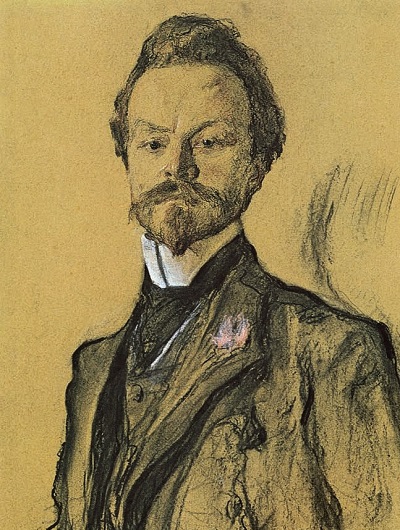
06-15 Balmont
Konstantin Balmont
Russian
1867 – 1942


The light will burn and darken, then burn with stronger blaze,
But unreturning darkens the sheen of youthful days.
Glow then, and be enkindled, the while thou still art young,
Let ever more undwindled the heart’s loud chords be strung,
That something be remembered in waning years of woe,
That chill old-age be lighted by that decayless glow,
Born of exalted fancies, and headstrong youth’s ado,
Heedless, but full of splendour, heedless and hallowed, too.


Translation by Paul Selver

Old Ironsides

We present this work in honor of Flag Day.

06-14 Holmes
Oliver Wendell Holmes
American
1809 – 1894

Ay, tear her tattered ensign down!
Long has it waved on high,
And many an eye has danced to see
That banner in the sky;
Beneath it rung the battle shout,
And burst the cannon’s roar; —
The meteor of the ocean air
Shall sweep the clouds no more.
Her deck, once red with heroes’ blood,
Where knelt the vanquished foe,
When winds were hurrying o’er the flood,
And waves were white below,
No more shall feel the victor’s tread,
Or know the conquered knee; —
The harpies of the shore shall pluck
The eagle of the sea!

Oh, better that her shattered hulk
Should sink beneath the wave;
Her thunders shook the mighty deep,
And there should be her grave;
Nail to the mast her holy flag,
Set every threadbare sail,
And give her to the god of storms,
The lightning and the gale!

from The Argonautica

06-13 Apollonius
Apollonius of Rhodes
Greek
c. 300 B.C.


First in my song shalt thou be, O Phœbus, the song that I sing
Of the heroes of old, who sped, at the hest of Pelias the king,
When down through the gorge of the Pontus-sea, through the Crags Dark-blue,
On the Quest of the Fleece of Gold the strong-ribbed Argo flew.
For an oracle came unto Pelias, how that in days to be
A terrible doom should be dealt him of him whom his eyes should see
From the field coming in, with the one foot only sandal-shod.
Nor long thereafter did Jason fulfil the word of the God:
For in wading the rush of Amaurus swollen with winter-tide rain
One sandal plucked he forth of the mire, but the one was he fain
To leave in the depths, for the swirl of the waters to sweep to the main.
Straightway to the presence of Pelias he came, and his hap was to light
On a banquet, the which unto Father Poseidon the king had dight,
And the rest of the Gods, but Pelasgian Hêrê he heeded not.
And the king beheld him, and straightway laid for his life the plot,
And devised for him toil of a troublous voyage, that lost in the sea,
Or lost amid alien men his home-return might be.
Of the ship and her fashioning, bards of the olden time have told
How Argus wrought, how Athênê made him cunning-souled.
But now be it mine the lineage and names of her heroes to say,
And to tell of the long sea-paths whereover they needs must stray,
And the deeds that they wrought:—may the Muses vouchsafe to inspire the lay.


Translation by Arthur S. Way

Forever You, the Unwashed Russia!

We present this work in honor of Russian National Day.

06-12 Lermontov
Mikhail Lermontov
Russian
1814 – 1841

Forever you, the unwashed Russia!
The land of slaves the land of lords:
And you, the blue-uniformed ushers,
And people who worship them as gods.

I hope, from your tyrannic hounds
To save me with Caucasian wall:
From their eye, that sees through ground,
From their ears, that hear all.

Natural Progress

We present this work in honor of the poet’s 350th birthday.

06-11 Jonson
Ben Jonson
English
1572 – 1637

In all faith, we did our part:
generated punctually, prepared adequately,
ejected promptly,
and swam in the approved manner
in the appropriate direction;
did all instinctive things well,
even eagerly-
an exemplary start.
But then the barrier: unexpectedness
unexpectedly.
(They did not tell us this).
To go back impossible, unnatural:
so round; many times;
we tired ourselves.
Where were the promised homes,
embedded in the soft wall?
Or the anticipated achievement
so momentous, fulfilling?
So we died:
what else was there to do?
But in all faith, we did our part!

I Saw the Red Sun

We present this work in honor of the poet’s 205th birthday.

06-09 Pombo
Julio Arboleda Pombo
Colombian
1817 – 1862

I saw the red sun’s serene light
troubled and at one point its brilliant face
disappeared and the sky darkened,
with a darkness full of horror.

The stormy South winds sound angry,
their anger grows, and the storm grows,
and the shoulders of Atlas shudder
high Olympus, with a dreadful thunderclap.

But then I saw the black veil
of rain part, and by the previous light
the brilliant and clear day was restored.

And again I looked upon the sky’s ornate splendor,
and I said “Who knows if I should expect an equal
change in my fortune?”

Immortality

We present this work in honor of the 35th anniversary of the poet’s death.

06-07 Costantini
Humberto Costantini
Argentine
1924 – 1987

It simply happens I have become immortal.
The city buses respect me,
they bow before me,
like lap dogs they lick my shoes.

It simply happens I am no longer dying.
There’s no angina worth anything,
no typhus, cornice, war, or cannon,
cancer, knife, or flood,
no Junín fever, no vigilantes.
I’m on the other side,
Simply, I’m on the other side,
from this side,
fully immortal.

I move among Olympus, gods, ambrosias,
I laugh, or sneeze, or tell a joke
And time expands, expands like a crazy foam.
How marvelous existing
like this, immortal
celebrating birth every five minutes,
being a million birds,
an atrocious leavening.
What a scandal, caramba!
this swarm of life, this plague called by my
name, excessive, increasing,
fully immortal.

I used to suffer, sure, from flus, fears,
budgets,
Idiot bosses, indigestion,
homesickness, solitude,
bad luck…
But that was a century ago,
twenty centuries,
when I was mortal.
When I was
so mortal, so stupid and so mortal,
that I didn’t even love you,
you have to understand.

Drowning in Wheat

We present this work in honor of Western Australia Day.

06-06 Kinsella
John Kinsella
Australian
b. 1963

They’d been warned
on every farm
that playing
in the silos
would lead to death.
You sink in wheat.
Slowly. And the more
you struggle the worse it gets.
‘You’ll see a rat sail past
your face, nimble on its turf,
and then you’ll disappear.’
In there, hard work
has no reward.
So it became a kind of test
to see how far they could sink
without needing a rope
to help them out.
But in the midst of play
rituals miss a beat—like both
leaping in to resolve
an argument
as to who’d go first
and forgetting
to attach the rope.
Up to the waist
and afraid to move.
That even a call for help
would see the wheat
trickle down.
The painful consolidation
of time. The grains
in the hourglass
grotesquely swollen.
And that acrid
chemical smell
of treated wheat
coaxing them into
a near-dead sleep.

The Palace and the Garden

We present this work in honor of Shavuot.

06-05 Ibn Gabirol
Solomon Ibn Gabirol
Arab Andalusian
1021 – 1070

Come, spend a night in the country with me,
my friend (you whom the stars above would gladly call their friend),
for winter’s finally over. Listen
to the chatter of the doves and swallows!
We’ll lounge beneath the pomegranates, palm trees, apple trees,
under every lovely, leafy thing,
and walk among the vines,
enjoy the splendid faces we will see,
in a lofty palace built of noble stones.
Resting solidly on thick foundations,
its walls like towers fortified,
set upon a flat place, plains all around it
splendid to look at from within its courts.
Chambers constructed, adorned with carvings,
open-work and closed-work,
paving of alabaster, paving of marble,
gates so many that I can’t even count them!
Chamber doors paneled with ivory like palace doors,
reddened with panels of cedar, like the Temple.
Wide windows over them,
and within those windows, the sun and moon and stars!
It has a dome, too, like Solomon’s palanquin,
suspended like a jewel-room,
turning, changing,
pearl-colored; crystal and marble
in day-time; but in the evening seeming
just like the night sky, all set with stars.
It cheers the heart of the poor and the weary;
perishing, bitter men forget their want.
I saw it once and I forgot my troubles,
my heart took comfort from distress,
my body seemed to fly for joy,
as if on wings of eagles.
There was a basin brimming, like Solomon’s basin,
but not on the backs of bulls like his –
lions stood around its edge
with wells in their innards, and mouths gushing water;
they made you think of whelps that roar for prey;
for they had wells inside them, wells that emitted
water in streams through their mouths like rivers.
Then there were canals with does planted by them,
does that were hollow, pouring water,
sprinkling the plants planted in the garden-beds,
casting pure water upon them,
watering the myrtle-garden,
treetops fresh and sprinkling,
and everything was fragrant as spices,
everything as if it were perfumed with myrrh.
Birds were singing in the boughs,
peering through the palm-fronds,
and there were fresh and lovely blossoms –
rose, narcissus, saffron –
each one boasting that he was the best,
(though we thought every one was beautiful).
The narcissuses said, “We are so white
we rule the sun and moon and stars!”
The doves complained at such talk and said,
“No, we are the princesses here! Just see our neck-rings,
with which we charm the hearts of men,
dearer far than pearls.”
The bucks rose up against the girls
and darkened their splendor with their own,
boasting that they were the best of all,
because they are like young rams.
But when the sun rose over them,
I cried out, “Halt! Do not cross the boundaries!”