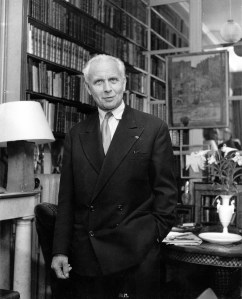
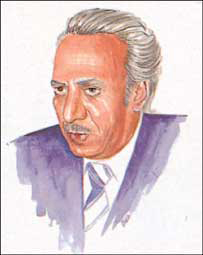
The Tale of Custard the Dragon

We present this work in honor of the 50th anniversary of the poet’s death.

Ogden Nash
American
1902 – 1971


Belinda lived in a little white house,
With a little black kitten and a little gray mouse,
And a little yellow dog and a little red wagon,
And a realio, trulio, little pet dragon.

Now the name of the little black kitten was Ink,
And the little gray mouse, she called her Blink,
And the little yellow dog was sharp as Mustard,
But the dragon was a coward, and she called him Custard.

Custard the dragon had big sharp teeth,
And spikes on top of him and scales underneath,
Mouth like a fireplace, chimney for a nose,
And realio, trulio, daggers on his toes.

Belinda was as brave as a barrel full of bears,
And Ink and Blink chased lions down the stairs,
Mustard was as brave as a tiger in a rage,
But Custard cried for a nice safe cage.

Belinda tickled him, she tickled him unmerciful,
Ink, Blink and Mustard, they rudely called him Percival,
They all sat laughing in the little red wagon
At the realio, trulio, cowardly dragon.

Belinda giggled till she shook the house,
And Blink said Week! , which is giggling for a mouse,
Ink and Mustard rudely asked his age,
When Custard cried for a nice safe cage.

Suddenly, suddenly they heard a nasty sound,
And Mustard growled, and they all looked around.
Meowch! cried Ink, and Ooh! cried Belinda,
For there was a pirate, climbing in the winda.

Pistol in his left hand, pistol in his right,
And he held in his teeth a cutlass bright,
His beard was black, one leg was wood;
It was clear that the pirate meant no good.

Belinda paled, and she cried, Help! Help!
But Mustard fled with a terrified yelp,
Ink trickled down to the bottom of the household,
And little mouse Blink strategically mouseholed.

But up jumped Custard, snorting like an engine,
Clashed his tail like irons in a dungeon,
With a clatter and a clank and a jangling squirm
He went at the pirate like a robin at a worm.

The pirate gaped at Belinda’s dragon,
And gulped some grog from his pocket flagon,
He fired two bullets but they didn’t hit,
And Custard gobbled him, every bit.

Belinda embraced him, Mustard licked him,
No one mourned for his pirate victim
Ink and Blink in glee did gyrate
Around the dragon that ate the pyrate.

But presently up spoke little dog Mustard,
I’d been twice as brave if I hadn’t been flustered.
And up spoke Ink and up spoke Blink,
We’d have been three times as brave, we think,
And Custard said, I quite agree
That everybody is braver than me.

Belinda still lives in her little white house,
With her little black kitten and her little gray mouse,
And her little yellow dog and her little red wagon,
And her realio, trulio, little pet dragon.

Belinda is as brave as a barrel full of bears,
And Ink and Blink chase lions down the stairs,
Mustard is as brave as a tiger in a rage,
But Custard keeps crying for a nice safe cage.

The Power of Prayer

In honor of Shavout, we present this work by a poet with a unique Jewish perspective.

Dannie Abse
Welsh
1923 – 2014


A kind of tune, heart in pilgrimage, yes,
But reversed thunder as Herbert said?
Herbert was right or we were April fools
Last night when we beheld a sign. Behold!
our Indian neighbor surely praying
since every house across the road was dark
except his own—his bedroom lit by volts,
no doubt, of the thunderstruck eternal.
Why else would those high surprising windows
be raging steadily with sheet lightning?

Herbert, such prayer-power! You’d not credit
these other, raving, more ancient gods
summoned here by fervent invitation.
How they swarmed in rudely, none so rampant
as Agni—tawny hair, all gold teeth,
long golden beard—whooping it up crazy
in that attic crackling room, his crimson
snorting horses and his dwarf golden car.
These wild, drunken fire deities! Neighbour,
we thought, oh cease praying do, for God’s sake.

And just in case called the bell-mad earthly
fire brigade whose hoses curved and hushed
so that the gods quit, disguised cleverly,
of course, as tiny butterflies of fire
or billowing out in cloaks of smoke
and sacred steam. Now no more thunderstorms,
only black debris of last night’s party.
And so we godless ones give thanks to God
For godless neighbors this April morning
and for ladders more than rainbows, Herbert.

The Storm

We present this work in honor of Eid al-Fitr.

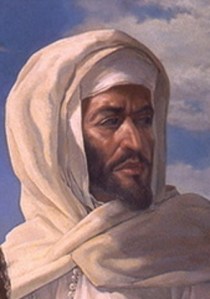
Mohammad ben Sliman
Moroccan
? – 1792


Friends, yesterday my beloved visited; it was the middle of Ramadan,
and it was as if I had gathered honey and roses,
but I was accused of breaking the fast—
why shouldn’t I have done so, after so much solitude!
Isn’t the sick person advised not to fast?

After the long drought, the storm makes its drum rumble;
saber at the ready, lightning routs the defeated cavalry;
while the wind, that intrepid rider,
after a short rest is ready to rumble.

The downpour attacks, standard flying,
victorious showers that have the torrents on the run,
and wherever the eye turns
my overflowing heart sees only green.

From the fields in bloom rises perfume—
spring, a king with no rival,
and restful shade
have invented marvelous new clothes.

Joyous inventor, Spring dispenses his riches:
roses, wild flowers, concerts of birdsong—
in a festive garden
where the bee gathers nectar among the roses.

Friends, yesterday my beloved visited; it was the middle of Ramadan,
and it was as if I had gathered honey and roses,
but I was accused of breaking the fast—
why shouldn’t I have done so, after so much solitude!
Isn’t the sick person advised not to fast?


Translation by Abdelfetah Chenni and Pierre Joris

The Floweret

Vasily Zhukovsky
Russian
1783 – 1852


Floweret, faded and forsaken,
Fragile beauty of the lea,
Autumn’s cruel hand hath taken
All thy summer charms from thee.

Heigho! that the years must bring
This same destiny to all;
One by one our joys take wing,
One by one your petals fall.

So each evening rings the knell
Of some dream or rapture perished,
And the fleeting hours dispel
Each some vision fondly cherished.

Life’s illusions lie unmasked,
And the star of hope burns paler.
Has not some sage long since asked:
Men or blossoms — which are frailer?


Translation by Rosa Newmarch

Tears Are Alike

In honor of V-E Day, we present this work by a poet of the French Resistance.

Louis Aragon
French
1897 – 1982


In the grey sky were porcelain angels
In the grey sky were stifled cries
I remember those days at Mainz
The Black Rhine and the weeping Loreleis

You would find sometimes at the end of an alley
A Frenchman dead with a knife-blade in the back
You would find sometimes that the peace was cruel
For all the young white wine of the terraces

I drank their transparent Kirschwasser
I drank the vows they whispered with clasped hand
How lovely were the palaces and churches
I was twenty then, I did not understand

What did I know about days of defeat
When you r country is a love forbidden
When you need the voice of false prophets
To bring lost hope to life again ?

I remember songs that touched the heart
I remember signs chalked in red
Found in the morning scribbled on walls
We never once deciphered what they said

Who can say where memory begins
Who can say where the present ends
Where the past becomes a sentimental ballad
And sorrow a paper yellowed with age?

Like a child surprised among his dreams
The blank looks of the vanquished made you
Then, at the tramp of guard relieving guard
The Rhenish silence shuddered to its heart.

On the Nature of Love

We present this work in honor of the poet’s 160th birthday.

Rabindranath Tagore
Indian
1861 – 1941


The night is black and the forest has no end;
a million people thread it in a million ways.
We have trysts to keep in the darkness, but where
or with whom – of that we are unaware.
But we have this faith – that a lifetime’s bliss
will appear any minute, with a smile upon its lips.
Scents, touches, sounds, snatches of songs
brush us, pass us, give us delightful shocks.
Then peradventure there’s a flash of lightning:
whomever I see that instant I fall in love with.
I call that person and cry: `This life is blest!
for your sake such miles have I traversed!’
All those others who came close and moved off
in the darkness – I don’t know if they exist or not.

Qasadi 25 in Praise of Sultan Suleyman

Hayâlî
Turkish
c.1500 – 1557


In the garden, the rose commanded a cavalry of flowers,
And put to flames again the dwelling place of the bulbul.

In the crucible of the bud the nightingale purifies gold,
That the rose might craft itself a ring for its ear.

The rose will not open the opium-vial of the bud to the knowers of mysteries,
So long as it is withdrawn, master of the secret of the trance.

The bulbul teaches the Parliament of birds to the garden of children,
Like the Perfumer, ‘Attar, the rose makes clear its every chapter.

Eager waiting opens wounds in the nightingale’s heart.
O Lord! Why does the rose keep such a tight collar on the bud?

Know this! In the rosebower every leaf is a page of delicate meaning,
Each bud The treasury of inner truth, each rose The dawn of illumination.

Truly, the flame and cotton can have no dance together.
The roses enfold the bulbul, like a salamander, in flames.

It is the black burn at its breast that makes each poppy loved,
So the rose in the meadow cannot shy from the cruelty of the thorn.

No wonder the flames of jealousy turn the bulbul to ash;
The playful rose hangs, laughing from the neck of every branch.

The rose made the bulbul’s nest a howdah for its kin,
Thus it seems to have made ready its caravan of exile.

It is time the rose caused the mouths of baby nightingales to open,
And thus make shepherd’s pipes of the bulbul’s nest.

The rose begs the morning breeze for the dust of the Monarch’s feet
As salve to cure the eye of the ailing narcissus of the garden.

What a Lord is Sultan Suleyman, the sound and firm of heart,
For whom the sun is but a gilded rosette on the portico of his palace!

The scent that wafts from the markets of China is but a trace of his virtue’s scent.
The rose, lord of flowers, is but a leaf in the chapter of his generosity.

Were it not, once a year, to bow its head in the dust at his feet,
The rose would not have bejewelled its ruby crown with pearls of dew.

Your enemy’s head, drenched in blood on the point of your spear,
Is like that tall and slender sapling tipped by a rose.

In the era of your justice, it is time that the rose beg mercy, O Shah!
For taking the blood of the bulbul, to rouge its face.

The bud is ever tight-lipped but in describing your justice;
And the rose recites no litany but that of your kind gifts.

My Lord, I came but to rub my face in the tracks of your hounds.
To me they are the only thornless roses in the bower of this world.

The rose made the nest of the bulbul a bowl for begging,
And thus came importunate to your court like a ragged dervish.

The rose-bush has adorned itself with brands all bloody,
O lord of beauty, since it became the lover of your face.

Tears made of dew are born on the rose’s face,
As it bewails the ill fortune of your slave Hayâlî.

O you, mighty as Jemshid, though I be transitory, my words live on.
The rose itself is destroyed but its traces remain in the rose-water.

Though I have come after Necâtĺ and Nevâyî, why sorrow?
The thorn sprouts first from the branch and after the thorn, a rose.

Though the thorn of grief bloodied my heart like the bud,
The fruit of the sprout of my fortune’s garden is a rose.

Just as every point of rain has for its source a cloud,
As the roses are drawn without compasses in the shapes of circles,

Let prosperity be the bud of the rose-bower of your reign,
And you, with rose-garden cheeks, smile like a rose at every breath.


Translation by Walter G. Andrews

That Evening

We present this work in honor of the poet’s 90th birthday.

Salah Abdel Sabour
Egyptian
1931 – 1981


You spoke to me
Of winged horse-shoes
Sparking all round,
Flashing, igniting
The golden crescents
Of city minarets;
You spoke to me
Of a bunch of swords hard,
Stuck in a rock so stark,
To be drawn only on a spell:
Namely, the names, the charmed names of
your bunch,
How great, how formidable,
How good, how nice, how sweet – unconquerable!
‘O minstrel’, you ordered, ‘Sing us a song
‘(But keep your eyes down
‘In our presence)
‘Sing us a lay
‘To tickle our pride
‘In the victory of the side,
‘And when the appointed hour comes
‘(An hour unveiled
‘By a cloud dispelled)
‘We’ll drink up the dregs
‘When the devil’s helmet begs
‘To be a goblet bright
‘For the wine of superior knight’.


Translation by M.M. Enani

When First My Way to Fair I Took

We present this work in honor of the 85th anniversary of the poet’s death.

A.E. Housman
English
1859 – 1936


When first my way to fair I took
Few pence in purse had I,
And long I used to stand and look
At things I could not buy.

Now times are altered: if I care
To buy a thing, I can;
The pence are here and here’s the fair,
But where’s the lost young man?

—To think that two and two are four
And neither five nor three
The heart of man has long been sore
And long ’tis like to be.