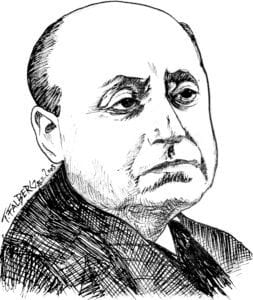
Why I am Not a Painter

We present this work in honor of the poet’s 95th birthday.
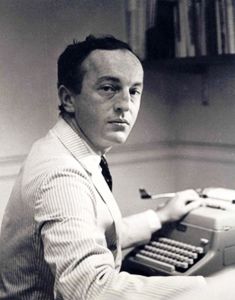
Frank O’Hara
American
1926 – 1966


I am not a painter, I am a poet.
Why? I think I would rather be
a painter, but I am not. Well,

for instance, Mike Goldberg
is starting a painting. I drop in.
“Sit down and have a drink” he
says. I drink; we drink. I look
up. “You have SARDINES in it.”
“Yes, it needed something there.”
“Oh.” I go and the days go by
and I drop in again. The painting
is going on, and I go, and the days
go by. I drop in. The painting is
finished. “Where’s SARDINES?”
All that’s left is just
letters, “It was too much,” Mike says.

But me? One day I am thinking of
a color: orange. I write a line
about orange. Pretty soon it is a
whole page of words, not lines.
Then another page. There should be
so much more, not of orange, of
words, of how terrible orange is
and life. Days go by. It is even in
prose, I am a real poet. My poem
is finished and I haven’t mentioned
orange yet. It’s twelve poems, I call
it ORANGES. And one day in a gallery
I see Mike’s painting, called SARDINES.
Weathering

We present this work in honor of the poet’s 95th birthday.

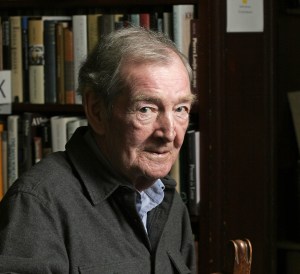
Alastair Reid
Scots
1926 – 2014


I am old enough now for a tree
once planted, knee high, to have grown to be
twenty times me,
and to have seen babies marry, and heroes grow deaf –
but that’s enough meaning-of-life.
It’s living through time we ought to be connoisseurs of.
From wearing a face all this time, I am made aware
of the maps faces are, of the inside wear and tear.
I take to faces that have come far.
In my father’s carved face, the bright eye
he sometimes would look out of, seeing a long way
through all the tree-rings of his history.
I am awed by how things weather: an oak mantel
in the house in Spain, fingered to a sheen,
the marks of hands leaned into the lintel,
the tokens in the drawer I sometimes touch –
a crystal lived-in on a trip, the watch
my father’s wrist wore to a thin gold sandwich.
It is an equilibrium
which breasts the cresting seasons but still stays calm
and keeps warm. It deserves a good name.
Weathering. Patina, gloss, and whorl.
The trunk of the almond tree, gnarled but still fruitful.
Weathering is what I would like to do well.

And Yet…

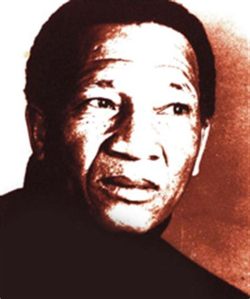
We present this work in honor of the South African holiday, Human Rights Day.

Don Mattera
South African
b. 1935


I have known silences
long and deep as death
when the mind questioned the logic
of my frailty
in the imminence of my destruction
by men ruled and ravaged by powerlust

I have known deep silences
when thoughts like angry waves
beat against the shores of my mind
revealing the scars of brutal memories
and the murder of my manhood

and yet
I cannot hate
try as I want to
I cannot hate… why?

Water

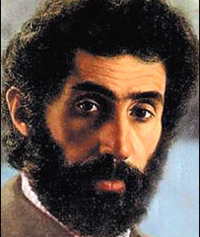
Sohrab Sepehri
Persian
1928 – 1980

Let’s not soil the water:
Perhaps a pigeon is drinking down there
Or a thrush dipping its wing by a far thicket
Or a pitcher being filled in a village.

Let’s not soil the water.
This stream is perhaps running to a white aspen
To sooth a lonely heart.
A dervish may have dipped his dry bread there.

A lovely lady has come to the stream.
Let’s not soil the water.
Beauty is doubled.

Sweet water!
Clear stream!
People are so affable there!
May their streams bubble!
And their cows produce abundant milk!
Never have I visited their village.
Their hedges must bear God’s footprints.
There, moonshine illuminates the expanse of speech.
No doubt, the fences are low in yonder village.
And its inhabitants know what peonies are.
No doubt, blue is blue there.

A bud blossoms! People know it.
What a glorious village it must be!
May its alleyways overflow with music!
The people living by the stream understand water.
They did not soil it
Nor should we.

Translation by Ismail Salami

Marina of the Rocks

We present this work in honor of the 25th anniversary of the poet’s death.

Oddyseas Elytis
Greek
1911 – 1996

You have a taste of tempest on your lips—But where did you wander
All day long in the hard reverie of stone and sea?
An eagle-bearing wind stripped the hills
Stripped your longing to the bone
And the pupils of your eyes received the message of chimera
Spotting memory with foam!
Where is the familiar slope of short September
On the red earth where you played, looking down
At the broad rows of the other girls
The corners where your friends left armfuls of rosemary.

But where did you wander
All night long in the hard reverie of stone and sea?
I told you to count in the naked water its luminous days
On your back to rejoice in the dawn of things
Or again to wander on yellow plains
With a clover of light on you breast, iambic heroine.

You have a taste of tempest on your lips
And a dress red as blood
Deep in the gold of summer
And the perfume of hyacinths—But where did you wander
Descending toward the shores, the pebbled bays?

There was cold salty seaweed there
But deeper a human feeling that bled
And you opened your arms in astonishment naming it
Climbing lightly to the clearness of the depths
Where your own starfish shone.

Listen. Speech is the prudence of the aged
And time is a passionate sculptor of men
And the sun stands over it, a beast of hope
And you, closer to it, embrace a love
With a bitter taste of tempest on your lips.

It is not for you, blue to the bone, to think of another summer,
For the rivers to change their bed
And take you back to their mother
For you to kiss other cherry trees
Or ride on the northwest wind.

Propped on the rocks, without yesterday or tomorrow,
Facing the dangers of the rocks with a hurricane hairstyle
You will say farewell to the riddle that is yours.

Translation by Edmund Keeley and Philip Sherrard

Bogland

We present this work in honor of St. Patrick’s Day.

Seamus Heaney
Irish
1939 – 2013


We have no prairies
To slice a big sun at evening—
Everywhere the eye concedes to
Encrouching horizon,

Is wooed into the cyclops’ eye
Of a tarn. Our unfenced country
Is bog that keeps crusting
Between the sights of the sun.

They’ve taken the skeleton
Of the Great Irish Elk
Out of the peat, set it up
An astounding crate full of air.

Butter sunk under
More than a hundred years
Was recovered salty and white.
The ground itself is kind, black butter

Melting and opening underfoot,
Missing its last definition
By millions of years.
They’ll never dig coal here,

Only the waterlogged trunks
Of great firs, soft as pulp.
Our pioneers keep striking
Inwards and downwards,

Every layer they strip
Seems camped on before.
The bogholes might be Atlantic seepage.

The wet centre is bottomless.

Home

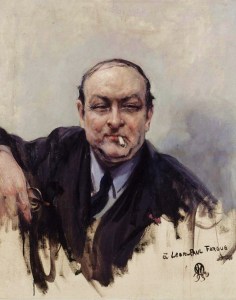
We present this work in honor of the poet’s 145th birthday.

Leon-Paul Fargue
French
1876 – 1947


A name, Cromac, makes us speak
Of a dark bay… O death of love,
Be less sad for weeping
Other names, other days

Where you were like the blind man
Looking at the dark red
And playing with his scratched hands
Over the old bench of his childhood…

Like the blind man, when he dreams
And grumbles, and when his heart
Scolds the warm bodied beauty
Watching him, in tears…

Cromac. The House under the branches
Whose window with flower eyes
Separated her long white hands
Gently, noiselessly, over your heart…