We present this work in honor of the poet’s 100th birthday.
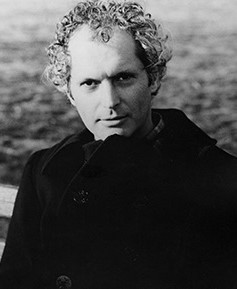
Edward Field American b. 1924
It sometimes happens that the woman you meet and fall in love with is of that strange Transylvanian people with an affinity for cats.
You take her to a restaurant, say, or a show, on an ordinary date, being attracted by the glitter in her slitty eyes and her catlike walk, and afterward of course you take her in your arms, and she turns into a black panther and bites you to death.
Or perhaps you are saved in the nick of time, and she is tormented by the knowledge of her tendency: that she daren’t hug a man unless she wants to risk clawing him up.
This puts you both in a difficult position, panting lovers who are prevented from touching not by bars but by circumstance: you have terrible fights and say cruel things, for having the hots does not give you a sweet temper.
One night you are walking down a dark street and hear the padpad of a panther following you, but when you turn around there are only shadows, or perhaps one shadow too many
You approach, calling, “Who’s there?” and it leaps on you. Luckily you have brought along your sword, and you stab it to death.
And before your eyes it turns into the woman you love, her breast impaled on your sword, her mouth dribbling blood saying she loved you but couldn’t help her tendency.
So death released her from the curse at last, and you knew from the angelic smile on her dead face that in spite of a life the devil owned, love had won, and heaven pardoned her.
We present this work in honor of the poet’s 120th birthday.
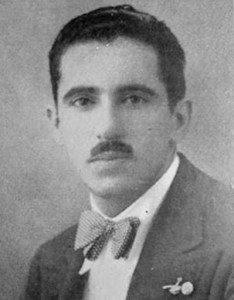
Francisco López Merino Argentine 1904 – 1928
You who go every Sunday to the Botanical Garden and while away hours in silence, contemplating the sumptuous colourings of flowers that you will never have in your own little garden ; you who ask fascinating things so ingenuously and explain to me the fantastic ambient of your dreams ; you who love like a child the leaves of the mint for the clean memories that its scent awakens; you who talk about the glittering enamels of exotic insects that blossom in the air; you who tell the life of Jean-Jacques, and know that under a clear sky he cuts herbs at close of day; you who dress in white for the Month of Mary and people the silence with images of peace: because you were my beloved you will lay on my tomb, when I am dead, lilacs of dark splendour.
o dove go to essaouira’s sons who live in tlemcen greet them with peace from allah pray for their glory & light that they come back the way they’ve left from the lion gate you’ll take flight o dove you’ll ask for protection from sidi mogdul patron of the harbor his news has reached istanbul take care & be cautious fly way beyond those rocky heaps and hilly lands touch with your wings Moulay durayn saint of regraga glory of our holy land tomorrow at dawn you’ll purify yourself when you hear the first call for prayer
I am a Turk; My religion and my race are great; Sinem, my essence is full of fire. A human being is a servant of his country. A Turkish child does not stay at home, I will go.
I will not have Muhammad’s book removed; I won’t let Osmancık’s flag be removed; I do not let my enemy attack my country. If the house of God does not fall into ruin, I will leave.
These lands are the home of my ancestors; My home, my village are always in this place; Here is the homeland, here is the lap of God. Your fatherland is your homeland, my son will not spoil it, I will leave.
My God is my witness, I will keep my word; The love of my nation is within me; I have nothing but my homeland in my eyes. My beloved bed does not have enemies, I will leave.
I wipe my tears with a white shirt; I sharpen my knife with a black stone; I wish greatness for my country. There will be no one left in this world, I will leave.
We present this work in honor of the poet’s 150th birthday.
Macedonio Fernández Argentine 1874 – 1952
Fathomless and full as two brief, graceful immensities, your eyes inhabit your countenance like lords; and when from their depths I see dallying and rising the flame of a radiant soul, it seems that the morning is rising from sleep, shining, over there between sea and sky, where that drowsy line rocks between two blue empires, the line where our hearts pause to caress it with their hopes, to kiss it with their glance; when our being meditates, drying its tears, and, silently, throws itself open to all the breezes of Life; when we glimpse the ashes of days gone by floating in the Past like the dust of all our pilgrimages left behind at the last turn of the road: Eyes that open like mornings and, closing, let evening fall.
We present this work in honor of May Revolution Day.
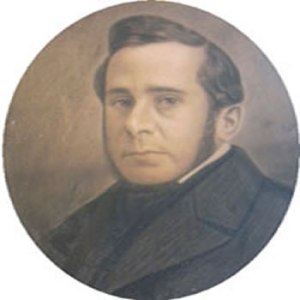
José Mármol Argentine 1817 – 1871
ON MAY 25, 1850
Roses! Roses! a genius without a second He formed your strange destiny at his whim: After Satan, no one in the world, Like you, it did less good or as much damage.
Aborted from a crime, you have wanted May your works be twinned with your origin; And, never repenting of the crime, Only the hours of stillness afflict you.
With the flames of Tartarus lit A cloud of blood surrounds you; And throughout the horizon of your life Blood, barbaric! and blood, and blood smokes.
Your hand will move like lightning The foundations of a temple, and suddenly From the altar the idols of May They poured blood from his broken forehead.
Justice is approaching religious To call at the tomb of Belgrano: And that immortal dead man opens his slab, Raising his helpless hand to the sky.
Freedom escapes with glory To hide in the crevices of the Andes; Claiming memory from the ice From those times when they were great.
Idols and time disappear; The radiant lights go out, And in immaculate blood they turn red The fragments of pyres and altars.
Glory, name, virtue, Argentine homeland, Everything perishes when your foot stamps, Everything turns to dust, in your ambition of ruin, Under the helmet the foals of your pampa.
Well, Rosas, later? such is—heed— The question of God and history: That after you accuse or defend In the ruin of a town or in its glory.
That fatal afterward that challenges you Over the corpse of my country, In my inspired poet’s voice, The tremendous voice of the one who lights the day.
Speak, and, in pursuit of destruction, respond: Where are the works that thy hand sprouted? Where your creation? The bases where A great idea or a vain thought?
What mind was there in your bloody insomnia That you were so driven to so much crime? Move away, move away, abortion of the devil What are you doing wrong to enjoy crying!
The human race is horrified to see you, Indus hyena transformed into a man; But woe to you, that one day when I understood you He will not hate you, he will despise your name!
Time has offered you its moments; Fortune has touched your head; And, barbarian and nothing more, you have not known Neither gain time, nor gain greatness.
You overthrew a republic, and your forehead With an imperial diadem you do not elevate ledo; Freedom died, and, omnipotent, Slave you live by your own fear.
You want to be king, and you fear it will become In the crown of Milan yours; You want to be great, and your soul is not right How to rise from his sphere.
Your kingdom is the empire of death; Your greatness, the terror of your crimes; And your ambition, your freedom, your luck Open graves and form outcasts.
Wild gaucho of the rough pampas, That is not glory, nor value, nor life; That’s only killing because it strips They gave you a fratricidal sword.
And, great criminal in memory Of the whole world, of your full crime, You will be a reptile that will step on history Disgusted by your form and your poison!
Nero sets fire to Rome, and contemplates it, And there is I don’t know what is heroic in such a crime; But you, with a soul that the devil tempers, How much do you do has your misery written on it.
No Atreus when in danger hesitates, And you, more than them for evil, trembled; And bloodier than bloody Attila, You never looked at the blood of the fight.
In all those eagles that grabbed Humanity and, in carnage fever, With their metal claws they wounded her, There is some virtue: even courage.
But your heart only overflows Of miseries and crimes and vices, With a stupid and rabid thirst Of doing evil and inventing torture.
You don’t even owe yourself fate With which you have quenched your thirst for blood; Tiger you met on the way A wounded lion that you have devoured.
Spirit of evil born to the world, You have not been good even to yourself; And you will only leave an unclean name When descending into your first abyss.
Mothers will name you for their children When you want to scare them in the crib; And they, trembling and fixed on your image, They will fall asleep dreaming that they saw you.
The troubadours will pay tribute To the stories that your memory invents; And execrating your fruitless crimes, Rude and vulgar History will call you.
Ah, that I bless almost your crimes, Faced with the anger of my country, Why do you suffer such a barbaric punishment? As long as the light of day shines!
Because as long as the sun shines in El Plata You will suffer that punishment eternally; Never to your name the thankless memory: Never curse your tender breast;
And finally scourge of your luck, You will see when you breathe out that it rises Beautiful and triumphant and powerful and strong The town that you outraged with your plant.
For there will not be in it, from your delicate hands, More than just a stain on the neck; That you don’t know, vulgar tyrant, Nor leave the mark of your chains.
We present this work in honor of the poet’s 125th birthday.
Kazi Nazrul Islam Indian 1899 – 1976
O poets of the future, may you arise Like the morning sun, Bright and red like hibiscus blossoms. In the golden dawn for which we long May you wake up like countless flocks of birds. I sing in the hope that you will come To soar in the blue sky that I create. I leave behind the memory of my greetings to you: Play on my veena the song of the new day.
We present this work in honor of the poet’s 225th birthday.
Thomas Hood English 1799 – 1845
One more Unfortunate Weary of breath Rashly importunate, Gone to her death!
Take her up tenderly; Lift her with care; Fashion’d so slenderly, Young, and so fair!
Look at her garments Clinging like cerements; Whilst the wave constantly Drips from her clothing; Take her up instantly, Loving, not loathing.
Touch her not scornfully; Think of her mournfully, Gently and humanly; Not of the stains of her — All that remains of her Now is pure womanly.
Make no deep scrutiny Into her mutiny Rash and undutiful: Past all dishonour, Death has left on her Only the beautiful.
Still, for all slips of hers, One of Eve’s family— Wipe those poor lips of hers Oozing so clammily.
Loop up her tresses Escaped from the comb, Her fair auburn tresses; Whilst wonderment guesses Where was her home?
Who was her father? Who was her mother? Had she a sister? Had she a brother? Or was there a dearer one Still, and a nearer one Yet, than all other?
Alas! for the rarity Of Christian charity Under the Sun! O! it was pitiful! Near a whole city full, Home she had none.
Sisterly, brotherly, Fatherly, motherly Feelings had changed: Love, by harsh evidence, Thrown from its eminence; Even God’s providence Seemed estranged.
Where the lamps quiver So far in the river, With many a light From window and casement, From garret to basement, She stood, with amazement, Houseless by night.
The bleak wind of March Made her tremble and shiver; But not the dark arch, Or the black flowing river: Mad from life’s history, Glad to death’s mystery Swift to be hurl’d— Anywhere, anywhere Out of the world!
In she plunged boldly, No matter how coldly The rough river ran, Over the brink of it,— Picture it, think of it, Dissolute Man! Lave in it, drink in it, Then, if you can!
Ere her limbs frigidly Stiffen too rigidly, Decently, kindly, Smooth and compose them; And her eyes, close them, Staring so blindly!
Dreadfully staring Thro’ muddy impurity, As when with the daring Last look of despairing Fix’d on futurity.
Perishing gloomily, Spurr’d by contumely, Cold inhumanity, Burning insanity, Into her rest. —Cross her hands humbly As if praying dumbly, Over her breast!
Owning her weakness, Her evil behaviour, And leaving, with meekness, Her sins to her Saviour!
We present this work in honor of the poet’s 255th birthday.
John Hookham Frere English 1769 – 1846
FRIEND OF HUMANITY.
“Needy Knife-grinder! whether are you going? Rough is the road, your wheel is out of order— Bleak blows the Blast;—your hat has got a hole in’t, So have your breeches!
“Weary Knife-grinder! little think the proud ones Who in their coaches roll along the turnpike- -road, what hard work ‘tis crying all day, ‘Knives and ‘Scissars to grind O!’
“Tell me Knife-grinder, how came you to grind knives? Did some rich man tyrannically use you? Was it the squire? or parson of the parish; Or the attorney?
“Was it the squire, for killing of his game? or Covetous parson, for his tithes distraining? Or roguish lawyer, made you lose your little All in a lawsuit?
“(Have you not read the Rights of Man, by Tom Paine?) Drops of compassion tremble on my eyelids, Ready to fall, as soon as you have told your Pitiful story.”
KNIFE-GRINDER.
“Story! God bless you! I have none to tell, Sir, Only last night a-drinking at the Chequers, This poor old hat and breeches, as you see, were Torn in a scuffle.
“Constables came up for to take me into Custody; they took me before the justice; Justice Oldmixon put me in the parish- stocks for a vagrant.
“I should be glad to drink your Honor’s health in A pot of beer, if you will give me sixpence; But for my part, I never love to meddle With Politics, Sir.”
FRIEND OF HUMANITY.
“I give thee sixpence! I will see thee damn’d first— Wretch! whom no sense of wrongs can rouse to vengeance— Sordid, unfeeling, reprobate, degraded, Spiritless outcast!”
Kicks the Knife-grinder, overturns his wheel, and exit in a transport of Republican enthusiasm and universal philanthropy.




 Poets Corner