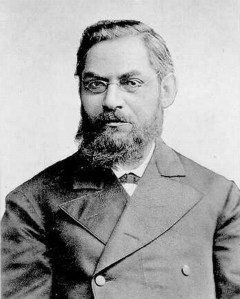
Awake, my people! How long will you sleep?
The night has passed, the sun shines through.
Awake, cast your eyes hither and yon
Recognize your time and place.
Has the march of time stood still
From the day you left for all parts of the globe?
Thousands of years have come and gone
Since your freedom was lost and you wandered away.
Many generations have been born and died
Oceans and continents have intervened
Remarkable changes have taken place
A different world engulfs us today.
Awake, my people! How long will you sleep?
The night has passed, the sun shines through.
Awake, cast your eyes hither and yon
Recognize your time and place.
The land where we live and are born
Is not thought to be part of Europe?
Europe, the smallest of continents
But the mightiest of all in wisdom and knowledge.
This land of Eden is now open to you
Its sons now call you “brothers.”
How long will you dwell among them as a guest
Why do you reject their hand?
They have already removed the burden from your back
And lifted the yoke from around your neck
They have erased from their hearts hatred and folly
The stretch out their hands to you in peace.
So raise your head high, stand up straight
Look at them with loving eyes,
Open your hearts to wisdom and reason
Become an enlightened nation, speaking their tongue.
Everyone capable of learning should study
Laborers and artisans should take to a craft
The strong and the brave should be soldiers
Farmers should buy fields and ploughs.
To the treasury of the state bring your wealth
Bear your share of its riches and bounty
Be a man in the streets and a Jew at home
A brother to your countryman and a servant to your king.
Awake, my people! How long will you sleep?
The night has passed, the sun shines through.
Awake, cast your eyes hither and yon
Recognize your time and place.
There are strange things done in the midnight sun By the men who moil for gold; The Arctic trails have their secret tales That would make your blood run cold; The Northern Lights have seen queer sights, But the queerest they ever did see Was that night on the marge of Lake Lebarge I cremated Sam McGee.
Now Sam McGee was from Tennessee, where the cotton blooms and blows.
Why he left his home in the South to roam ‘round the Pole, God only knows.
He was always cold, but the land of gold seemed to hold him like a spell;
Though he’d often say in his homely way that he’d “sooner live in hell”.
On a Christmas Day we were mushing our way over the Dawson trail.
Talk of your cold! through the parka’s fold it stabbed like a driven nail.
If our eyes we’d close, then the lashes froze till sometimes we couldn’t see;
It wasn’t much fun, but the only one to whimper was Sam McGee.
And that very night, as we lay packed tight in our robes beneath the snow,
And the dogs were fed, and the stars o’erhead were dancing heel and toe,
He turned to me, and “Cap,” says he, “I’ll cash in this trip, I guess;
And if I do, I’m asking that you won’t refuse my last request.”
Well, he seemed so low that I couldn’t say no; then he says with a sort of moan:
“It’s the cursed cold, and it’s got right hold till I’m chilled clean through to the bone.
Yet ‘tain’t being dead — it’s my awful dread of the icy grave that pains;
So I want you to swear that, foul or fair, you’ll cremate my last remains.”
A pal’s last need is a thing to heed, so I swore I would not fail;
And we started on at the streak of dawn; but God! he looked ghastly pale.
He crouched on the sleigh, and he raved all day of his home in Tennessee;
And before nightfall a corpse was all that was left of Sam McGee.
There wasn’t a breath in that land of death, and I hurried, horror-driven,
With a corpse half hid that I couldn’t get rid, because of a promise given;
It was lashed to the sleigh, and it seemed to say:
“You may tax your brawn and brains,
But you promised true, and it’s up to you to cremate those last remains.”
Now a promise made is a debt unpaid, and the trail has its own stern code.
In the days to come, though my lips were dumb, in my heart how I cursed that load.
In the long, long night, by the lone firelight, while the huskies, round in a ring,
Howled out their woes to the homeless snows — O God! how I loathed the thing.
And every day that quiet clay seemed to heavy and heavier grow;
And on I went, though the dogs were spent and the grub was getting low;
The trail was bad, and I felt half mad, but I swore I would not give in;
And I’d often sing to the hateful thing, and it hearkened with a grin.
Till I came to the marge of Lake Lebarge, and a derelict there lay;
It was jammed in the ice, but I saw in a trice it was called the “Alice May”.
And I looked at it, and I thought a bit, and I looked at my frozen chum;
Then “Here,” said I, with a sudden cry, “is my cre-ma-tor-eum.”
Some planks I tore from the cabin floor, and I lit the boiler fire;
Some coal I found that was lying around, and I heaped the fuel higher;
The flames just soared, and the furnace roared — such a blaze you seldom see;
And I burrowed a hole in the glowing coal, and I stuffed in Sam McGee.
Then I made a hike, for I didn’t like to hear him sizzle so;
And the heavens scowled, and the huskies howled, and the wind began to blow.
It was icy cold, but the hot sweat rolled down my cheeks, and I don’t know why;
And the greasy smoke in an inky cloak went streaking down the sky.
I do not know how long in the snow I wrestled with grisly fear;
But the stars came out and they danced about ere again I ventured near;
I was sick with dread, but I bravely said: “I’ll just take a peep inside.
I guess he’s cooked, and it’s time I looked”;… then the door I opened wide.
And there sat Sam, looking cool and calm, in the heart of the furnace roar;
And he wore a smile you could see a mile, and he said: “Please close that door.
It’s fine in here, but I greatly fear you’ll let in the cold and storm —
Since I left Plumtree, down in Tennessee, it’s the first time I’ve been warm.”
There are strange things done in the midnight sun By the men who moil for gold; The Arctic trails have their secret tales That would make your blood run cold; The Northern Lights have seen queer sights, But the queerest they ever did see Was that night on the marge of Lake Lebarge I cremated Sam McGee.
We present this work in honor of the poet’s 185th birthday.
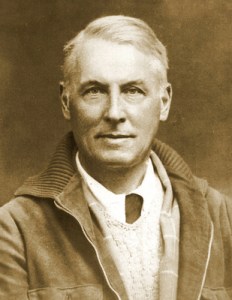
Mark Twain American 1835 – 1910
It was a time of great and exalting excitement.
The country was up in arms, the war was on, in every breast burned the holy fire of patriotism; the drums were beating, the bands playing, the toy pistols popping, the bunched firecrackers hissing and spluttering; on every hand and far down the receding and fading spread of roofs and balconies a fluttering wilderness of flags flashed in the sun; daily the young volunteers marched down the wide avenue gay and fine in their new uniforms, the proud fathers and mothers and sisters and sweethearts cheering them with voices choked with happy emotion as they swung by; nightly the packed mass meetings listened, panting, to patriot oratory which stirred the deepest deeps of their hearts, and which they interrupted at briefest intervals with cyclones of applause, the tears running down their cheeks the while; in the churches the pastors preached devotion to flag and country, and invoked the God of Battles beseeching His aid in our good cause in outpourings of fervid eloquence which moved every listener. It was indeed a glad and gracious time, and the half dozen rash spirits that ventured to disapprove of the war and cast a doubt upon its righteousness straightway got such a stern and angry warning that for their personal safety’s sake they quickly shrank out of sight and offended no more in that way.
Sunday morning came – next day the battalions would leave for the front; the church was filled; the volunteers were there, their young faces alight with martial dreams – visions of the stern advance, the gathering momentum, the rushing charge, the flashing sabers, the flight of the foe, the tumult, the enveloping smoke, the fierce pursuit, the surrender! Then home from the war, bronzed heroes, welcomed, adored, submerged in golden seas of glory! With the volunteers sat their dear ones, proud, happy, and envied by the neighbors and friends who had no sons and brothers to send forth to the field of honor, there to win for the flag, or, failing, die the noblest of noble deaths. The service proceeded; a war chapter from the Old Testament was read; the first prayer was said; it was followed by an organ burst that shook the building, and with one impulse the house rose, with glowing eyes and beating hearts, and poured out that tremendous invocation
God the all-terrible!
Thou who ordainest!
Thunder thy clarion
and lightning thy sword!
Then came the “long” prayer. None could remember the like of it for passionate pleading and moving and beautiful language. The burden of its supplication was, that an ever-merciful and benignant Father of us all would watch over our noble young soldiers, and aid, comfort, and encourage them in their patriotic work; bless them, shield them in the day of battle and the hour of peril, bear them in His mighty hand, make them strong and confident, invincible in the bloody onset; help them to crush the foe, grant to them and to their flag and country imperishable honor and glory –
An aged stranger entered and moved with slow and noiseless step up the main aisle, his eyes fixed upon the minister, his long body clothed in a robe that reached to his feet, his head bare, his white hair descending in a frothy cataract to his shoulders, his seamy face unnaturally pale, pale even to ghastliness. With all eyes following him and wondering, he made his silent way; without pausing, he ascended to the preacher’s side and stood there waiting. With shut lids the preacher, unconscious of his presence, continued with his moving prayer, and at last finished it with the words, uttered in fervent appeal, “Bless our arms, grant us the victory, O Lord our God, Father and Protector of our land and flag!”
The stranger touched his arm, motioned him to step aside – which the startled minister did – and took his place. During some moments he surveyed the spellbound audience with solemn eyes, in which burned an uncanny light; then in a deep voice he said:
“I come from the Throne – bearing a message from Almighty God!” The words smote the house with a shock; if the stranger perceived it he gave no attention. “He has heard the prayer of His servant your shepherd, and will grant it if such shall be your desire after I, His messenger, shall have explained to you its import – that is to say, its full import. For it is like unto many of the prayers of men, in that it asks for more than he who utters it is aware of – except he pause and think.
“God’s servant and yours has prayed his prayer. Has he paused and taken thought? Is it one prayer? No, it is two – one uttered, the other not. Both have reached the ear of Him Who heareth all supplications, the spoken and the unspoken. Ponder this – keep it in mind. If you would beseech a blessing upon yourself, beware! lest without intent you invoke a curse upon a neighbor at the same time. If you pray for the blessing of rain upon your crop which needs it, by that act you are possibly praying for a curse upon some neighbor’s crop which may not need rain and can be injured by it.
“You have heard your servant’s prayer – the uttered part of it. I am commissioned of God to put into words the other part of it – that part which the pastor – and also you in your hearts – fervently prayed silently. And ignorantly and unthinkingly? God grant that it was so! You heard these words: ‘Grant us the victory, O Lord our God!’ That is sufficient. The whole of the uttered prayer is compact into those pregnant words. Elaborations were not necessary. When you have prayed for victory you have prayed for many unmentioned results which follow victory – must follow it, cannot help but follow it. Upon the listening spirit of God fell also the unspoken part of the prayer. He commandeth me to put it into words. Listen!
“O Lord our Father, our young patriots, idols of our hearts, go forth to battle – be Thou near them! With them – in spirit – we also go forth from the sweet peace of our beloved firesides to smite the foe.
O Lord our God,
help us to tear their soldiers to bloody shreds with our shells;
help us to cover their smiling fields with the pale forms of their patriot dead;
help us to drown the thunder of the guns with the shrieks of their wounded, writhing in pain;
help us to lay waste their humble homes with a hurricane of fire;
help us to wring the hearts of their unoffending widows with unavailing grief;
help us to turn them out roofless with little children to wander unfriended the wastes of their desolated land in rags and hunger and thirst,
sports of the sun flames of summer and the icy winds of winter,
broken in spirit,
worn with travail,
imploring Thee for the refuge of the grave and denied it –
for our sakes who adore Thee, Lord,
blast their hopes,
blight their lives,
protract their bitter pilgrimage,
make heavy their steps,
water their way with their tears,
stain the white snow with the blood of their wounded feet!
We ask it, in the spirit of love,
of Him Who is the Source of Love, and Who is the ever-faithful refuge and friend of all that are sore beset and seek His aid with humble and contrite hearts.
Amen.
(After a pause.) “Ye have prayed it; if ye still desire it, speak! The messenger of the Most High waits!”
It was believed afterward that the man was a lunatic, because there was no sense in what he said.
We present this work in honor of the Japanese holiday, Labor Thanksgiving Day.
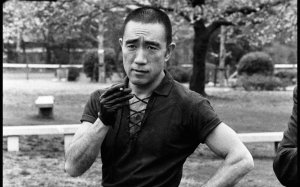
Shinkichi Takahashi Japanese 1901 – 1987
Beyond words,
this no-thingness within,
Which I’ve become.
So to remain
Only one thing’s needed:
Zen sitting.
I think, breathe with my whole body – Marvellous.
The joy’s so pure,
It’s beyond lovemaking, anything.
I can see, live anywhere, everywhere.
I need nothing, not even life.
In honor of Revolution Day, we present this work by one of Mexico’s most romantic poets.
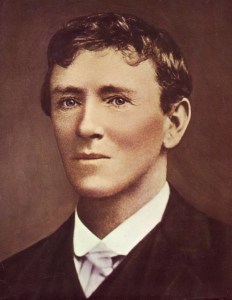
Manuel Acuña Mexican 1849 – 1873
When your bud barely half-opened
Aspires to good fortune and happiness,
Do you already bend tired and breathless,
Giving yourself over to pain and despair?
Do you not see that the vile shadow
Which blackens the firmament’s blue,
Is only a cloud which will at the blow
Of the wind, again let you see the day?…
Wake up and rise!… The time is not yet here
When deep within your heart,
You yield to the pain that humbles you.
Unjust to the sun is your accusation
That the shadow which passes and blinds you
Is darkness, for night hasn’t arrived yet.
In Xanadu did Kubla Khan
A stately pleasure-dome decree:
Where Alph, the sacred river, ran
Through caverns measureless to man
Down to a sunless sea.
So twice five miles of fertile ground
With walls and towers were girdled round:
And there were gardens bright with sinuous rills,
Where blossomed many an incense-bearing tree;
And here were forests ancient as the hills,
Enfolding sunny spots of greenery.
But oh! that deep romantic chasm which slanted
Down the green hill athwart a cedarn cover!
A savage place! as holy and enchanted
As e’er beneath a waning moon was haunted
By woman wailing for her demon-lover!
And from this chasm, with ceaseless turmoil seething,
As if this earth in fast thick pants were breathing,
A mighty fountain momently was forced:
Amid whose swift half-intermitted burst
Huge fragments vaulted like rebounding hail,
Or chaffy grain beneath the thresher’s flail:
And ‘mid these dancing rocks at once and ever
It flung up momently the sacred river.
Five miles meandering with a mazy motion
Through wood and dale the sacred river ran,
Then reached the caverns measureless to man,
And sank in tumult to a lifeless ocean:
And ‘mid this tumult Kubla heard from far
Ancestral voices prophesying war!
The shadow of the dome of pleasure
Floated midway on the waves;
Where was heard the mingled measure
From the fountain and the caves.
It was a miracle of rare device,
A sunny pleasure-dome with caves of ice!
A damsel with a dulcimer
In a vision once I saw:
It was an Abyssinian maid,
And on her dulcimer she played,
Singing of Mount Abora.
Could I revive within me
Her symphony and song,
To such a deep delight ‘twould win me,
That with music loud and long,
I would build that dome in air,
That sunny dome! those caves of ice!
And all who heard should see them there,
And all should cry, Beware! Beware!
His flashing eyes, his floating hair!
Weave a circle round him thrice,
And close your eyes with holy dread,
For he on honey-dew hath fed,
And drunk the milk of Paradise.
In a double observance, we present this work in honor of Moroccan Independence Day and the 25th anniversary of the poet’s death.
Mohammed Khaïr-Eddine Moroccan 1941 – 1995
the bloody morning sprinkled the legends born from dregs
from stars deflowered at full speed
and it lifts my blood like a mustang ringed by eagles
from the high plateau where your fingers fold the sumacs’ fire
to the steppe cracked open by the beaks of ernes
I beat the sky with the questions of my fists
milky morning salt of lilies and agrotis moths
the abyss rewards us with the belly of an antelope slaughtered
in the thunder’s millet
but not a word
not a word if not the flour of lyctus beetles by this masculine weather
and by sheaves the aphids of wind under catnip
too bad so lonely too bad I forge the public flag
of dawn I wipe my eyes with it before entering
the inextricably fair tradition of time

 Poets Corner