We present this work in honor of the Day of the Dead.
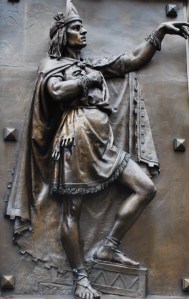
Nezahualcoyotl Mexican 1402 – 1472
He makes the Eagles and Ocelots dance with him!
Come to see the Huexotzinca:
On the dais of the Eagle he shouts out,
Loudly cries the Mexica.
The battlefield is the place: where one toasts the divine liquor in war,
where are stained red the divine eagles,
where the tigers howl,
where all kinds of precious stones rain from ornaments,
where wave headdresses rich with fine plumes,
where princes are smashed to bits.
There is nothing like death in war,
nothing like the flowery death
so precious to Him who gives life:
far off I see it: my heart yearns for it!
And they called it Teotihulcan
because it was the place
where the lords were buried.
Thus they said:
‘When we die,
truly we die not,
because we will live, we will rise,
we will continue living, we will awaken
This will make us happy.’
Thus the dead one was directed,
when he died:
‘Awaken, already the sky is rosy,
already dawn has come,
already sing the flame-coloured guans,
the fire-coloured swallows,
already the butterflies fly.’
Thus the old ones said
that who has died has become a god,
they said: ‘He has been made a god there,
meaning ‘He has died.’
Even jade is shattered,
Even gold is crushed,
Even quetzal plume are torn . . .
One does not live forever on this earth:
We endure only for an instant!
Will flowers be carried to the Kingdom of Death:
Is it true that we are going, we are going?
Where are we going, ay, where are we going?
Will we be dead there or will we live yet?
Does one exist again?
Perhaps we will live a second time?
Thy heart knows:
Just once do we live!.
Like a quetzal plume, a fragrant flower,
friendship sparkles:
like heron plumes, it weaves itself into finery.
Our song is a bird calling out like a jingle:
how beautiful you make it sound!
Here, among flowers that enclose us,
among flowery boughs you are singing.
the earth is a grave and nothing escapes it, nothing is so perfect
that it does not descend to its tomb. Rivers, rivulets, fountains and
waters flow, but never return to their joyful beginnings; anxiously
they hasten on the vast realms of the rain god. As they widen their
banks, they also fashion the sad urn of their burial.
Filled are the bowels of the earth with pestilential dust once flesh and bone,
once animate bodies of man who sat upon thrones, decided cases, presided in
council, commanded armies, conquered provinces, possessed treasure, destroyed
temples, exulted in their pride, majesty, fortune, praise and power. Vanished
are these glories, just as the fearful smoke vanishes that belches forth from
the infernal fires of Popocatepetl. Nothing recalls them but the written page.
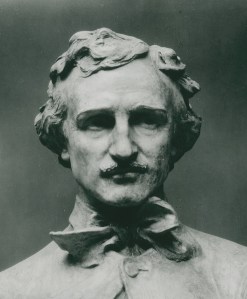
Once upon a midnight dreary, while I pondered, weak and weary,
Over many a quaint and curious volume of forgotten lore,
While I nodded, nearly napping, suddenly there came a tapping,
As of some one gently rapping, rapping at my chamber door.
“Tis some visitor,’ I muttered, ‘tapping at my chamber door-
Only this, and nothing more.’
Ah, distinctly I remember it was in the bleak December,
And each separate dying ember wrought its ghost upon the floor.
Eagerly I wished the morrow;- vainly I had sought to borrow
From my books surcease of sorrow- sorrow for the lost Lenore-
For the rare and radiant maiden whom the angels name Lenore-
Nameless here for evermore.
And the silken sad uncertain rustling of each purple curtain
Thrilled me- filled me with fantastic terrors never felt before;
So that now, to still the beating of my heart, I stood repeating,
“Tis some visitor entreating entrance at my chamber door-
Some late visitor entreating entrance at my chamber door;-
This it is, and nothing more.’
Presently my soul grew stronger; hesitating then no longer,
‘Sir,’ said I, ‘or Madam, truly your forgiveness I implore;
But the fact is I was napping, and so gently you came rapping,
And so faintly you came tapping, tapping at my chamber door,
That I scarce was sure I heard you’- here I opened wide the door;-
Darkness there, and nothing more.
Deep into that darkness peering, long I stood there wondering, fearing,
Doubting, dreaming dreams no mortals ever dared to dream before;
But the silence was unbroken, and the stillness gave no token,
And the only word there spoken was the whispered word, ‘Lenore!’
This I whispered, and an echo murmured back the word, ‘Lenore!’-
Merely this, and nothing more.
Back into the chamber turning, all my soul within me burning,
Soon again I heard a tapping somewhat louder than before.
‘Surely,’ said I, ‘surely that is something at my window lattice:
Let me see, then, what thereat is, and this mystery explore-
Let my heart be still a moment and this mystery explore;-
‘Tis the wind and nothing more.’
Open here I flung the shutter, when, with many a flirt and flutter,
In there stepped a stately raven of the saintly days of yore;
Not the least obeisance made he; not a minute stopped or stayed he;
But, with mien of lord or lady, perched above my chamber door-
Perched upon a bust of Pallas just above my chamber door-
Perched, and sat, and nothing more.
Then this ebony bird beguiling my sad fancy into smiling,
By the grave and stern decorum of the countenance it wore.
‘Though thy crest be shorn and shaven, thou,’ I said, ‘art sure no craven,
Ghastly grim and ancient raven wandering from the Nightly shore-
Tell me what thy lordly name is on the Night’s Plutonian shore!’
Quoth the Raven, ‘Nevermore.’
Much I marvelled this ungainly fowl to hear discourse so plainly,
Though its answer little meaning- little relevancy bore;
For we cannot help agreeing that no living human being
Ever yet was blest with seeing bird above his chamber door-
Bird or beast upon the sculptured bust above his chamber door,
With such name as ‘Nevermore.’
But the raven, sitting lonely on the placid bust, spoke only
That one word, as if his soul in that one word he did outpour.
Nothing further then he uttered- not a feather then he fluttered-
Till I scarcely more than muttered, ‘other friends have flown before-
On the morrow he will leave me, as my hopes have flown before.’
Then the bird said, ‘Nevermore.’
Startled at the stillness broken by reply so aptly spoken,
‘Doubtless,’ said I, ‘what it utters is its only stock and store,
Caught from some unhappy master whom unmerciful Disaster
Followed fast and followed faster till his songs one burden bore-
Till the dirges of his Hope that melancholy burden bore
Of ‘Never- nevermore’.’
But the Raven still beguiling all my fancy into smiling,
Straight I wheeled a cushioned seat in front of bird, and bust and door;
Then upon the velvet sinking, I betook myself to linking
Fancy unto fancy, thinking what this ominous bird of yore-
What this grim, ungainly, ghastly, gaunt and ominous bird of yore
Meant in croaking ‘Nevermore.’
This I sat engaged in guessing, but no syllable expressing
To the fowl whose fiery eyes now burned into my bosom’s core;
This and more I sat divining, with my head at ease reclining
On the cushion’s velvet lining that the lamplight gloated o’er,
But whose velvet violet lining with the lamplight gloating o’er,
She shall press, ah, nevermore!
Then methought the air grew denser, perfumed from an unseen censer
Swung by Seraphim whose footfalls tinkled on the tufted floor.
‘Wretch,’ I cried, ‘thy God hath lent thee- by these angels he hath sent thee
Respite- respite and nepenthe, from thy memories of Lenore!
Quaff, oh quaff this kind nepenthe and forget this lost Lenore!’
Quoth the Raven, ‘Nevermore.’
‘Prophet!’ said I, ‘thing of evil!- prophet still, if bird or devil!-
Whether Tempter sent, or whether tempest tossed thee here ashore,
Desolate yet all undaunted, on this desert land enchanted-
On this home by horror haunted- tell me truly, I implore-
Is there- is there balm in Gilead?- tell me- tell me, I implore!’
Quoth the Raven, ‘Nevermore.’
‘Prophet!’ said I, ‘thing of evil- prophet still, if bird or devil!
By that Heaven that bends above us- by that God we both adore-
Tell this soul with sorrow laden if, within the distant Aidenn,
It shall clasp a sainted maiden whom the angels name Lenore-
Clasp a rare and radiant maiden whom the angels name Lenore.’
Quoth the Raven, ‘Nevermore.’
‘Be that word our sign in parting, bird or fiend,’ I shrieked, upstarting-
‘Get thee back into the tempest and the Night’s Plutonian shore!
Leave no black plume as a token of that lie thy soul hath spoken!
Leave my loneliness unbroken!- quit the bust above my door!
Take thy beak from out my heart, and take thy form from off my door!’
Quoth the Raven, ‘Nevermore.’
And the Raven, never flitting, still is sitting, still is sitting
On the pallid bust of Pallas just above my chamber door;
And his eyes have all the seeming of a demon’s that is dreaming,
And the lamplight o’er him streaming throws his shadow on the floor;
And my soul from out that shadow that lies floating on the floor
Shall be lifted- nevermore!
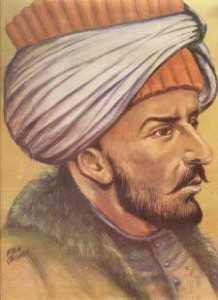
In honor of the Turkish holiday, Republic Day, we present this work by one of Turkey’s most celebrated poets.
Nedim Turkish 1681 – 1730
Let us bestow joy upon this heart filled with woe;
let us go to Sa’dabad, my beloved cypress;
here is the six-oared boat awaiting us;
let us go to Sa’dabad, my beloved cypress.
Let us laugh and play, let us enjoy the world;
let us drink nectar from the newly-made fountain;
let us watch the elixir pour from the dragon’s mouth;
let us go to Sa’dabad, my beloved cypress.
Let us go, for a while, and wander around the pond;
let us later gaze upon the Heavenly Pavilion;
let us always sing songs and recite poems;
let us go to Sa’dabad, my beloved cypress.
Ask your mother’s permission to go to the Friday prayer;
let us steal a day from reproachful destiny;
going through the secret roads towards the quay,
let us go to Sa’dabad, my beloved cypress.
Just you and me and a nice, old musician and,
if you permit, the mad poet Nedim,
let us, today, forget about the others;
let us go to Sa’dabad, my beloved cypress.
The women tell me every day
That all my bloom has past away.
‘Behold,’ the pretty wantons cry,
‘Behold this mirror with a sigh;
The locks upon thy brow are few,
And, like the rest, they’re withering too!’
Whether decline has thinn’d my hair,
I’m sure I neither know nor care;
But this I know, and this I feel,
As onward to the tomb I steal,
That still as death approaches nearer,
The joys of life are sweeter, dearer;
And had I but an hour to live,
That little hour to bliss I’d give!
We present this work in honor of the Chung Yeung Festival.
Hanshan Chinese c. 9th Century
Where’s the trail to Cold Mountain?
Cold Mountain? There’s no clear way.
Ice, in summer, is still frozen.
Bright sun shines through thick fog.
You won’t get there following me.
Your heart and mine are not the same.
If your heart was like mine,
You’d have made it, and be there!
You must stay up all night at least four times a year.
There aren’t enough crazy people around me to go further than that.
A single sleepless night isn’t worth much when you’re on your own.
It needs to be shared.
Only then does the city open up to you without thoughts of death.
Gargoyles carry out their work as exorcists.
Muezzins get drunk on street corners.
There is always a couple who get married at dawn by drawing lots.
The Partisans’ Chant becomes a drinking song.
Satan starts to wax lyrical and hands out unbaited,
red apples to the worshippers.
Feet trample on a treasure-hoard of stars.
The taste of sex rises in the mouth like lemon on oysters.
Only vagabonds can be poets.
Light of light, O Sun of heaven,
O Thou bright and morning Star,
To mankind in mercy given,
Send Thy radiance from afar,
Bringing light to all the earth,
Health and strength, and joy and mirth;
Darkness past, the dawn is breaking,
All creation is awaking.
Still my soul is thickly shrouded
In the chilling mist of sin,
And my conscience is beclouded
By the ignorance within.
Lead me by the hand, I pray,
Lest in error’s path I stray;
Make Thy light my sole attraction,
Guiding every thought and action.
Spirit of the heavenly morning,
Shine into my darkened heart,
That, the way of life discerning,
I may choose the better part.
Make my erring walk secure,
Every thought and action pure;
Whereso’er my feet be turning,
Keep Thy zeal within me burning.
Deign Thy feeble flock to strengthen
By the bonds of sacred love,
And Thy lines of empire lengthen
By Thy power from above.
Help us govern in Thy sight,
That our laws be just and right;
That we suffer no oppression,
Make our land Thine own possession.
Let our lamp of faith be burning
On that awful judgment day.
While in sin’s domain sojourning,
Guide us in the heavenward way:
Then their praise and thanks to Thee,
Lord, in all eternity
Shall Thy happy children render,
For Thy mercies, kind and tender.


 Poets Corner