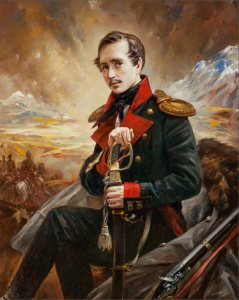
We present this work in honor of the poet’s 210th birthday.
Mikhail Lermontov Russian 1814 – 1841
By a loophole, I sit in my prison, Could see the blue of the heaven from there, I feel sharp pain and a shame at the vision Of heedless birds, freely playing in air.
On my dry lips, I’ve not any prayers, Nor any songs, that have ever to fly on, But I remember the ancient battles, My heavy sword and my coat of iron.
My stony armor – the cross I’m to bear, My stony helmet compresses my brow, My shield’s worn from a sword and a spear, My horse takes roads – I don’t now how.
Time is my horse that stays always my own, A helmet’s mask-visor – the grate on a hole, The walls are my armor that’s made of the stone, My permanent shield is the door’s iron fold.
Time! I desire to speed your hooves’ rattle! My stony armor is heavy to rise on! Death, when we’ve come, will help me by the saddle; I will dismount and rise up my visor.
And moan of winds and whispered thoughts of gloom, From life no joy is won… Yet somewhere, — warmth, and ocean’s muffled boom, And lustre of the sun. The blizzard wails, and in the heart it throws A load of tears unshed. Yet somewhere myrtle, verdant myrtle grows, And stainless roses spread. Life, passing by, in empty brooding delves, Unmeaning, unbedight… Yet somewhere, mirth and bliss will yield themselves, And comeliness and light!
This is your last life, so what you don’t agree? – Born to move belongings, hug friends at the gate, To buy some ibuprofen in duty free, To nod at giggling Koreans, notice their traits. This is your last body, a sound one-seat frame Waiting in lounge to board for the hut above Wait a little, baby, thirty-or-so lame Years and you’ll sit to laugh with Him who you love.
If you regret then only that you’ve seen You grasp eternal truth hard and belated. My new fringe does filter the world as a screen Therefore it becomes a little less-hated.
Sit down and taste everything new that glistens. If there’s anything you can’t see from the ground – Research from above. There’s a load not yet found In last youth, this tough coordinate system.
Dance in your poems, with heels flick in a fling. A party? No sleep for neighbors and friends hang Here. And you are so beautiful with your bangs – Geez, some idiot gets lucky this spring.
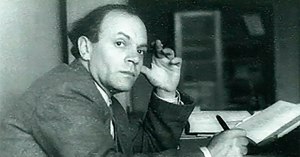
We present this work in honor of the Russian holiday, Victory Day.
David Samoilov Russian 1920 – 1990
The forties, fateful, warring, frontline, with funeral notices, clattering trains. The hum of the rails. All is cold, high and barren. Their houses have burned — they’re heading east. That’s me at the station in my scruffy wool cap. The star’s not standard issue — it’s cut from a can. Yes, here I am in the world, skinny, happy, carefree. I’ve got tobacco in my pouch — I have a stash of rolling papers. I joke with the girls, and limp a little overmuch. I break my rationed bread in half, and I know everything on earth. Imagine! What coincidence — war, horror, dreams and youth! And all of it sank deep inside me… and only later did it wake. The forties, fateful, lead and gun smoke… War wanders through the land. And we are all so young!
What sober intoxication gives me voice for glorious cause? Muses, pure adornment of Parnassus, do I not see you now? I hear the sound of your sweet strings and the strength of lovely choirs. All gives rise in me to exultant speech. Nations! Receive my song joyously. Stormy winds! Be silent. I desire to sing of brave Anna’s glory.
In their songs, eternally in glory, incomparable Pindar and Horace rose up to the very stars in heaven like swift, bold eagles. But if the voice of my lyre would equal my sincere zeal, which burns eternally for Anna, then Orpheus of Thrace himself, together with Amphion of Thebes, would surely marvel at its sweetness.
Sing, my lyre, a sweet song. Sing of Anna, who is happy; sing, to the greater downfall of all our foes, to their eternal misfortune. O her bravery and might! O the joyous delight of all her subjects! Conquering everything, her bravery inspires dread. Happiness leads us to a strange ecstasy; it removes our sorrowful thoughts, swelling our hearts with pride.
Was it Neptune himself built these walls that stand so proudly near the sea? Do they not resemble those of Troy, which sought long to be in quarrel with arms most powerful in combat and with a battle-hardened warrior? Do not all call the Vistula River now by the name of Skamander? Does Mount Stalzenberg not now bear the name of Ida?
That is not Troy, of fables’ subject; not one Achilles alone wages battle. Every warrior storms more valiantly than the son of Thetis. What leader shines with wondrous helmet? Is it not Minerva hurling her spear? ‘Tis evident that Heaven sent her, for in all respects she is a goddess; fearful is she even without her shield or aegis. ‘Tis the Russian Empress Anna.
And ‘tis Russian warriors have surrounded Danzig, hostile city. Each who fought there deserved to be called Mars, for in might each was more wondrous than Mars: ready to shed his blood freely, or carry off a complete victory in Anna’s name. All embolden themselves with Anna’s good fortune; only Anna is their strong hope, and because Anna is gracious to them they take greater anger at her enemies.
Beautiful and favorable sun of the European and Asian sky! O Russian monarch! Many times blessed, because you are so dear to your subjects, because you rule them so benignly! Your name is already fearful to the world and the universe will not contain your glory. Wishing to be obedient to you, all of it marvels at the flower of beauty.
But what do I behold? Do my eyes not deceive me? A youth opposed to Hercules, raising high his proud brow, desires to be the marvel of the entire world! With unwise counsel, Danzig, as if made drunk with heady beverage, opposes – and now openly so – the mighty empress of all Russia. Judging rashly, it does not see the abyss, as on a moonless night.
Into its very heart it accepts as a friend Stanislaus, who comes a second time in search of a crown. It hopes for defense through fields o’er which Neptune has flowed, but fearing the Russian Perun it seeks assistance of the nation that dwells along the banks of the Seine. But to its own loss does this nation beat drums for the advantage of Weichselmünde.
Proud of its fire and iron no less than of its warriors everywhere, Danzig already places its machines on embankments against the Russians. That it is rich in many stores, it shouts, “Long live Stanislaus!” It encourages anger in its soldiers who do not have stout hearts and look only to preserving their lives by flight.
O Danzig! Oh, what are you daring? Collect your senses! Counsel with them. You are approaching destruction. Why have you stopped? Why do you hesitate? Surrender! Wherefrom have you such audacity that you do not pale before Anna? Of their own will entire nations submit themselves without a battle. In order not to pay her tribute the Chinese rulers twice revere her.
Whosoever beseeches kindness of her learns that in kindness Anna has no equal. There is no one upon the world more generous to him who inflicts no war upon her. Her sword, wound with the olive branch, is fierce in battle, not in peace. O Danzig, abandon this wicked thought. You see the Alcidae are ready. You behold the terrible woes of your inhabitants; you hear wrathful Anna herself.
You are closely surrounded on all sides by thousands of courageous athletes. You have no hope of withstanding the bolts of lightning raining down on you, smashing everything before them. And that thunder is real, not false. On the ramparts there is no longer any defense. The earth opens up abysses; buildings fly up in the air; many fortifications are seized.
Even though all the powers came ardently to your defense now, Danzig; if the elements themselves defended you; even if brave soldiers came to you from all over he world and freely spilled their life’s blood for you – verily these can in no way save you, and though they made bold effort, they cannot puck you from the hands of Anna.
See, hostile nations, how brave are the Russian people! Fire does not harm them, nor water; their chests are bared to everything. See how they rush to the assault! How they batter themselves without giving way! The thunder of cannon scares them not; they go as to dance at a wedding celebration, and through the smoky clouds it is clear to whom all bravery is familiar.
Within the walls of poor Danzig town, fears are on the rise; buildings crumble into dust; the siege is everywhere triumphant. When from the last remaining wall the city magistrate beholds that all their hope in aid from distant lands and in the good will of Stanislaus was just in vain, he shouts, standing dumbstruck like an ignoramus: “Oh! Our glory has fallen!”
What I prophesied desires to come true: Danzig already begins to tremble; each person thinks now just of surrender as he thought earlier of fighting. He thinks this way of saving himself from the bombs flying in the air and from the spirit bearing death in plague. Everyone shouts: it is time to begin – To all it was an unbearable burden. Ah! It is time to open all the city’s gates to Anna’s triumphant army.
And so it passed. Surrender’s sign is made; at Anna’s feet Danzig has fallen. The warrior has begun rejoicing at his success; the fire has been extinguished; to all, the roads are free. Soaring, Glory flies everywhere and proclaims with her trumpet: “Anna is supreme in fortune! Anna, O our Anna! Braver than all is she! Anna more august than Augustus! The beauty and honor of all nations!”
Desist, lyre! ‘Tis time to end your song. Who is it can properly bear praise to the greatness of our Anna and sing of a courage higher than hers? In this there is much praise to Anna, that she is loved by God Himself. I desire her to conquer by this, and she is always able to conquer whomsoever dares oppose her. With that, “Long live Anna!” I exclaim.
Fifteen boys and maybe more, or fewer than fifteen, maybe, said to me in frightened voices: “Let’s go to a movie or the Museum of Fine Arts.” “I haven’t time.” Fifteen boys presented me with snowdrops. Fifteen boys in broken voices said to me: “I’ll never stop loving you.” I answered them more or less like this: “Well see.”
Fifteen boys are now living a quiet life. They have done their heavy chores of snowdrops, despair and writing letters. Girls love them — some more beautiful than me, others less beautiful. Fifteen boys with a shoe of freedom, and at times spite salute when we meet, their liberation, normal sleep and regular meals.
In vain you come to me, last boy. I shall place your snowdrops in a glass of water, and silver bubbles will cover their stocky stems… But, you see, you too will cease to love me, and, mastering yourself, you’ll talk in a superior way, as though you’d mastered me, and I’ll walk off down the street, down the street…
When off from work he’d sit at home all day atop his tin-bound wooden trunk and pout. This town was too familiar, he’d complain: he knew each square, each house inside and out.
Yes, he’d go somewhere far away, and soon: maybe he’d try the hide trade in Siberia. Mother would listen with a knowing grin and never lift her head from her embroidery.
While we’d cling to his knees, climb higher, higher… So many little hands, so tight our grip! He would fall silent, and the little fire would die out slowly in his meerschaum pipe…
Of course we knew he’d stay. No foreign country would ever rob us of our papa. Still, his melancholy eyes were always watching the stunted cactus on the windowsill.
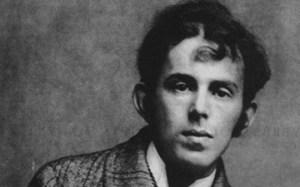
We present this work in honor of the 85th anniversary of the poet’s death.
Osip Mandelstam Russian 1891 – 1938
My age, my beast, who will ever Look into your eyes And with his own blood glue together The backbones of two centuries? Blood the builder gushes From the throat of earthly things, Only the parasite trembles On the threshold of new days.
As long as it holds life, a creature Must carry to the end a spine, And a wave plays With the unseen backbone. Like a child’s tender cartilage Is the age of earth’s infancy— Once more, like a sacrificial lamb, The crown of life’s skull is offered up.
To wrest the age from captivity, To begin a new world, The knees of gnarled and knotted days Must fit together like a flute. It is the age that rocks the wave With human yearning, And in the grass an adder breathes The golden measure of the age.
And again the buds will swell, Shoots of greenery will spring up, But your backbone is broken, My beautiful, pathetic age. And with a senseless smile You look back, both cruel and weak, Like a beast that once was lithe, Upon the prints of your own paws.
Blood the builder gushes From the throat of earthly things, And the seas’ warm cartilage splashes ashore like a burning fish. And from the high bird netting, From humid billows of azure Cool indifference pours, pours down On your mortal injury.
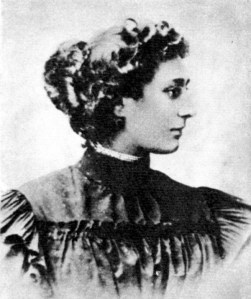
We present this work in honor of the 95th anniversary of the poet’s death.
Cherubina de Gabriak Russian 1887 – 1928
Bitter and wild — the smell of the earth: The fields are o’ergrown with dark carnations! Having flung my garments onto the grass, I burn, like a candle, in the evening field. Running into the distance, my steps are moist, Tenderly naked, I blossom by the water. Like white coral in an overgrowth of vines, I am scarlet in the scarlet of my scarlet hair.





 Poets Corner