We present this work in honor of the poet’s 135th birthday.
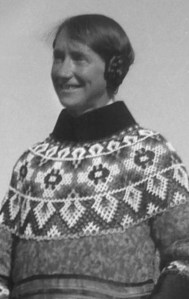
Isobel Wylie Hutchison Scots 1889 – 1982
Over the wheatfields the sky was shot with light And there was one large star. The Pentland Hills were full of purple night. I heard afar The rush of a motor car, And as I passed by the hedge the corn leaned out Wind-impelled, and touched my hand about, Then withdrew.
I knew The star as my own And the fields full-grown; I looked at the wheat and said ‘At Liège the gold is red, And to-night how still the dead must lie With their faces stark to the open sky Or dreadfully earthward turned.’ Over the corn the wind mourned. I looked at the star and cried, ‘Of Heaven the doors are very wide, And God has hung a little light For stragglers who fall in to-night.’
We present this work in honor of the poet’s 320th birthday.
Jean Adam Scots 1704 – 1765
And are ye sure the news is true? And are ye sure he’s weel? Is this a time to talk o’ wark? Ye jades, fling by your wheel! Is this a time to think o’ wark, When Colin’s at the door? Gie me my cloak! I’ll to the quay, And see him come ashore.
For there’s nae luck aboot the hoose, There’s nae luck ava’; There’s little pleasure in the hoose, When our gudeman’s awa’.
Rise up, and mak a clean fire-side, Put on the muckle pot; Gie little Kate her cotton gown, And Jock his Sunday coat; And make their shoon as black as slaes, Their hose as white as snaw; It’s a’ to please my ain gudeman, He likes to see them braw.
For there’s nae luck aboot the hoose, There’s nae luck ava’; There’s little pleasure in the hoose, When our gudeman’s awa’.
There are twa hens upon the bauk, ‘Been fed this month and mair, Make haste and thraw their necks aboot, That Colin weel may fare; And spread the table neat and clean, Gar ilka thing look braw; It’s a’ to pleasure our gudeman, For he’s been lang awa’.
For there’s nae luck aboot the hoose, There’s nae luck ava’; There’s little pleasure in the hoose, When our gudeman’s awa’.
Come gie me down my bigonets, My bishop-satin gown; And rin and tell the Bailie’s wife That Colin’s come to town; My Sunday sheen they maun gae on, My hose o’ pearl blue, It’s a’ to please my ain gudeman, For he’s baith leal and true.
For there’s nae luck aboot the hoose, There’s nae luck ava’; There’s little pleasure in the hoose, When our gudeman’s awa’.
Sae true his words, sae smooth his speech, His breath like caller air, His very foot has music in’t, When he comes up the stair: And will I see his face again? And will I hear him speak? I’m downright dizzie wi’ the thought, In troth I’m like to greet!
For there’s nae luck aboot the hoose, There’s nae luck ava’; There’s little pleasure in the hoose, When our gudeman’s awa’.
The cauld blasts o’ the winter wind, That thrilled through my heart. They’re a’ blawn by; I hae him safe, ‘Till death we’ll never part; But what puts parting in my mind? It may be far awa; The present moment is our ain. The niest we never saw!
For there’s nae luck aboot the hoose, There’s nae luck ava’; There’s little pleasure in the hoose, When our gudeman’s awa’.
Since Colin’s weel, I’m weel content, I hae nae mair to crave; Could I but live to make him blest, I’m blest aboon the lave; And will I see his face again? And will I hear him speak? I’m downright dizzie wi’ the thought, In troth I’m like to greet!
For there’s nae luck aboot the hoose, There’s nae luck ava’; There’s little pleasure in the hoose, When our gudeman’s awa’.
You’ve come early to see us this year, John Frost, Wi’ your crispin’ an’ poutherin’ gear, John Frost, For hedge, tower, an’ tree, As far as I see, Are as white as the bloom o’ the pear, John Frost.
You’re very preceese wi’ your wark, John Frost! Altho’ ye ha’e wrought in the dark, John Frost, For ilka fit-stap, Frae the door to the slap, Is braw as a new linen sark, John Frost.
There are some things about ye I like, John Frost, And ithers that aft gar me fyke, John Frost; For the weans, wi’ cauld taes, Crying “shoon, stockings, claes,” Keep us busy as bees in the byke, John Frost.
And gae ’wa’ wi’ your lang slides, I beg, John Frost! Bairn’s banes are as bruckle’s an egg, John Frost; For a cloit o’ a fa’ Gars them hirple awa’, Like a hen wi’ a happity leg, John Frost.
Ye ha’e fine goings on in the north, John Frost! Wi’ your houses o’ ice and so forth, John Frost! Tho’ their kirn’s on the fire, They may kirn till they tire, Yet their butter—pray what is it worth, John Frost?
Now, your breath would be greatly improven, John Frost, By a scone pipin’-het frae the oven, John Frost; And your blae frosty nose Nae beauty wad lose, Kent ye mair baith o’ boiling and stovin’, John Frost.
We present this work in honor of the 50th anniversary of the poet’s death.
Mary Wedderburn Cannan Scots 1893 – 1973
After the war perhaps I’ll sit again Out on the terrace where I sat with you, And see the changeless sky and hills beat blue And live an afternoon of summer through.
I shall remember then, and sad at heart For the lost day of happiness we knew, Wish only that some other man were you And spoke my name as once you used to do.
We present this work in honor of the poet’s 105th birthday.
Margaret Tait Scots 1918 – 1999
One day I Lit a fire At which I Boiled eggs Made tea Dried my shoes And I sat On a stool Watching The sticks catch and flame Quite a while It seemed, Until the whole pile I’d gathered had all burnt away.
Flame Is a thing I Always wonder about. It seems to be made of colour only. I don’t know what else it’s made of.
We present this work in honor of the poet’s 160th birthday.
Mary Symon Scots 1863 – 1938
God bless our land, our Scotland, Grey glen an’ misty brae, The blue heights o’ the Coolins, The green haughs yont the Spey, The weary wastes on Solway, Snell winds blaw owre them a’ — But aye it’s Hame, lad, Yours an’ mine, lad, Shielin’ or ha’.
It’s Hame, it’s Hame for ever, Let good or ill betide! The croon o’ some dear river, The blink o’ ae braeside.
God bless our land; it’s yonder – Far in the cold North Sea: But ‘neath the old Saint’s glamour It’s calling you an’ me: Your feet tread Libyan deserts, Mine press the wattle’s bloom, But to-night we stand together Among the broom.
It’s Hame, it’s Hame for ever, Let shore or sea divide! The croon o’ some dear river, The blink o’ ae braeside.
God bless our land. We dream o’t — The days aye brakin’ fine On the lang, lane glints o’ heather In the glens we kent langsyne.
Ay, we are Reubens, rovers, ‘Neath mony an alien star, But flaunt the blue flag o’er us, Pipe up the ” Braes o’ Mar,” And steppe and nullah vanish, And pomp and pelf and fame — It’s gloamin’ — on a lown hillside, An’ lads, . . . We’re . . . Hame.
We present this work in honor of the 275th anniversary of the poet’s death.
James Thomson Scots 1700 – 1748
As we rush, as we rush in the Train, The trees and the houses go wheeling back, But the starry heavens above the plain Come flying on our track.
All the beautiful stars of the sky, The silver doves of the forest of Night, Over the dull earth swarm and fly, Companions of our flight.
We will rush ever on without fear; Let the goal be far, the flight be fleet! For we carry the Heavens with us, dear, While the Earth slips from our feet!
We present this work in honor of the poet’s 210th birthday.
William Edmondstoune Aytoun Scots 1813 – 1865
It was a Moorish maiden was sitting by a well, And what the maiden thought of, I cannot, cannot, tell, When by there rode a valiant knight from the town of Oviedo, Alphonso Guzman was he hight, the Count of Tololedo.
‘Oh, maiden, Moorish maiden! why sitt’st thou by the spring? Say, dost thou seek a lover, or any other thing? Why dost thou look upon me, with eyes so dark and wide, And wherefore doth the pitcher lie broken by thy side?’
‘I do not seek a lover, thou Christian knight so gay, Because an article like that hath never come my way; And why I gaze upon you, I cannot, cannot tell, Except that in your iron hose you look uncommon swell.
‘My pitcher it is broken, and this the reason is – A shepherd came behind me, and tried to snatch a kiss; I would not stand his nonsense, so ne’er a word I spoke, But scored him on the costard, and so the jug was broke.
‘My uncle, the Alcaydé, he waits for me at home, And will not take his tumbler, until Zorayda come: I cannot bring him water – the pitcher is in pieces – And so I’m sure to catch it, ‘cos he wallops all his nieces’
‘Oh maiden, Moorish maiden! Wilt thou be ruled by me? Then wipe thine eyes and rosy lips, and give me kisses three; And I’ll give thee my helmet, thou kind and courteous lady, To carry home the water to thy Uncle, the Alcaydé.’
He lighted down from off his steed line – he tied him to a tree – He bent him to the maiden, and he took his kisses three; ‘To wrong thee, sweet Zorayda, I swear would be a sin!’ And he knelt him at the fountain, and he dipped his helmet in.
Up rose the Moorish maiden – behind the Knight she steals, And caught Alphonso Guzman in a twinkling by the heels: She tipped him in and held him down beneath the bubbling water – ‘Now, take thou that for venturing to kiss Al Hamet’s daughter!’
A Christian maid is waiting in the town of Oviedo; She waits the coming of her love, the Count of Tololedo; I pray you all in charity, that you will never tell, How he met the Moorish maiden beside the lonely well.
We present this work in honor of the poet’s 130th birthday.
Nan Shepherd Scots 1893 – 1981
Clear as the endless ecstasy of stars That mount for ever on an intense air; Or running pools, of water cold and rare, In chiselled gorges deep amid the scaurs, So still, the bright dawn were their best device, Yet like a thought that has no end they flow; Or Venus, when her white unearthly glow Sharpens like awe on skies as green as ice:
To such a clearness love is come at last, Not disembodied, transubstantiate, But substance and its essence now are one; And love informs, yet is the form create. No false gods now, the images o’ercast, We are love’s body, or we are undone.



 Poets Corner