Nocturne Among Grotesqueries

We present this work in honor of the 60th anniversary of the poet’s death.

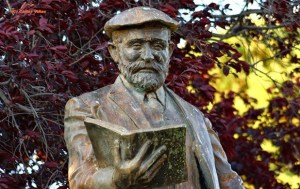
Luis Cernuda
Spanish
1902 – 1963


Body of stone, morose body
In woolens like the walls of the universe,
Body like the birthdays of the races,
Like edifices overwhelmingly innocent,
Like the shyest waterfalls
White as the night, while the mountain
Rips up manic shapes,
Pains like fingers
And pleasures like fingernails.

Not knowing where to go, where to go back to,
Seeking those merciful winds
That wear away the wrinkles in the earth,
That bless those desires cut out at the roots
Before flowering.
Their great blossom, like a child.

Lips want that flower
Whose fist, kissed by the night,
Opens the doors of oblivion lip by lip.

Translation by Reginald Gibbons

Orpheus

We present this work in honor of the poet’s 450th birthday.

Rodrigo Caro
Spanish
1573 – 1647


Oblivion’s misty prison ceased its moan
Before the Thracian youth; ceased too the lyre
Its consonance; the tears and fond desire
Ceased in their gentle sweetness to intone.

Sisiphus, at hearing, rests his stone;
And Tantalus might have eased his hunger dire
With that elusive apple, and no ire
Attend him from dread Radamanthus’ Throne.

But see, Eurydice is passing through
The deeps of Orcus, oh, behold her doom!
They turn, he to his moan, she to her chains!

O Love, how good and ill are joined in you!
In one poor lover how could you presume
To give his voice such power,—his eyes such pains?

Translation by Thomas Walsh

I Know All the Stories

We present this work in honor of the 55th anniversary of the poet’s death.

León Felipe
Spanish
1884 – 1968


I don’t know much, it’s true.
I can only tell you what I’ve seen.
And I’ve seen:
that the cradle of man is rocked with stories…
that the anguished cries of man are smothered with stories…
that the moan of man is stifled with stories…
that the bones of man are buried with stories…
And the fear of man
has invented all the stories.
I know very few things, it’s true.
But they’ve put me to sleep with all the stories…
And I know all the stories.

Translation by Margaret Randall

Sonnet XVII

We present this work in honor of the 445th anniversary of the poet’s death.

Francisco de Aldana
Spanish
1537 – 1578


A thousand times I say, in Galatea’s
arms, that she’s more lovely than the sun;
then she, with a sweet look, disdainfully,
tells me, “My Tyrsis, do not tell me that.”

I try to swear it, and she, suddenly,
her face now blazing with a rosy hue
restrains me with a kiss and hastily
my words with her own lips seeks to combat.

I struggle with her mildly to break free,
and she holds me more tightly and then says,
“Don’t swear, my love, I know it’s not a lie.”

With this she so completely shackles me
that Love, a witness to our gentle play,
causes with deeds my hope to satisfy.

Translation by Alix Inber

It’s Not Air that I Breathe

We present this work in honor of the poet’s 125th birthday.

Concha Mendez
Spanish
1898 – 1986


It’s not air that I breathe,
that is ice freezing
the blood of my senses.
The ground I tread opens for me.
Wherever I look darkens.
My eyes open, weeping
already when the day dawns.

And before dawn,
they look at the world
and do not want to believe…

Translation by José Angel Araguz

To find a kiss of yours

We present this work in honor of the poet’s 125th birthday.

Federico Garcia Lorca
Spanish
1898 – 1936

To find a kiss of yours
what would I give
A kiss that strayed from your lips
dead to love

My lips taste
the dirt of shadows

To gaze at your dark eyes
what would I give
Dawns of rainbow garnet
fanning open before God—

The stars blinded them
one morning in May

And to kiss your pure thighs
what would I give
Raw rose crystal
sediment of the sun

Translation by Sarah Arvio

Lover

We present this work in honor of the poet’s 125th birthday.

Vicente Aleixandre
Spanish
1898 – 1984


What I do not want
is to give you the words of day dreams.
Not to spread the image with my lips
on your face, nor with my kiss.
I take the tip of your finger
with pink nail, for my gesture,
and, in this manner of airs,
I give it back to you.
From the grace and the lightsomeness of your pillow.
And the heat of your exotic eyes.
And the light of your secret
breasts.
Like the moon in the spring
a window
gives us yellow light, and a heart
beat
seems to flow back from you to me.
It’s not that. Nor will it be. Your true sense
has already given me the peace,
the beautiful secret,
the charming dimple,
the lovely corner of your mouth
and the weary
morning.

Translation by Tanzan Kopra

Serranilla

We present this work in honor of the 565th anniversary of the poet’s death.

Íñigo López de Mendoza y de la Vega
Spanish
1398 – 1458


From Calatrava as I took my way
At holy Mary’s shrine to kneel and pray,
And sleep upon my eyelids heavy lay,
There where the ground was very rough and wild,
I lost my path and met a peasant child:
From Finojosa, with the herds around her,
There in the fields I found her.

Upon a meadow green with tender grass,
With other rustic cowherds, lad and lass,
So sweet a thing to see I watched her pass:
My eyes could scarce believe her what they found her,
There with the herds around her.

I do not think that roses in the Spring
Are half so lovely in their fashioning:
My heart must needs avow this secret thing,
That had I known her first as then I found her,
From Finojosa, with the herds around her,
I had not strayed so far her face to see
That it might rob me of my liberty.

I questioned her, to know what she might say:
“Has she of Finojosa passed this way?”
She smiled and answered me: “In vain you sue,
Full well my heart discerns the hope in you:
But she of whom you speak, and have not found her.
Her heart is free, no thought of love has bound her,
Here with the herds around her.”

Translation by John Pierrepont Rice

from El Vergonzoso en Palacio

We present this work in honor of the 375th anniversary of the poet’s death.

Tirso de Molina
Spanish
1579 – 1648


Have you told your lady of your love? – I have not dared to. – So she has never found out? – I don’t doubt that she’s seen the flame of love in my infatuated eyes, which cry out in silence. – The tongue should perform that task; otherwise it may as well be a foreign jargon. Has she not given you occasion to declare yourself? – So much so, that my shyness amazes me. – Speak, then. Any delay can only hurt your love. – I’m afraid to lose by speaking what I enjoy by keeping quiet. – That’s just foolish. A wise man once compared a mute lover to a Flemish painting that’s always kept rolled up. The painter won’t get very far unless he shows his paintings to the public, so they can admire and buy them. The court is no place for reticence. Unroll your painting so it may be sold. No one can cure you if you won’t tell them what’s wrong. – Yes, my lady. But the inequality between us holds me back. – Isn’t love a god? – Yes, my lady. – Well then, speak, for the laws of the god are absolute, toppling the mightiest monarchs and leveling crowns and clogs. Tell me who you love, and I’ll be your go-between. – I don’t dare. – Why not? Am I not fit to be your messenger? – No, but I’m afraid… Oh, god! – What if I say her name? Would you tell me if she is, by any chance… me? – My lady, yes. – Let me finish! And you are jealous of the Count of Vasconcelos, right? – It’s hopeless. He is your equal, my lady, and the heir of Braganza. – Equality and likeness don’t come down to whether a lover is noble, humble or poor, but to an affinity of soul and will. Make yourself clear from now on, don Dionís, I urge you. When it comes to games of love, it’s better to go over than to undershoot the mark. For a long time now I’ve preferred you to the Count of Vasconcelos.

Translation by Ben Sachs-Hamilton