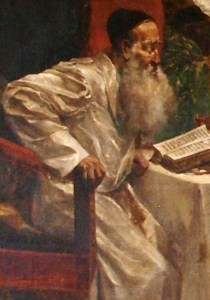
from Ardhakathānaka

Banarasidas
Indian
1586 – 1643


Samvat 1662.
Came the month of Kartik and the end of the rainy season.
The great Emperor Akbar
Died in the city of Agra.

The news of his death reached Jaunpur.
The people, bereft of their emperor, felt orphaned and helpless.
The townsfolk were afraid,
Their hearts troubled, their faces pale with fear.

Banarasi suddenly
Heard of Akbar’s death.
He had been sitting on the stairs,
The news struck him like a blow upon the heart.

He swooned and fell,
He could not help himself.
He cracked his head and began bleeding profusely.
The word ‘God’ slipped from his mouth.

He had hurt his head on the stone floor
Of the courtyard, which turned red with his blood.
Everyone began making a great fuss;
His mother and father were frantic.

His mother held him in her arms,
Applied a piece of burnt cloth to his wound.
Then, making up a bed, she laid her son upon it
His mother wept unceasingly.

Meanwhile there was chaos in the city,
Riots broke out everywhere.
People sealed shut the doors of their houses,
Shopkeepers would not sit in their shops.

Fine clothes and expensive jewellery–
These, people buried underground.
Books recording their business transactions they buried somewhere else,
And hid their cash and other goods in safe and secure places.

In every house, weapons were gathered.
Men began to wear plain clothes
And casting off fine shawls, wrapped themselves in rough blankets.
The women too began to dress plainly.

No one could tell the difference between the high and the low.
The rich and the poor were alike.
No thieves or robbers were to be seen anywhere,
People were needlessly afraid.

The chaos and confusion continued for ten days.
Then peace returned:
A letter came from Agra saying that all was well.
This was what the letter said–

“The great Akbar was emperor
For fifty-two years.
Now in Samvat 1662,
He died in the month of Kartik.”

“Akbar’s oldest son
Sahib Shah Salim,
Has, in the city of Agra, assumed the throne
In Akbar’s palace.”

“He has taken the name of Nuruddin
Jahangir Sultan.
This news is being given all over the kingdom,
In every place where the emperor’s authority holds sway.”

This was the news contained in the letter
Which was read from house to house
And spread around Jaunpur
Causing the people to give thanks in relief.

There was joy in Kharagsen’s house
A state of well-being prevailed, gone were sorrow and strife;
Banarasi recovered, and bathed;
The family rejoiced and gave alms generously in their joy.

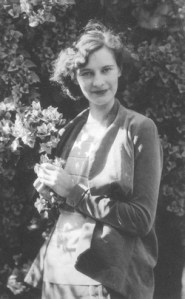
Under the Lantern

We present this work in honor of the Japanese holiday, Autumnal Equinox Day.

Fumiko Hayashi
Japanese
1903 – 1951


If you give me ten cups of King of Kings to drink
I shall throw you a kiss
ah, what a pitiful waitress I am.

Outside the blue window, rain falls like drops of cut glass
under the light of the lantern
all has turned to wine.

Is Revolution the wind blowing north…?
I’ve spilled the wine
opening my red mouth over the spill on the table
I belch fire.

Shall I dance in my blue apron?
“Golden Wedding,” or “Caravan”
tonight’s dance music….

Still three more cups to go
How’m I doing? you ask
I’m just fine
although I’m a nice girl
a really nice girl
I scatter my feelings
generously like cut flowers
among petty pigs of men.
Ah, is Revolution the wind blowing north…”

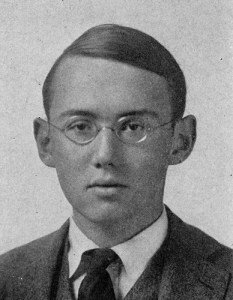
For Dinah, the Adeney’s Cat

We present this work in honor of the poet’s 110th birthday.

Anne Wilkinson
Canadian
1910 – 1961


Thirty elongated seconds
By the sun
We stare, the cat and I,
Strangers, cool and crouched
Behind unwinking green

Till flick
Along the spine, a whip
Of recognition cut
Our masks of fur and skin,
Cat-o’-nine-tails with a sting
Neither hinted at
By curl of lip
Or spitting tongue.

Then one cat turned
With poise of air
And washed a spotless paw,
The other took a tortoiseshell comb
And almost yawned
As she combed her tatless hair.

Immortality

In honor of Oktoberfest, we present this work by one of the great German-American poets.

Liesel Mueller
German
1924 – 2020


In Sleeping Beauty’s castle
the clock strikes one hundred years
and the girl in the tower returns to the world.
So do the servants in the kitchen,
who don’t even rub their eyes.
The cook’s right hand, lifted
an exact century ago,
completes its downward arc
to the kitchen boy’s left ear;
the boy’s tensed vocal cords
finally let go
the trapped, enduring whimper,
and the fly, arrested mid-plunge
above the strawberry pie
fulfills its abiding mission
and dives into the sweet, red glaze.

As a child I had a book
with a picture of that scene.
I was too young to notice
how fear persists, and how
the anger that causes fear persists,
that its trajectory can’t be changed
or broken, only interrupted.
My attention was on the fly:
that this slight body
with its transparent wings
and life-span of one human day
still craved its particular share
of sweetness, a century later.

(to the smell of misfortune)

We present this work in honor of Chilean Independence Day.

Rosabetty Muñoz
Chilean
b. 1960


The aridity of the gardens
finally tired them all.
Nothing, not even carrots
would grow in that rocky soil.

Breaking your back for
a fistful of herbs.

And the flowers? You’ll say.
And those huge dahlias, like trees?
Don’t remind me of those carnivores.
They seemed to shine their petals
to the smell of misfortune.
They grew
opened
moved their stamens
as we steadily fell.

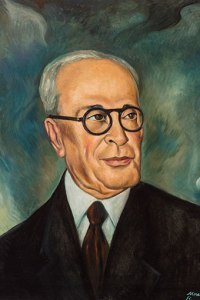
from John Brown’s Body

We present this work in honor of Citizenship Day.

Stephen Vincent Benet
American
1898 – 1943


Thirteen sisters beside the sea,
(Have a care, my son.)
Builded a house called Liberty
And locked the doors with a stately key.
None should enter it but the free.
(Have a care, my son.)

The walls are solid as Plymouth Rock.
(Rock can crumble, my son.)
The door of seasoned New England stock.
Before it a Yankee fighting-cock.
Pecks redcoat kings away from the lock.
(Fighters can die, my son.)

The hearth is a corner where sages sit.
(Sages pass, my son.)
Washington’s heart lies under it.
And the long roof-beams are chiseled and split
From hickory tough as Jackson’s wit.
(Bones in the dust, my son.)

The trees in the garden are fair and fine.
(Trees blow down, my son.)
Connecticut elm and Georgia pine.
The warehouse groans with cotton and swine.
The cellar is full of scuppernong-wine.
(Wine turns sour, my son.)

Surely a house so strong and bold,
(The wind is rising, my son,)
Will last till Time is a pinch of mould!
There is a ghost, when the night is old.
There is a ghost who walks in the cold.
(The trees are shaking, my son.)

The sisters sleep on Liberty’s breast,
(The thunder thunders, my son,)
Like thirteen swans in a single nest.
But the ghost is naked and will not rest
Until the sun rise out of the West.
(The lightning lightens, my son.)

All night long like a moving stain,
(The trees are breaking, my son,)
The black ghost wanders his house of pain.
There is blood where his hand has lain.
It is wrong he should wear a chain.
(The sky is falling, my son.)

Wring the Swan’s Neck

In honor of Mexican Indepedence Day, we present this work by one of Mexico’s greatest poets.

Enrique Gonzalez Martinez
Mexican
1871 – 1952


Wring the swan’s neck who with deceiving plumage
inscribes his whiteness on the azure stream;
he merely vaunts his grace and nothing feels
of nature’s voice or of the soul of things.

Every form eschew and every language
whose processes with deep life’s inner rhythm
are out of harmony…and greatly worship
life, and let life understand your homage.

See the sapient owl who from Olympus
spreads his wings, leaving Athene’s lap,
and stays his silent flight on yonder tree.

His grace is not the swan’s, but his unquiet
pupil, boring into the gloom, interprets
the secret book of the nocturnal still.

from Die Goldenen Schmiede

Konrad von Würzburg
German
1225 – 1287


He who would braid and decorate
Your noble chaplet with flowers
Must bear within his breast
The blooming May branch of the arts
In order to adorn it
With rose-read phrases
And decorate it all around
With words like violets
To purify it utterly
Of everything false,
And most beautifully interweave
The herbs of exotic rhymes
Beneath, around, between
The blossoms of sweet speech.