One. I’m going to stop lying. I’m going to stop
smoking. I’m going to stop being afraid of the dark.
Two. I’m never going to make mistakes again just
because it’s nighttime or it’s cold or there’s a
melancholy cloud over my head.
Three. I have to stop wasting time. When I get
home I’m going to start writing. I’m not going to
answer the phone or eat the leftovers from my
fridge or read all those books waiting on my
bedside table like skyscrapers.
Four. I’m thirty tomorrow. Instead of having a party
I’m going to get in the bath and read my old diaries.
How old are you when youth ends?
Five. I can’t hear my heart under the water. I could
die now and I’d never know. If I die I want to be
cremated and my ashes scattered in the sea or the
river or flushed down the toilet. I’d rather be dead
under water than dead under ground.
Six. I have to learn to breathe better. I’d like the air
to leave me without my realizing, as if I were a
mermaid at the bottom of a bathtub.
Macquarie Harbour jailers lock
the sullen gates no more…
but lash-strokes sound in every shock
of ocean on the dismal rocks
along that barren shore.
No more the bolters hear the hound
that bays upon the wind,
and terror-spurred kept onward-bound
until they drop upon the ground
starved and terror-pinned…
But gales that whine among the hills
sniff at the savage tracks
the hopeless took. The snowfall fills
bleak ranges; then the moonlight spills
broad arrows on their backs.
The broken pillar of the wing jags from the clotted shoulder,
The wing trails like a banner in defeat,
No more to use the sky forever but live with famine
And pain a few days: cat nor coyote
Will shorten the week of waiting for death, there is game without talons.
He stands under the oak-bush and waits
The lame feet of salvation; at night he remembers freedom
And flies in a dream, the dawns ruin it.
He is strong and pain is worse to the strong, incapacity is worse.
The curs of the day come and torment him
At distance, no one but death the redeemer will humble that head,
The intrepid readiness, the terrible eyes.
The wild God of the world is sometimes merciful to those
That ask mercy, not often to the arrogant.
You do not know him, you communal people, or you have forgotten him;
Intemperate and savage, the hawk remembers him;
Beautiful and wild, the hawks, and men that are dying, remember him.
II
I’d sooner, except the penalties, kill a man than a hawk;
but the great redtail
Had nothing left but unable misery
From the bone too shattered for mending, the wing that trailed under his talons when he moved.
We had fed him six weeks, I gave him freedom,
He wandered over the foreland hill and returned in the evening, asking for death,
Not like a beggar, still eyed with the old
Implacable arrogance.
I gave him the lead gift in the twilight.
What fell was relaxed, Owl-downy, soft feminine feathers; but what
Soared: the fierce rush: the night-herons by the flooded river cried fear at its rising
Before it was quite unsheathed from reality.
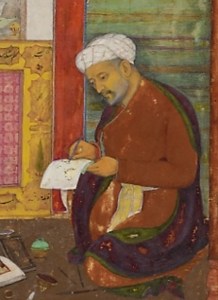
In honor of National Sovereignty and Children’s Day, we present this work by one of Turkey’s cleverest poets.
Rewani Turkish 1475 – 1524
Come hither, Mistrel of the Feast of Time,
Whose minstrelsy ennobleth every clime!
As thou the songster at Joy’s Banquet art,
Wilt thou not look on us in kindly part?
Let all the feast be filled with melody,
Let beauties carol in thy company.
Be all the instruments of music blent,
And let the veil of mystery be rent.
For each is potent in some gramarye,
Magicians some, and some enchaters be.
The Harp in magic craft is great of worth,
It brings the new moon down from heaven to earth.
The Mandoline pursues its humours e’er;
If thou would have it sing, then twist its ear.
The Mandoline can’t grapple with the Lute;
Then why torment itself when naught can boot?
A spell it sings when chants the Dulcimer;
It is the ruler for Love’s register.
No Tabret deem that in the minstrel’s hand,
A target ‘tis woe’s arrows to withstand.
What wonder if it all the world o’erthrow? —
The bandit Viol’s armed with shaft and bow.
Amid the feast to call me into mind
The Flute a thread doth round its finger bind.
Where bides one like the Ghittern sweet of say,
The chosen, the elect of the array?
Since joy of soul doth from their voices tide,
Withouten music let no party bide.
A small green valley where a slow stream flows
And leaves long strands of silver on the bright
Grass; from the mountaintop stream the Sun’s
Rays; they fill the hollow full of light.
A soldier, very young, lies open-mouthed,
A pillow made of fern beneath his head,
Asleep; stretched in the heavy undergrowth,
Pale in his warm, green, sun-soaked bed.
His feet among the flowers, he sleeps. His smile
Is like an infant’s – gentle, without guile.
Ah, Nature, keep him warm; he may catch cold.
The humming insects don’t disturb his rest;
He sleeps in sunlight, one hand on his breast;
At peace. In his side there are two red holes.
You gave birth to me. I bore wings.
The blood of the dead was kept
in the trough.
It was Entroido, Carnival. I believed in the open sincerity of accordions.
There’s snow, so much snow in the fields and in the language I speak,
inside the political stomach of cows.
2
You gave birth to me striking softly
in the difficult percussion of my body.
The theatrical walls of the wellsprings burst
in the crystal of night.
I took flight.
3
You had four children, and forty years.
You gave birth in the kitchen of a dirt-floored house.
My blood was a knot in your domed belly.
4
You danced, and brought in the harvest.
I had whooping cough and
was expiring in your arms.
5
“I’ve two godmothers. Two meadows. Two pasts. Two trains. I’m two women, two sisters, two neighbour ladies, two wee boats.”
6
“There at that baptism, in 1972, was my godmother Marisol who wanted to name me for a tiny Virgin revered in that dark, chilly, lovely church. Also there /present and absent / were my godmother Virtudes and godfather Antonio. They lived in Germany, in the emigration of flowers. Virtudes’s eyes are wide-open blue camellias. Antonio was a decent and elegant man from Hermida. Though he’s dead, he keeps giving me gifts.”
Night is memory . . .
7
Mother camouflaged. Nest for birds.
Cuddle. Linguistic embraces.
I went hunting for birds.
8
I love you, with my mute fingers.
With butterflies of air I make you tatted lace.
With the blind power of my sad eyes
I rehearse a work of theatre for you.
With my love I make you
a forest.
I learn to listen to clouds, to work earth and to read heaven, in your lap.
9
“You gave birth to me, and your man looked on in silence, bursting with happiness and trees. I brought electric shadows.”
10
You screamed,
ate sops,
sipped Sanson fortified wine.
11
From your body mine was born,
as if you were sharing
the mystery of magpies.
12
You had no dreams
because village women don’t dream.
The economic backwardness of Galicia
was a form of artistic avant-garde.
Hou long sall I in languishing lament?
Hou long sall I bot duyne, and dou not di[e ?]
Hou long sall Love, but mercy, murther me?
Hou long against me sall his bou be bent?
Hou long sall pane my plesiur so prevent ?
Hou long sall weping blind my watrie ee ?
Hou long sall baill my bed felou jit be?
Or vhen sall I with comfort be acquent?
Hou long sall hope be hindrit be mishap ?
Hou long jit, Love, will thou my patience prove?
Hou long sall wo in wrechitnes me wrap ?
Vp once, and my melancholie remove.
Revenge, revert, revive, revest, reveall,
My hurt, my hairt, my hope, my hap, my heall.
The socks
the pants
the water in the iron basin reflect her hair
it lie there
engrossed by the stare
of our mamma
our mamma
our story teller
our dear
The sun shines on her voice
with rays of pleasantries
with strokes of plenitude
an air of delight
as she speaks with so much power
so much power and so much might
Our eyes survey her presence
and she asks that we not despair
this is about life
about the lives that was
and those to come
and those to regain
for pleasure and not shame
of lives and land
to reclaim and rename
of experiences unknown
untold but bold
but behold
mamma talks
tells the story
and so it unfolds:
We hear mamma talk about the shore
the tip of Africa — our home — our life
about the white man’s dreams
and oh, so galore
she tells their desires
of the young Black girls they admire
of the girls who they ask to parade
not in the sunlight
but in their shade
where they lie and compete
for fresh Black women’s meat
and so they explore
on every possible shore
forever and ever
for Black women for their dela
for their tings dat hang like grapes
for der tings dat hold dem men tings tight
for der dela brings delight
delight and pleasure
to the white man’s liesure
Der story is not finished
we are told dat there is more
we know all about der shore
about der rules and der law
about der women who lived before
about der times when we were more
Mamma tells about der times
when the rivers ran and ran
when they covered all the land
when der women washed in der shore
when they were grabbed and spoke no more
We want to cry
but mamma says “No”
there’s no tears for what happened
no tears for all der years
no time to reminisce
if we are only going to miss
the objective of the lesson
of the lesson and the story
of our pain and future glory
of the glory still to come
if we stand and fight as one
and build our hearts and hopes
and dream about the land that’s ours
and keep our dela safe ashore
in our bloomers
shut behind our door
Our dela
our heritage
and still our fight
our knowledge
our history
our right
our land
our culture
in their hands tight
The plan is clear as daylight
our legs apart
our hearts crossed
our fists clenched
our mouths sealed
pressed hard against our will
our dela pinched closed
our teeth chattering to our spirits
our spirits racing to the future
racing for the day
when our dela can be ours
and only ours
to have and to hold
to savour and to fold
We clasp our hands together
and jpin mamma loud in song
it’s a pray and a story
a story and a song
a story overdue
overdue
so long
Today we have naming of parts. Yesterday,
We had daily cleaning. And tomorrow morning,
We shall have what to do after firing. But today,
Today we have naming of parts. Japonica
Glistens like coral in all the neighboring gardens,
And today we have naming of parts.
This is the lower sling swivel. And this
Is the upper sling swivel, whose use you will see,
When you are given your slings. And this is the piling swivel,
Which in your case you have not got. The branches
Hold in the gardens their silent, eloquent gestures,
Which in our case we have not got.
This is the safety-catch, which is always released
With an easy flick of the thumb. And please do not let me
See anyone using his finger. You can do it quite easy
If you have any strength in your thumb. The blossoms
Are fragile and motionless, never letting anyone see
Any of them using their finger.
And this you can see is the bolt. The purpose of this
Is to open the breech, as you see. We can slide it
Rapidly backwards and forwards: we call this
Easing the spring. And rapidly backwards and forwards
The early bees are assaulting and fumbling the flowers:
They call it easing the Spring.
They call it easing the Spring: it is perfectly easy
If you have any strength in your thumb: like the bolt,
And the breech, the cocking-piece, and the point of balance,
Which in our case we have not got; and the almond blossom
Silent in all of the gardens and the bees going backwards and forwards,
For today we have the naming of parts.
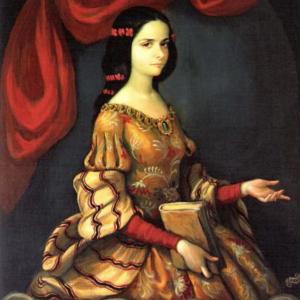
We present this work in honor of the 325th anniversary of the poet’s death.
Sor Juana Inés de la Cruz Mexican 1651 – 1695
This that you see, the false presentment planned
With finest art and all the colored shows
And reasonings of shade, doth but disclose
The poor deceits by earthly senses fanned!
Here where in constant flattery expand
Excuses for the stains that old age knows,
Pretexts against the years’ advancing snows,
The footprints of old seasons to withstand;
‘Tis but vain artifice of scheming minds;
‘Tis but a flower fading on the winds;
‘Tis but a useless protest against Fate;
‘Tis but stupidity without a thought,
A lifeless shadow, if we meditate;
‘Tis death, tis dust, tis shadow, yea, ‘tis nought.



 Poets Corner