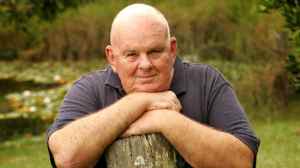
The Passionate Man’s Pilgrimage

Sir Walter Raleigh
English
1554 – 1618


Give me my scallop shell of quiet,
My staff of faith to walk upon,
My scrip of joy, immortal diet,
My bottle of salvation,
My gown of glory, hope’s true gage,
And thus I’ll take my pilgrimage.
Blood must be my body’s balmer,
No other balm will there be given,
Whilst my soul, like a white palmer,
Travels to the land of heaven;
Over the silver mountains,
Where spring the nectar fountains;
And there I’ll kiss
The bowl of bliss,
And drink my eternal fill
On every milken hill.
My soul will be a-dry before,
But after it will ne’er thirst more;
And by the happy blissful way
More peaceful pilgrims I shall see,
That have shook off their gowns of clay,
And go apparelled fresh like me.
I’ll bring them first
To slake their thirst,
And then to taste those nectar suckets,
At the clear wells
Where sweetness dwells,
Drawn up by saints in crystal buckets.
And when our bottles and all we
Are fill’d with immortality,
Then the holy paths we’ll travel,
Strew’d with rubies thick as gravel,
Ceilings of diamonds, sapphire floors,
High walls of coral, and pearl bowers.
From thence to heaven’s bribeless hall
Where no corrupted voices brawl,
No conscience molten into gold,
Nor forg’d accusers bought and sold,
No cause deferr’d, nor vain-spent journey,
For there Christ is the king’s attorney,
Who pleads for all without degrees,
And he hath angels, but no fees.
When the grand twelve million jury
Of our sins and sinful fury,
‘Gainst our souls black verdicts give,
Christ pleads his death, and then we live.
Be thou my speaker, taintless pleader,
Unblotted lawyer, true proceeder,
Thou movest salvation even for alms,
Not with a bribed lawyer’s palms.
And this is my eternal plea
To him that made heaven, earth, and sea,
Seeing my flesh must die so soon,
And want a head to dine next noon,
Just at the stroke when my veins start and spread,
Set on my soul an everlasting head.
Then am I ready, like a palmer fit,
To tread those blest paths which before I writ.
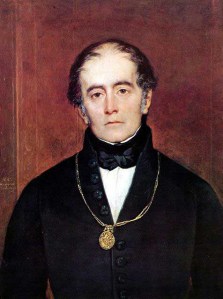
To the Bio-Bio

In honor of Chilean Independence Day, we present this work by one of Chile’s greatest poets.

Andres Bello
Chilean
1781 – 1865


Blest were he, O Bio-Bio!
Who could dwell forevermore
In a deep grove, cool and shady,
Upon thine enchanted shore!

Just a lowly thatched-roofed cottage
Where thy limpid waters are seen
Pouring their calm flood in silence
Amid foliage fresh and green;

Where, instead of shifting changes
In the fickle things of state,
Wind-stirred oaks and maitens murmur,
And the forest peace is great;

Where the bird amid the branches,
In the early dawning gray,
Sings its untaught, artless music,
Greeting thus the new-born day.

In that humble thatched-roof cottage,
Oh, how happy were my lot,
In the peace that nothing troubles,
Envied not and envying not!

This to me in truth were sweeter
Than the Babel wild and loud
Where in chase of a chimera
All are rushing in a crowd;

Where dark treachery and falsehood
Near the quaking altar stay
That the people’s favor raises
To the idols of a day.

Sweet repose, most blissful quiet,
Earthly paradise divine!
Has the palm of war or wisdom
Worth which can outrival thine?

Truth I love, not adulation—
Truth all unadorned and plain,
Not the clamorous applauses
That are raised in Fortune’s train.

Growing old, for that false treasure
I would cease my soul to fret—
Say ‘Farewell to disappointments!
The forgetful I forget.

‘Others call excitement pleasure,
Madly seeking fame or pelf;
I in earth’s most hidden corner
Wish to live now for myself.’

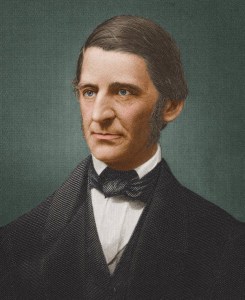
Concord Hymn

We present this work in honor of Constitution Day.

Ralph Waldo Emerson
American
1803 – 1882


By the rude bridge that arched the flood,
Their flag to April’s breeze unfurled,
Here once the embattled farmers stood
And fired the shot heard round the world.

The foe long since in silence slept;
Alike the conqueror silent sleeps;
And Time the ruined bridge has swept
Down the dark stream which seaward creeps.

On this green bank, by this soft stream,
We set today a votive stone;
That memory may their deed redeem,
When, like our sires, our sons are gone.

Spirit, that made those heroes dare
To die, and leave their children free,
Bid Time and Nature gently spare
The shaft we raise to them and thee.

No More Clichés

In honor of Mexican Independence Day, we present this work by one of Mexico’s most legendary poets.

Octavio Paz
Mexican
1914 – 1998


Beautiful face
That like a daisy opens its petals to the sun
So do you
Open your face to me as I turn the page.

Enchanting smile
Any man would be under your spell,
Oh, beauty of a magazine.

How many poems have been written to you?
How many Dantes have written to you, Beatrice?
To your obsessive illusion
To you manufacture fantasy.

But today I won’t make one more Cliché
And write this poem to you.
No, no more clichés.

This poem is dedicated to those women
Whose beauty is in their charm,
In their intelligence,
In their character,
Not on their fabricated looks.

This poem is to you women,
That like a Shahrazade wake up
Everyday with a new story to tell,
A story that sings for change
That hopes for battles:
Battles for the love of the united flesh
Battles for passions aroused by a new day
Battle for the neglected rights
Or just battles to survive one more night.

Yes, to you women in a world of pain
To you, bright star in this ever-spending universe
To you, fighter of a thousand-and-one fights
To you, friend of my heart.

From now on, my head won’t look down to a magazine
Rather, it will contemplate the night
And its bright stars,
And so, no more clichés.

If We Must Die

We present this work in honor of the poet’s 130th birthday.

Claude McKay
American
1889 – 1948


If we must die, let it not be like hogs
Hunted and penned in an inglorious spot,
While round us bark the mad and hungry dogs,
Making their mock at our accursèd lot.

If we must die, O let us nobly die,
So that our precious blood may not be shed
In vain; then even the monsters we defy
Shall be constrained to honor us though dead!

O kinsmen! we must meet the common foe!
Though far outnumbered let us show us brave,
And for their thousand blows deal one death-blow!
What though before us lies the open grave?

Like men we’ll face the murderous, cowardly pack,
Pressed to the wall, dying, but fighting back!

Siren Song

Margaret Atwood
Canadian
b. 1939


This is the one song everyone
would like to learn: the song
that is irresistible:

the song that forces men
to leap overboard in squadrons
even though they see the beached skulls

the song nobody knows
because anyone who has heard it
is dead, and the others can’t remember.

Shall I tell you the secret
and if I do, will you get me
out of this bird suit?

I don’y enjoy it here
squatting on this island
looking picturesque and mythical

with these two faethery maniacs,
I don’t enjoy singing
this trio, fatal and valuable.

I will tell the secret to you,
to you, only to you.
Come closer. This song

is a cry for help: Help me!
Only you, only you can,
you are unique

at last. Alas
it is a boring song
but it works every time.

Wall

In honor of the Mid Autumn Festival, we present this work by one of 20th century China’s greatest poets.

Ai Qing
Chinese
1910 – 1996


A wall is like a knife
It slices a city in half
One half is on the east
The other half is on the west

How tall is this wall?
How thick is it?
How long is it?
Even if it were taller, thicker and longer
It couldn’t be as tall, as thick and as long
As China’s Great Wall
It is only a vestige of history
A nation’s wound
Nobody likes this wall

Three metres tall is nothing
Fifty centimetres thick is nothing
Forty-five kilometres long is nothing
Even a thousand times taller
Even a thousand times thicker
Even a thousand times longer
How could it block out
The clouds, wind, rain, and sunshine of the heavens?

And how could it block out
The currents of water and air?

And how could it block out
A billion people
Whose thoughts are freer than the wind?
Whose will is more entrenched than the earth?
Whose wishes are more infinite than time?

The Names

We present this work in honor of Nine-Eleven.

Billy Collins
American
b. 1941


Yesterday, I lay awake in the palm of the night.
A soft rain stole in, unhelped by any breeze,
And when I saw the silver glaze on the windows,
I started with A, with Ackerman, as it happened,
Then Baxter and Calabro,
Davis and Eberling, names falling into place
As droplets fell through the dark.
Names printed on the ceiling of the night.
Names slipping around a watery bend.
Twenty-six willows on the banks of a stream.
In the morning, I walked out barefoot
Among thousands of flowers
Heavy with dew like the eyes of tears,
And each had a name —
Fiori inscribed on a yellow petal
Then Gonzalez and Han, Ishikawa and Jenkins.
Names written in the air
And stitched into the cloth of the day.
A name under a photograph taped to a mailbox.
Monogram on a torn shirt,
I see you spelled out on storefront windows
And on the bright unfurled awnings of this city.
I say the syllables as I turn a corner —
Kelly and Lee,
Medina, Nardella, and O’Connor.
When I peer into the woods,
I see a thick tangle where letters are hidden
As in a puzzle concocted for children.
Parker and Quigley in the twigs of an ash,
Rizzo, Schubert, Torres, and Upton,
Secrets in the boughs of an ancient maple.
Names written in the pale sky.
Names rising in the updraft amid buildings.
Names silent in stone
Or cried out behind a door.
Names blown over the earth and out to sea.
In the evening — weakening light, the last swallows.
A boy on a lake lifts his oars.
A woman by a window puts a match to a candle,
And the names are outlined on the rose clouds —
Vanacore and Wallace,
(let X stand, if it can, for the ones unfound)
Then Young and Ziminsky, the final jolt of Z.
Names etched on the head of a pin.
One name spanning a bridge, another undergoing a tunnel.
A blue name needled into the skin.
Names of citizens, workers, mothers and fathers,
The bright-eyed daughter, the quick son.
Alphabet of names in a green field.
Names in the small tracks of birds.
Names lifted from a hat
Or balanced on the tip of the tongue.
Names wheeled into the dim warehouse of memory.
So many names, there is barely room on the walls of the heart.

Inside Ayers Rock

Les Murray
Australian
1938 – 2019


Inside Ayers Rock is lit
with paired fluorescent lights
on steel pillars supporting the ceiling
of haze-blue marquee cloth
high above the non-slip pavers.
Curving around the cafeteria
throughout vast inner space
is a Milky way of plastic chairs
in foursomes around tables
all the way to the truck drivers’ enclave.
Dusted coolabah trees grow to the ceiling,
TVs talk in gassy colours, and
round the walls are Outback shop fronts:
the Beehive Bookshop for brochures,
Casual Clobber, the bottled Country Kitchen
and the sheet-iron Dreamtime Experience
that is turned off at night.
A high bank of medal-ribbony
lolly jars preside over
island counters like opened crates,
one labelled White Mugs, and covered with them.
A two-dimensional policeman
discourages shoplifting of gifts
and near the entrance, where you pay
for fuel, there stands a tribal man
in rib-paint and pubic tassel.
It is all gentle and kind.
In beyond the children’s playworld
there are fossils, like crumpled
old drawings of creatures in rock.