We present this work in honor of the poet’s 50th birthday.
Gabeba Baderoon South African b. 1969
From the end of the bed, I pull
the sheets back into place.
An old man paints a large sun striped
by clouds of seven blues.
Across the yellow centre each
blue is precisely itself and yet,
at the point it meets another,
the eye cannot detect a change.
The air shifts, he says,
and the colours.
When you touched me in a dream,
your skin an hour ago did not end
where it joined mine. My body continued
the movement of yours. Something flowed
between us like birds in a flock.
In a solitude larger than our two bodies
the hardening light parted us again
But under the covering the impress
of our bodies is a single, warm hollow.
That’s my last Duchess painted on the wall,
Looking as if she were alive. I call
That piece a wonder, now: Frà Pandolf’s hands
Worked busily a day, and there she stands.
Will ‘t please you sit and look at her? I said
‘Frà Pandolf’ by design, for never read
Strangers like you that pictured countenance,
The depth and passion of its earnest glance,
But to myself they turned (since none puts by
The curtain I have drawn for you, but I)
And seemed as they would ask me, if they durst,
How such a glance came there; so, not the first
Are you to turn and ask thus. Sir, ‘t was not
Her husband’s presence only, called that spot
Of joy into the Duchess’ cheek: perhaps
Frà Pandolf chanced to say, ‘Her mantle laps
Over my lady’s wrist too much,’ or ‘Paint
Must never hope to reproduce the faint
Half-flush that dies along her throat:’ such stuff
Was courtesy, she thought, and cause enough
For calling up that spot of joy. She had
A heart—how shall I say?—too soon made glad,
Too easily impressed; she liked whate’er
She looked on, and her looks went everywhere.
Sir, ‘t was all one! My favour at her breast,
The dropping of the daylight in the West,
The bough of cherries some officious fool
Broke in the orchard for her, the white mule
She rode with round the terrace—all and each
Would draw from her alike the approving speech,
Or blush, at least. She thanked men,—good! but thanked
Somehow—I know not how—as if she ranked
My gift of a nine-hundred-years-old name
With anybody’s gift. Who’d stoop to blame
This sort of trifling? Even had you skill
In speech—(which I have not)—to make your will
Quite clear to such an one, and say, ‘Just this
Or that in you disgusts me; here you miss,
Or there exceed the mark’—and if she let
Herself be lessoned so, nor plainly set
Her wits to yours, forsooth, and made excuse,
—E’en then would be some stooping; and I choose
Never to stoop. Oh, sir, she smiled, no doubt,
Whene’er I passed her; but who passed without
Much the same smile? This grew; I gave commands;
Then all smiles stopped together. There she stands
As if alive. Will ‘t please you rise? We’ll meet
The company below then. I repeat,
The Count your master’s known munificence
Is ample warrant that no just pretence
Of mine for dowry will be disallowed;
Though his fair daughter’s self, as I avowed
At starting, is my object. Nay, we’ll go
Together down, sir. Notice Neptune, though,
Taming a sea-horse, thought a rarity,
Which Claus of Innsbruck cast in bronze for me!
At the next vacancy for God, if I am elected,
I shall forgive last the delicately wounded
who, having been slugged no harder than anyone else,
never got up again, neither to fight back,
nor to finger their jaws in painful admiration.
They who are wholly broken, and they in whom
mercy is understanding, I shall embrace at once
and lead to pillows in heaven. But they who are
the meek by trade, baiting the best of their betters
with the extortions of a mock-helplessness
I shall take last to love, and never wholly.
Let them all into Heaven—I abolish Hell—
but let it be read over them as they enter:
“Beware the calculations of the meek, who gambled nothing,
gave nothing, and could never receive enough.”
We present this work in honor of the poet’s 155th birthday.
Banjo Paterson Australian 1864 – 1941
I had written him a letter which I had, for want of better
Knowledge, sent to where I met him down the Lachlan, years ago,
He was shearing when I knew him, so I sent the letter to him,
Just ‘on spec’, addressed as follows, ‘Clancy, of The Overflow’.
And an answer came directed in a writing unexpected,
(And I think the same was written with a thumb-nail dipped in tar)
‘Twas his shearing mate who wrote it, and verbatim I will quote it:
‘Clancy’s gone to Queensland droving, and we don’t know where he are.’
In my wild erratic fancy visions come to me of Clancy
Gone a-droving ‘down the Cooper’ where the Western drovers go;
As the stock are slowly stringing, Clancy rides behind them singing,
For the drover’s life has pleasures that the townsfolk never know.
And the bush hath friends to meet him, and their kindly voices greet him
In the murmur of the breezes and the river on its bars,
And he sees the vision splendid of the sunlit plains extended,
And at night the wond’rous glory of the everlasting stars.
I am sitting in my dingy little office, where a stingy
Ray of sunlight struggles feebly down between the houses tall,
And the foetid air and gritty of the dusty, dirty city
Through the open window floating, spreads its foulness over all
And in place of lowing cattle, I can hear the fiendish rattle
Of the tramways and the ‘buses making hurry down the street,
And the language uninviting of the gutter children fighting,
Comes fitfully and faintly through the ceaseless tramp of feet.
And the hurrying people daunt me, and their pallid faces haunt me
As they shoulder one another in their rush and nervous haste,
With their eager eyes and greedy, and their stunted forms and weedy,
For townsfolk have no time to grow, they have no time to waste.
And I somehow rather fancy that I’d like to change with Clancy,
Like to take a turn at droving where the seasons come and go,
While he faced the round eternal of the cash-book and the journal–
But I doubt he’d suit the office, Clancy, of ‘The Overflow’.
I met a traveller from an antique land
Who said: “Two vast and trunkless legs of stone
Stand in the desert . . . Near them, on the sand,
Half sunk, a shattered visage lies, whose frown,
And wrinkled lip, and sneer of cold command,
Tell that its sculptor well those passions read
Which yet survive, stamped on these lifeless things,
The hand that mocked them, and the heart that fed:
And on the pedestal these words appear:
‘My name is Ozymandias, king of kings:
Look on my works, ye Mighty, and despair!’
Nothing beside remains. Round the decay
Of that colossal wreck, boundless and bare
The lone and level sands stretch far away.”
In honor of Valentine’s Day, we present one of the most widely loved celebrations of erotic romance in poetic history.
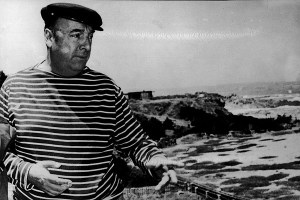
Pablo Neruda Chilean 1904 – 1973
Naked, you are simple as one of your hands,
Smooth, earthy, small, transparent, round:
You have moonlines, applepathways:
Naked, you are slender as a naked grain of wheat.
Naked, you are blue as the night in Cuba;
You have vines and stars in your hair;
Naked, you are spacious and yellow
As summer in a golden church.
Naked, you are tiny as one of your nails,
Curved, subtle, rosy, till the day is born
And you withdraw to the underground world,
as if down a long tunnel of clothing and of chores:
Your clear light dims, gets dressed, drops its leaves,
And becomes a naked hand again.