The Fifth Feed of the Furrier

François Villon
French
1431 – 1463?


A furrier once, as one reports,
Espoused a lady young and fair
Who craved that best of indoor sports
And made him run the gamut there,
Who, though he blamed her not, could bear
Only a little, so ‘twas said,
And loved a jug of wine to share
Better than any woman’s bed.

A curate, seeing how things stood,
Of the said wife grew amorous,
And thought that to his house he would
Invite this beggar of Bacchus.
Wherefore he sought him, all joyous,
Because he’d found the way to tup her,
Saying: “Neighbor, I am desirous
Of having you this night to supper.”

The furrier liked this well enough,
Who always liked a fine free feast,
And took his belly there to stuff
And make good cheer with this said priest,
Who, using compliments for yeast,
Said: “Since the lining’s worn away,
I wish you’d mend my robe—at least
Tell me what I shall have to pay.”

“Ah well,” replied the furrier,
“I’ll do so since you wish it done;
Provided that you pay me, sir,
I’m yours: I never work for fun.”
With bargain made the work’s begun,
It being agreed, as you may think,
That, more than ten sous, such a one
Would ask sufficient wine to drink.

In order there be no delay,
Because he needed it to wear,
It was arranged he’d start straightaway,
The priest’s clerk for his fellow there.
He was content of this affair,
And master curate locked them up
(To drink and labour, not for prayer),
Then left the house and went to tup.

The curate to the furrier’s house
Came thus by way of sterling debts,
And found so fine a chance to chouse
He sang right well in love’s duets.
In all shirts do with chemisettes
He bore his part well, so it seems,
And parting then without regrets,
Went out and home to pleasant dreams.

And thus the furrier, for his feed,
Was made a cuckold, as was meant;
And his good wife, who’d found her need,
Begged curate be not indolent,
And charged him, by the Sacrament,
That he remember her and do
As much again, expedient,
Whenever he’d a fancy to.

Nevertheless, a man should guard,
Who’s got a wife that’s young and fair,
Lest he acquire some plumage hard
For a free feed: they’re ill to wear:
The scandal’s gossiped everywhere
And shames a man through all his days.
Remember and avoid the snare,
For feeds are found in divers ways.
On the Border

In honor of Moroccan Independence day, we present a work by one of the nation’s finest living poets.

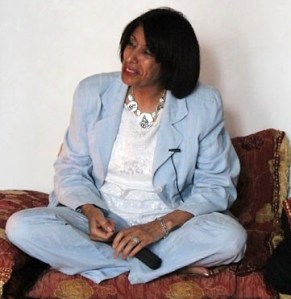
Hafsa Bekri
Moroccan
b. 1948


Being on the border
on the edge,
on the verge
on the brink
on the brim
on the rim
on the fringe
on the coast
on the bank
of Scotland and
finding an open door

No boundaries
no barriers
no pillar of Hercules to crush
no Rubicon to cross
only a few stoned dwarf Wall
in a dreamlike nature
now veiled in mist
now blooming in the sun

And

People !
All the Grahams and Bells
the Ogles and the Pringles,
the Armstrongs and the Robsons
the Nixons and the Dixons
the Scotts , and the Elliotts
The Ridleys, and the Beatties

All these and other Reivers,
Once dreaded warriors
Now peaceful farmers or
Haafnetters
Joined for ales or else
In Kingsarms Pub
with no arms but
darts to play and jokes to share

I felt tempted
In this land
Teeming with ghosts
To ask Hadrian’s soul
Perhaps present and invisible
In some corner of this pub
Where his fort once stood,
Ask his two thousand year old soul
About people and barriers.

And I could almost sense
A smile on his face
As he would tell me:
“Poets and poetry taught me
History’s ephemeral vanity and
The strength of life over stones
At the self moment I was building
Walls”

And Hadrian’s soul
Suddenly vanished
As Lawrence in his Scottish kilt
Gave vent to a cry of joy :
He had won the darts game !

Voyage of Love or Death

Ausiàs March
Spanish
1400 – 1459


The power of sails and winds shall work my wish,
Setting a chancy course across the sea.
Ponente and Mistral rise to resist.
Levante and Sirocco fight for me
Backed by their allies Midi and Gregal
Beseeching the North Mountain Wind to turn
Its storms aside in their support, so all
Five winds may blow the way of my return.

The sea shall seethe like boiling casserole,
Change colors, taking on unnatural form,
Showing its ill will at full blast to all
That stray on it one second in that storm.
The fish will panic all throughout the sea
And seek out secret shelter in the deep,
Till from the sea that gave them life they flee
To their deaths on dry land with desperate leap.

The pilgrim passengers aboard my ship
Will call on God, pledge votive gifts in tears,
And fear force every secret from their lips
That never fell on a confessor’s ears.
Through those dangers, you will not leave my mind.
Before the God that joined us two I swear
Nothing shall weaken this resolve of mine,
And you’ll be with me always, everywhere.

I fear death – lest it break my heart from yours,
For death can cancel love out with its still,
Not that I think even death’s severing force
Could overcome my strength of loving will.
I wish I could believe your love for me
Would not leave me forgotten when I die,
And though while we two live this could not be
One thought makes all life’s pleasure out a lie:

That on the day I died, your love as well
Would die, and be transformed to hate that night.
While I, cast from this world, would feel full Hell
Never again to hold you in my sight.
Oh God, if only there were bounds to love
So I at love’s extreme might stand apart!
I’d face the future without fear or hope
Knowing the cutoff limit of your heart.

I am the most extreme of all in love
Save those who’ve breathed in love their life’s last breath.
The anguish of my heart I cannot prove
Without the good faith agony of death.
For good or ill at love’s command I wait
Though Fortune still withholds my fate from me.
She’ll find the gates unbarred, and me awake,
Prepared to humbly follow her decree.

Getting what I so wish may cost me dear
Yet this alone consoles the soul in strife:
If it turns out my fate is what I fear
I only ask that God not spare my life.
For then people will see the outward fact
Of love at work within, needing no faith.
Capacity will be revealed in act,
And my words’ credit backed by deed of death.

Envoi:
Love! I who feel you don’t know you at all,
And so can only win the loser’s prize.
No one who knows you is within your thrall.
Your simile: addictive game of dice.

On Autumn

Baki
Turkish
1526 – 1600


There’s no trace of spring left
The tree leaf has fallen on the grass
The orchard trees wear the robe of divestiture
The autumn wind in the grass has the plane tree’s permission.
Golden is the flow at their feet from every side
The orchard trees hope for the river’s favor.
Don’t wait on the grass’ theatrical stage. Let it sway with the light breeze
The sapling is free of leaf and fruit.
Baki, the leaf is distraught in the grass
It resembles a complaint against the wind.

Black Woman

Nancy Morejón
Cuban
b. 1944


I still smell the foam of the sea they made me cross.
The night, I can’t remember it.
The ocean itself could not remember it.
But I don’t forget the first gull I made out in the distance.
High, the clouds, like innocent eye-witnesses.
Perhaps I have not forgotten my lost coast,
nor my ancestral language.
The left me here and here I have lived.
And because I worked like an animal,
here I came to be born.
How many Mandinga epics did I look to for strength.

I rebelled.

His Worship bought me in a public square.
I embroidered His Worship’s coat and bore him a male child.
My son had no name.
And His Worship died at the hands of an impeccable English lord.

I walked.

This is the land where I suffered
mouth-in-the-dust and the lash.
I rode the length of all its rivers.
Under its sun I sowed seeds, gathered crops,
but did not eat the harvests.
A slave barracks was my house.
I myself brought stones to raise it up,
but I sang to the natural rhythm of native birds.

I rose up.

In this same land I touched the wet blood
and decayed bones of many others,
brought to this land, or not, the same as I.
I no longer imagined the road to Guinea.
Was it to Guinea? To Benin?
To Madagascar? Or Cape Verde?

Landscapes

In honor of Coptic Christmas, we present this work by one of the 20th century’s premier Egyptian poets.

Andree Chedid
Egyptian
1920 – 2011

Behind faces and gestures
We remain mute
And spoken words heavy
With what we ignore or keep silent
Betray us

I dare not speak for mankind
I know so little of myself

But the Landscape

I see as a reflection
Is also a lie stealing into
My words I speak without remorse
Of this image of myself
And mankind my unequaled torment

I speak of Desert without repose
Carved by relentless winds
Torn up from its bowels

Blinded by sands
Unsheltered solitary
Yellow as death
Wrinkled like parchment
Face turned to the sun.

I speak
Of men’s passing
So rare in this arid land
That it is cherished like a refrain
Until the return
Of the jealous wind

And of the bird, so rare,
Whose fleeting shadow
Soothes the wounds made by the sun

And of the tree and the water
Named Oasis
For a woman’s love

I speak of the voracious Sea
Reclaiming shells from beaches
Waves from children

The faceless Sea
Its hundreds of drowned faces
Wrapped in seaweed
Slippery and green
Like creatures of the deep

The reckless Sea, unfinished story,
Removed from anquish
Full of death tales

I speak of open valleys
Fertile at men’s feet
Overgrown with flowers

Of captive summits

Of mountains, of clear skies
Devoured by untamed evergreens

And of trees that know
The welcome of lakes
Black earth
Errant pathways

Echoes of the faces
Haunting our days.

The Beautiful Night

In honor of the German holiday, Three Kings Day, we present this work from one of the nation’s most legendary poets.

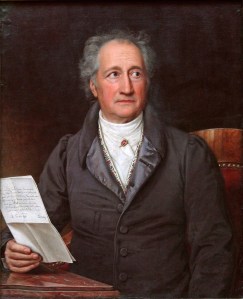
Johann Wolfgang von Goethe
German
1749 – 1832


Now I leave the little cottage
Of my dearest; through the dark,
Secret, in a dreary silence,
Wander through the wooded park.
Luna peers through bush and oak tree
Birches bow, they strew a fragrance
On the winds of midnight blown.

What a pleasure in the coolness
Of so rich a summer’s night!
What a hush! The feeling spirit
Revels in untold delight.
Rapture I can hardly cope with,
Nights of secrecy astir,
Yet, I’d trade them, by the thousand,
For a single night with her.

Zimeo

Charles Tompson
Australian
1807 – 1883

In a slave-cultured isle, on the verge of the main,
Sable Zimeo’s form was reclined;
He wept his dark destiny, gazed on his chain,
And mingled his sighs with the wind.

“O ye Gods!” he exclaimed, “whose beneficent care
Shields the innocent suff’rer from woe;
Permit me no longer these shackles to bear,
Some gleam of soft pity bestow!

“In the dawn of my youth, dear companions! with you,
When I rambled in Afric’s green shade.
When my hours, ‘mid your smiles, so delightfully flew,
I dreamed not they ever would fade.

“On the lip of my Ninda, when panting with love,
With what exstacy heaved my fond heart!
When we vowed by those pow’rs in the mansions above,
That we never—no, never, would part.

‘The bright sun of prosperity glistened awhile,
Diffusing ephemeral rays;
I basked ‘neath the phantom’s encouraging smile,
And bliss was the badge of my days!

“ ‘Till a little black cloud, wing’d by demons of air,
And urged by the fates from below,
Interposed ‘tween my sight and that sun’s cheering glare,
And hurled me from bliss into woe.

“Inured to the arts of seduction and wile,
White merchants arrived in our bay,
Allured us on board, unsuspicious of guile,
And bore us in triumph away.

“On that accurst day all my happiness fled,
My Ninda—my country—my home;
Here slavery’s ignoble fetters are spread,
Here liberty never will come!

“O, never!—what horrors compose that dread word,
But this weary pilgrimage o’er,
I go where the sound of sweet mercy is heard,
Where mis’ry’s remember’d no more.

“See, bright from elysium, a seraph appears,
And smiling she calls me away;
“ ‘My Zimeo, quit this dull region of tears!
Lo, thy Ninda!’ “—”Loved shade, I obey.”

Oblivion shed her dark veil o’er his woes;
Young Hope soothed the horrors of death;
From the cliff where he pondered, undaunted he rose,
And plunged in the billows beneath.

Nocturne

Dorothy Livesay
Canadian
1909 – 1996


Out of the turmoil mustered up by day
We may not free our hands, nor turn our heads to pray—
So tight the knot our sunlight ties.

So firm the hold of voices, thoughts are drowned
The river’s chant is lost, in the splintering gunshot sound:
Or from its song the essence dies.

Brightness was all, when earth lay primitive
Fair to the hands’ fresh touch, ready to burst and live:
Now in her womb corrosion lies.

Therefore we search alone the shuttered dark
Where faces of the dead shine luminous, a spark
Of lightning from encircled skies.

Therefore we seek the peace of broken ground
After the wars have buried all the young, and found
Dark remedy for shining eyes…

Therefore we hide our faces; make no sound.

Betrayal

We present this piece in honor of the 60th anniversary of the poet’s death.

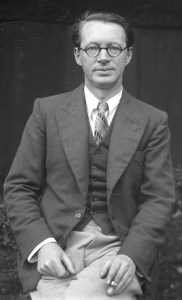
Edwin Muir
Scots
1887 – 1959

Sometimes I see, caught in a snare,
One with a foolish lovely face,
Who stands with scattered moon-struck air
Alone, in a wild woody place

She was entrapped there long ago.
Yet fowler none has come to see
His prize; though all the tree-trunks show
A front of silent treachery.

And there she waits, while in her flesh
Small joyless teeth fret without rest.
But she stands smiling in the mesh,
The while she is duped and dispossest.

I know her name; for it is told
That Beauty is a prisoner,
And that her gaoler, bleak and bold,
Scores her fine flesh, and murders her.

He slays her with invisible hands,
And inly wastes her flesh away,
And strangles her with stealthy bands;
Melts her as snow day after day.

Within his thicket life decays
And slow is changed by hidden guile;
And nothing now of Beauty stays,
Save her divine and witless smile.

For still she smiles, and does not know
Her feet are in the snaring lime.
He who entrapped her long ago,
And kills her, is unpitying Time.