In honor of Morocco’s Independence Day, we present this Moroccan classic.
Mawlay Zidan Abu Maali Moroccan d. 1627
I passed by a beautiful tomb in the middle of a cemetery on which flowers had formed a carpet so I asked whose grave this was. And I was told, “Pray for him respectfully—it is the grave of a lover.”
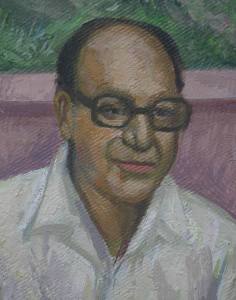
We present this work in honor of the 10th anniversary of the poet’s death.
Doris Lessing English 1919 – 2013
Oh Cherry trees you are too white for my heart, And all the ground is whitened with your dying, And all your boughs go dipping towards the river, And every drop is falling from my heart.’
Now if there is justice in the angel with the bright eyes He will say ‘Stop!’ and hand me a bough of cherry. The bearded angel, four-square and straight like a goat Lifts a ruminant head and slowly chews at the snow.
Goat, must you stand here? Must you stand here still? Is it that you will always stand here, Proof against faith, proof against innocence?
We present this work in honor of the poet’s 710th birthday.
Ibn al-Khatib Arab Andalusian 1313 – 1374
With my jewels and with my crown I surpass the most beautiful, And before me the stars of the zodiac all bow down … It is as though I had received the gift of that bounty which Flows from the hand of my lord Abu al-Hajjaj
When you were a kid we celebrated your graces and ups and downs; as a little man your ingenious good taste and daring. Now that you use your Cervantes, your French, your Péguy, everything you previously learned, heard and wrote in praise of tyranny, let us celebrate your crime.
After the ashes of the fatherland and the fallen heights of relatives, that the Thuringian land bore from the hostile sword, if I spoke of wars of wars lived through in unfortunate strife, to what tears should I, a captured woman, be drawn first? What remains for me to weep? This people pressed by death or the sweet race family ruined by various vicissitudes? For the father falling first, the uncle following him each relative fixed a sad wound in me. A last brother remained, but by execrable fate the sand pressed me equally to his tomb. With all those extinct (alas the rough guts of the one grieving!) you who were the one left, Hamalafred, you lie dead. Do I Radegund seek such after long times? that your page brought this to speak to the sad one? I waited so long for such a gift from my loving one and you send me this act of your military service? You direct these silken sheepskins to me now to my thought so that, while I draw threads, I the sister have communication with love? Did your care thus counsel powerful grief? Did the first and last messenger give this? Did we rush elsewhere with ample tears in our desires? It was not for the one desiring to be given bitter sweets. I am twisted by solicitous sense, anxious in my bosom: is such fever of the spirit healed by these waters? I did not deserve to see him alive nor to be at his burial, I am pierced by your funeral rites with higher losses. Why do I yet remind you of these things, dear surrogate-son Artachis, to add with my weepings to what you must weep? I ought rather to bring solace to my relative, but sorrow for the dead compels me to speak bitter things. He was not close to me from distant consanguinity, but was a near relative from the brother of my father. For Bertharius was my father, Hermenedfred was his: we were born from brothers, but we are not in the same world. Or you, dear nephew, give me back the peaceful close relation and be mine in love what he was before, and I ask that you often seek me with messages to the monastery and that that place be your help with God, that with your pious mother this perennial care may give you back honor on the starry throne. Now may the lord give you both to be happy in broad present health and future salvation.
Under the sky born after the rain, I hear the quiet slap of oars against the water and I’m thinking: happiness is nothing but the quiet slap of oars against the water. Or maybe it’s nothing but the light on a small boat, appearing and disappearing on the dark swell of years slow as a funeral supper. Or the light of a house discovered behind the hill when we’d thought nothing remained but to walk and walk. Or the gulf of silence between my voice and the voice of someone revealing to me the true names of things simply by calling them up: poplars, roofs. The distance between the clinking of a bell on a sheep’s neck at dawn and the thud of a door closing after a party. The space between the cry of a wounded bird out on the marsh and the folded wings of a butterfly just over the crest of a wind-swept ridge. That was happiness: drawing random figures in the frost, fully aware they’d hardly last at all, breaking off a pine bough on the spur of the moment to write our names in the damp ground, catching a piece of thistledown to try and stop the flight of a whole season. That’s what happiness was like: brief as the dream of a felled sweet acacia tree or the dance of a crazy old woman in front of a broken mirror. Happy days pass as quickly as the journey of a star cut loose from the sky, but it doesn’t matter. We can always reconstruct them from memory, just as the boy sent out to the courtyard for punishment collects pebbles to form resplendent armies. We can always be in the day that’s neither yesterday nor tomorrow, gazing up at a sky born after the rain and listening from afar to a quiet slap of oars against the water.
We present this work in honor of the poet’s 100th birthday.
Rubén Bonifaz Nuño Mexican 1923 – 2013
Because I was alone I want to think of you as alone. That you didn’t go, that you slept. That you left me without leaving, and that you needed me to be able to be happy.
Anyway, I’ve recovered my place in the world: you came back, you became reachable
You give me back the time, the pain, the ways, happiness, the voice, the body, the soul, life, and death, and what lives beyond death.
You give me back everything locked up in the appearance of a woman, your self, the one I love.
You came back little by little, you woke and weren’t surprised to find me beside you.
And I could almost see the last step of the secret you climbed while sleeping, as you opened —slowly, quietly—your eyes inside my eyes that kept the deathwatch over you.
We present this work in honor of the poet’s 105th birthday.
Margaret Tait Scots 1918 – 1999
One day I Lit a fire At which I Boiled eggs Made tea Dried my shoes And I sat On a stool Watching The sticks catch and flame Quite a while It seemed, Until the whole pile I’d gathered had all burnt away.
Flame Is a thing I Always wonder about. It seems to be made of colour only. I don’t know what else it’s made of.
We present this work in honor of the poet’s 95th birthday.
Anne Sexton American 1928 – 1974
You always read about it: the plumber with the twelve children who wins the Irish Sweepstakes. From toilets to riches. That story.
Or the nursemaid, some luscious sweet from Denmark who captures the oldest son’s heart. from diapers to Dior. That story.
Or a milkman who serves the wealthy, eggs, cream, butter, yogurt, milk, the white truck like an ambulance who goes into real estate and makes a pile. From homogenized to martinis at lunch.
Or the charwoman who is on the bus when it cracks up and collects enough from the insurance. From mops to Bonwit Teller. That story.
Once the wife of a rich man was on her deathbed and she said to her daughter Cinderella: Be devout. Be good. Then I will smile down from heaven in the seam of a cloud. The man took another wife who had two daughters, pretty enough but with hearts like blackjacks. Cinderella was their maid. She slept on the sooty hearth each night and walked around looking like Al Jolson. Her father brought presents home from town, jewels and gowns for the other women but the twig of a tree for Cinderella. She planted that twig on her mother’s grave and it grew to a tree where a white dove sat. Whenever she wished for anything the dove would drop it like an egg upon the ground. The bird is important, my dears, so heed him.
Next came the ball, as you all know. It was a marriage market. The prince was looking for a wife. All but Cinderella were preparing and gussying up for the event. Cinderella begged to go too. Her stepmother threw a dish of lentils into the cinders and said: Pick them up in an hour and you shall go. The white dove brought all his friends; all the warm wings of the fatherland came, and picked up the lentils in a jiffy. No, Cinderella, said the stepmother, you have no clothes and cannot dance. That’s the way with stepmothers.
Cinderella went to the tree at the grave and cried forth like a gospel singer: Mama! Mama! My turtledove, send me to the prince’s ball! The bird dropped down a golden dress and delicate little slippers. Rather a large package for a simple bird. So she went. Which is no surprise. Her stepmother and sisters didn’t recognize her without her cinder face and the prince took her hand on the spot and danced with no other the whole day.
As nightfall came she thought she’d better get home. The prince walked her home and she disappeared into the pigeon house and although the prince took an axe and broke it open she was gone. Back to her cinders. These events repeated themselves for three days. However on the third day the prince covered the palace steps with cobbler’s wax and Cinderella’s gold shoe stuck upon it. Now he would find whom the shoe fit and find his strange dancing girl for keeps. He went to their house and the two sisters were delighted because they had lovely feet. The eldest went into a room to try the slipper on but her big toe got in the way so she simply sliced it off and put on the slipper. The prince rode away with her until the white dove told him to look at the blood pouring forth. That is the way with amputations. They just don’t heal up like a wish. The other sister cut off her heel but the blood told as blood will. The prince was getting tired. He began to feel like a shoe salesman. But he gave it one last try. This time Cinderella fit into the shoe like a love letter into its envelope.
At the wedding ceremony the two sisters came to curry favor and the white dove pecked their eyes out. Two hollow spots were left like soup spoons.
Cinderella and the prince lived, they say, happily ever after, like two dolls in a museum case never bothered by diapers or dust, never arguing over the timing of an egg, never telling the same story twice, never getting a middle-aged spread, their darling smiles pasted on for eternity. Regular Bobbsey Twins. That story.







 Poets Corner