We present this work in honor of the 50th anniversary of the poet’s death.
Jean Sénac Algerian 1926 – 1973
I love you that’s true I love you that’s false crows on my tongue wage war with swallows we’ve got blackness inside our backs But if one day the beloved or the beauty comes along we find our spinning tops again sunlight scars the water All around the air thins we throw a shovel of earth on the thighs the ivy comes into focus Migratory pleasures you bequeath to the heart decaying nymphs and we go on living gropingly under the waves like crayfish I love you for you I write poems to stop thinking drunk on images I invent margins to prolong you If I had at least your name to speak o my unknown my madwoman of the streets honored in my veins like a king by his empire My needle of gold missing in the hay!
We present this work in honor of the poet’s 70th birthday.
Diana Ferrus South African b. 1953
My name is February. I was sold my breasts, private parts and eyes my brain are not mine yet like the São José I am ruined often sank by another storm no Jesus walking on water for me.
My name is February I am searching for the rod of the steering wheel Because the family lies at the bottom The child stitched to a mother’s dress Mother’s hand locked in father’s fist How deep down are they lying, on which side?
My name is February auctioned, sold, the highest bidder disposed of my real name paid no compensation for that, my name, stolen, sunked underwater it still lies with the family wrecks of the São José ran aground by a wind furious waves that decided the future of the loot smashing the profit against the embankment.
My name is February the Masbieker on the São José that’s how I was called when my mother tongue of here came into being when tongues started to form a bond and letters started walking freely in a desperate attempt at survival and hope that forces should not strip this identity too I became the Masbieker, only a name born under a different sky and deeply filled with shame.
My name is February I rearranged this landscape. my hands wove the patterns of the vineyards my feet pressed the grapes and I was paid with the wine. I carry Alcohol-Foetal Syndrome children on my back.
My name is February. I still march on the eve of December one, I walk the cobblestones of this city when I cry in desperation, “remember the emancipation of the slaves!”
My name is February. two hundred years after the São José I was given the vote, they said I was free
But do you see how often I am submerged, weighed down? I am the sunken, the soiled, forgotten and yet memory will not leave me!
My name is February, stranded at Third beach but no one comes to look for me, no one waves from the dunes, no bridges back to Mozambique.
My name is February. I will be resurrected, brought to the surface unshackled, unchained, unashamed! My name is February!
We present this work in honor of the 40th anniversary of the poet’s death.
José Bergamín Spanish 1895 – 1983
The soul is memory; the body, forgetting. If memory, through words, is the soul of history, will history also contain through the word, a body of forgetting?
We present this work in honor of the 275th anniversary of the poet’s death.
James Thomson Scots 1700 – 1748
As we rush, as we rush in the Train, The trees and the houses go wheeling back, But the starry heavens above the plain Come flying on our track.
All the beautiful stars of the sky, The silver doves of the forest of Night, Over the dull earth swarm and fly, Companions of our flight.
We will rush ever on without fear; Let the goal be far, the flight be fleet! For we carry the Heavens with us, dear, While the Earth slips from our feet!
We present this work in honor of the poet’s 100th birthday.
Álvaro Mutis Colombian 1923 – 2013
Tequila is a clean flame that clambers up the walls and shoots over tiled roofs, relief to despair. Tequila isn’t for sailors because it blurs the navigational instruments and dismisses the wind’s tacit orders. But tequila, on the other hand, enraptures those returning by train and those driving the train, because it stays faithful and blind in its loyalty to the rails’ parallel delirium and to hurried greetings in the stations where the train pauses to testify to its inscrutable destination, errant, subject to the inevitable laws. There are trees under whose shadow it is wonderful to drink it with the parsimony of those who preach in wind and other trees where tequila can’t stand the shade that dims its powers and in whose branches it stirs up a flower blue as the warnings on bottles of poison. When tequila waves its fringed, serrated flag, the battle halts and armies return the order they intended to impose. Often two squires accompany it: salt and lime. But it is always ready to start the conversation without any more help than its lustrous clarity. From the start, tequila doesn’t recognize borders. But there are propitious climates just as certain hours suggest it, knowing full well: to fix the time when night arrives at its stores, in the splendor of an afternoon without obligations, in the highest pitch of doubt and hesitation. It is then when tequila offers us its consoling lesson, its infallible joy, its unreserved indulgence. Also, there are foods that call for its presence: those springing from the ground from which it, too, was born. Inconceivable if they didn’t bond with millenary certainty. To break that pact would be a grave breach with dogma prescribed to allay the rough job of living. If “gin smiles like a dead girl,” tequila spies on us with the green eyes of a prudent sentry. Tequila has no history, no anecdote confirming its birth. It is so from the beginning because it is the gift of the gods and, usually, when they promise something they aren’t telling tales. That is the office of mortals, children of panic and habit. Such is tequila and so it will be keeping us company all the way to the silence from which no one returns. Praise be, then, until the end of our days and praise the daily effort toward denying that end.
You used to love my Cypress Rafter Terrace, But now you dote upon her Bright Yang Palace. I know my place, take leave of your palanquin. Hold in my feelings, weep for a cast-off fan. There was a time my dances, songs, brought honor. These letters and poems of long ago? Despised! It’s true, I think–your favor collapsed like waves. Hard to offer water that’s been spilled
We present this work in honor of the poet’s 155th birthday.
Edgar Lee Masters American 1868 – 1950
I have known the silence of the stars and of the sea, And the silence of the city when it pauses, And the silence of a man and a maid, And the silence of the sick When their eyes roam about the room. And I ask: For the depths, Of what use is language? A beast of the field moans a few times When death takes its young. And we are voiceless in the presence of realities — We cannot speak.
A curious boy asks an old soldier Sitting in front of the grocery store, “How did you lose your leg?” And the old soldier is struck with silence, Or his mind flies away Because he cannot concentrate it on Gettysburg. It comes back jocosely And he says, “A bear bit it off.” And the boy wonders, while the old soldier Dumbly, feebly lives over The flashes of guns, the thunder of cannon, The shrieks of the slain, And himself lying on the ground, And the hospital surgeons, the knives, And the long days in bed. But if he could describe it all He would be an artist. But if he were an artist there would be deeper wounds Which he could not describe.
There is the silence of a great hatred, And the silence of a great love, And the silence of an embittered friendship. There is the silence of a spiritual crisis, Through which your soul, exquisitely tortured, Comes with visions not to be uttered Into a realm of higher life. There is the silence of defeat. There is the silence of those unjustly punished; And the silence of the dying whose hand Suddenly grips yours. There is the silence between father and son, When the father cannot explain his life, Even though he be misunderstood for it.
There is the silence that comes between husband and wife. There is the silence of those who have failed; And the vast silence that covers Broken nations and vanquished leaders. There is the silence of Lincoln, Thinking of the poverty of his youth. And the silence of Napoleon After Waterloo. And the silence of Jeanne d’Arc Saying amid the flames, “Blessed Jesus” — Revealing in two words all sorrows, all hope. And there is the silence of age, Too full of wisdom for the tongue to utter it In words intelligible to those who have not lived The great range of life.
And there is the silence of the dead. If we who are in life cannot speak Of profound experiences, Why do you marvel that the dead Do not tell you of death? Their silence shall be interpreted As we approach them.
We present this work in honor of National Senior Citizens’ Day.
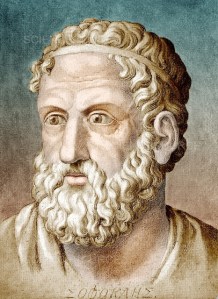
Sophocles Greek c. 497 BC – c. 406 BC
What man is he that yearneth For length unmeasured of days? Folly mine eye discerneth Encompassing all his ways. For years over-running the measure Small change thee in evil wise: Grief draweth nigh thee; and pleasure, Behold it is hid from thine eyes. This to their wage have they Which overlive their day. And He that looseth from labor Doth one with other befriend, Whom bride nor bridesmen attend, Song, nor sound of the tabor, Death, that maketh an end.
Thy portion esteem I highest, Who was not even begot; Thine next, being born who diest And straightway again art not. With follies light as the feather Doth Youth to man befall; Then evils gather together, There wants not one of them all— Wrath, envy, discord, strife, The sword that seeketh life. And sealing the sum of trouble Doth tottering Age draw nigh, Whom friends and kinsfolk fly, Age, upon whom redouble All sorrows under the sky.
This man, as me, even so, Have the evil days overtaken; And like as a cape sea-shaken With tempest at earth’s last verges And shock of all winds that blow, His head the seas of woe, The thunders of awful surges Ruining overflow; Blown from the fall of eve, Blown from the dayspring forth, Blown from the noon in heaven, Blown from night and the North.





 Poets Corner