We present this work in honor of the 430th anniversary of the poet’s death.
Robert Greene English 1558 – 1592
Sweet are the thoughts that savour of content; The quiet mind is richer than a crown; Sweet are the nights in careless slumber spent; The poor estate scorns fortune’s angry frown: Such sweet content, such minds, such sleep, such bliss, Beggars enjoy, when princes oft do miss.
The homely house that harbours quiet rest; The cottage that affords no pride nor care; The mean that ‘grees with country music best; The sweet consort of mirth and music’s fare; Obscured life sets down a type of bliss: A mind content both crown and kingdom is.
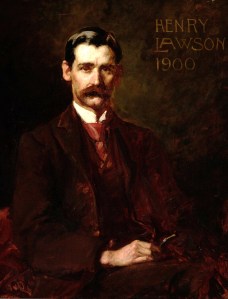
We present this work in honor of the 100th anniversary of the poet’s death.
Henry Lawson Australian 1867 – 1922
“Where are you going with your horse and bike, And the townsfolk still at rest? Where are you going, with your swag and pack, And the night still in the West? Your clothes are worn, and your cheques are gone, But your eyes are free from care?” “We’re bushmen down for a spree in town, And we’re bound for the Lord-knows-where, Old chap-we’re bound for the Lord-knows-where.” (There are great dark scrubs in the Lord-knows-where, Where they fight it out alone, There are wide wide plains in the Lord-knows-where, Where a man’s soul is his own. There is healthy work, there is healthy rest, There is peace from self-torture there, And the glorious freedom from paltriness! And they’re bound for the Lord-knows-where.) “Now, where are you going in your Sunday suit, And a bag for your second best? Now where are you going with your chest of tools, And the old togs in the chest? With your six clean shirts and a pound of ‘weed’, And enough for a third-class fare?” “Oh! I’ll be afloat by the very next boat, And I’m bound for the Lord-knows-where, Old chap-I’m bound for the Lord-knows-where.” (There are wide wide seas to the Lord-knows-where, Where a man might have a spell, The things turn up in the Lord-knows-where that We waited for too well. There’s a stranger land in the Lord-knows-where, And a show for the stranger there. There is war and quake more work to make, And he’s bound for the Lord-knows-where.) “Now where are you going with your Gladstone bag, With your shirt-case and valise? Now where are you going with your cap and shoes, And your looks of joyful peace? Now where are you going with your money belts, And your drafts on the first bank there?” “‘We have made a hit,’ or ‘we’ve made a bit,’ And we’re bound for the Lord-knows-where, Old chap-we’re bound for the Lord-knows-where.” (There are sinful ports in the Lord-knows-where, There are marvellous sights to see, There are high old games in the Lord-knows-where, That were known to you and me. There is love and music, and life and light from The Heads to “Lester” Square, There is more than space for their high young hearts There is safety or danger there, And they’ll come back wild, or they’ll come back tamed When they’ve been to the Lord-knows-where.) “Now where am I going with my whisky flask, And with little else beside? Now where am I going with my second shirt, To wear while the first is dried? I have marred my name, and I’ve lost my fame, But my hope’s in good repair. There are lies about, there are warrants out- And I’m bound for the Lord-knows-where, Old Chap-and I’m bound for the Lord-knows-where.” (There’s a rise and fall of the sloping decks, That is good for a soul in pain; There’s the drowsy rest on the sunlight sea Till your strength comes back again. Oh, the wild mad spirit is hypnotized, And nerves are tranquil there, And the past is hushed in forgetfulness, On the road to the Lord-knows-where.)
The song of little birds from spray to spray, The fragrant breeze that wafts among the flowers, The lights that in transparent liquors play, Awaking laughter in these eyes of ours,
Are here since nature and the heavens agree With him who willeth that the whole world fall Under love’s spell; hence sweetest melody And fragrance thrill earth, wind, and waters all.
Wherever foot doth tread and eye doth rove A passionate spirit kindleth, fraught with love, Which giveth warmth before the summer days; At his caressing smile and soft, sweet gaze
The flowers don brilliant hues, the grass grows green, The waves are quieted, the skies serene.
We present this work in honor of the Turkish holiday, Victory Day.
Lale Müldür Turkish b. 1956
to Ömer
For it is written of them, they will not believe even a voice from out of the grave “I, Lazarus, have come from the dead.” Transfiguration! The Holy Prophets Adam, Noah, Abraham, and Jesus As a race that comes from one another! Those who did not see Elijah in John the Baptist How could they ever see Muhammed, Moses, Jesus, each Holy Prophet, A wretch whose every journey begins from the desert One who suffers, one who is always about to be killed! Pitiful human being! Who does not hear the melodies of forest and light Whose eyes are veiled by arrogance Who mutters delusions of infinity Who builds castles and houses, as though to dwell there to infinity Even the disciples Wanting to build a tabernacle of leaves For Moses, Elijah, and Jesus meeting on the mountaintop They were nothing but uncomprehending servants O those who take themselves seriously! Integrals of arrogance! For it is written, they will not believe even a voice from out of the grave
“I, Lazarus, have come from the dead” And the disciples saw Jesus turn to light His garments transfigure in a weird whiteness. Jezebel’s hatred and Elijah Herodias’ hatred and John The Jews’ hatred and Jesus Prophets! Rough drafts of one another! Melodies of forest and light! Behold a swan, For you, Splitting into particles of light!
Father sir, but do not be so harsh! If I couldn’t, three times a day, be allowed to drink my little cup of coffee, in my anguish I will turn into a shriveled-up roast goat.
Ah! How sweet coffee tastes, more delicious than a thousand kisses, milder than muscatel wine. Coffee, I have to have coffee, and, if someone wants to pamper me, ah, then bring me coffee as a gift!
We present this work in honor of Women’s Equality Day.
Amy Levy English 1861 – 1889
Swept into limbo is the host Of heavenly angels, row on row; The Father, Son, and Holy Ghost, Pale and defeated, rise and go. The great Jehovah is laid low, Vanished his burning bush and rod— Say, are we doomed to deeper woe? Shall marriage go the way of God?
Monogamous, still at our post, Reluctantly we undergo Domestic round of boiled and roast, Yet deem the whole proceeding slow. Daily the secret murmurs grow; We are no more content to plod Along the beaten paths—and so Marriage must go the way of God.
Soon, before all men, each shall toast The seven strings unto his bow, Like beacon fires along the coast, The flame of love shall glance and glow. Nor let nor hindrance man shall know, From natal bath to funeral sod; Perennial shall his pleasures flow When marriage goes the way of God.
Grant, in a million years at most, Folk shall be neither pairs nor odd— Alas! we sha’n’t be there to boast “Marriage has gone the way of God!”
I live, I die, I burn, I drown I endure at once chill and cold Life is at once too soft and too hard I have sore troubles mingled with joys
Suddenly I laugh and at the same time cry And in pleasure many a grief endure My happiness wanes and yet it lasts unchanged All at once I dry up and grow green
Thus I suffer love’s inconstancies And when I think the pain is most intense Without thinking, it is gone again.
Then when I feel my joys certain And my hour of greatest delight arrived I find my pain beginning all over once again.








 Poets Corner