We present this work in honor of the 95th anniversary of the poet’s death.
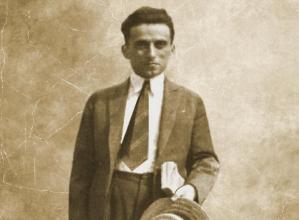
Greek
1896 – 1928
Such peace holds sway here!
One would say the graves themselves were smiling,
while the dead converse in muted tones
in upper case, deep in the darkness.
From there with plain and simple words
they want to reach our peaceful hearts.
But their lament, whatever they desire to say,
fails in its purpose, for they’ve fled too far away.
All that’s here to mark Martzokis are two
sticks of wood laid one across the other.
For Vasiliadis, here’s a great stone book.
And a plaque half hidden in the grass
– for that’s how Death presents her now –
this is Lamari, a forgotten poet.


The title “Athenean Cemetery” made me think of a series of translations I did of ancient Greek epitaphs taken from tombstones and monuments…
Athenian Epitaphs
by Michael R. Burch
Mariner, do not ask whose tomb this may be,
But go with good fortune: I wish you a kinder sea.
—Michael R. Burch, after Plato
Passerby,
Tell the Spartans we lie
Lifeless at Thermopylae:
Dead at their word,
Obedient to their command.
Have they heard?
Do they understand?
—Michael R. Burch, after Simonides
Here he lies in state tonight: great is his Monument!
Yet Ares cares not, neither does War relent.
—Michael R. Burch, after Anacreon
Blame not the gale, nor the inhospitable sea-gulf, nor friends’ tardiness,
Mariner! Just man’s foolhardiness.
—Michael R. Burch, after Leonidas of Tarentum
Does my soul abide in heaven, or hell?
Only the sea gulls in their high, lonely circuits may tell.
—Michael R. Burch, after Glaucus
Here I lie with sea-enclosed Cyzicus shrouding my bones.
Faretheewell, O my adoptive land that reared and suckled me;
Once again I take rest at your breast.
—Michael R. Burch, after Erycius
They observed our fearful fetters, marched against encroaching darkness.
Now we gratefully commemorate their excellence: Bravely, they died for us.
―Michael R. Burch, after Mnasalcas
Shine, while you live;
blaze beyond grief,
for life is brief
and time, a thief.
—Michael R. Burch, after Seikilos of Euterpes
NOTE: The famous Seikilos Epitaph is the oldest known surviving complete musical composition which includes musical notation. It is believed to date to the first or second century AD. The epitaph appears to be signed “Seikilos of Euterpes” or dedicated “Seikilos to Euterpe.” Euterpe was the Muse of music.
We who left behind the Aegean’s bellowings
Now sleep peacefully here on the mid-plains of Ecbatan:
Farewell, dear Athens, nigh to Euboea,
Farewell, dear sea!
—Michael R. Burch, after Plato
Stripped of her stripling, if asked, she’d confess:
“I am now less than nothingness.”
—Michael R. Burch, after Diotimus
I lived as best I could, and then I died.
Be careful where you step: the grave is wide.
—Michael R. Burch, Epitaph for a Palestinian Child
LikeLike
I’m glad you liked my translations enough to publish eleven of them.
LikeLike