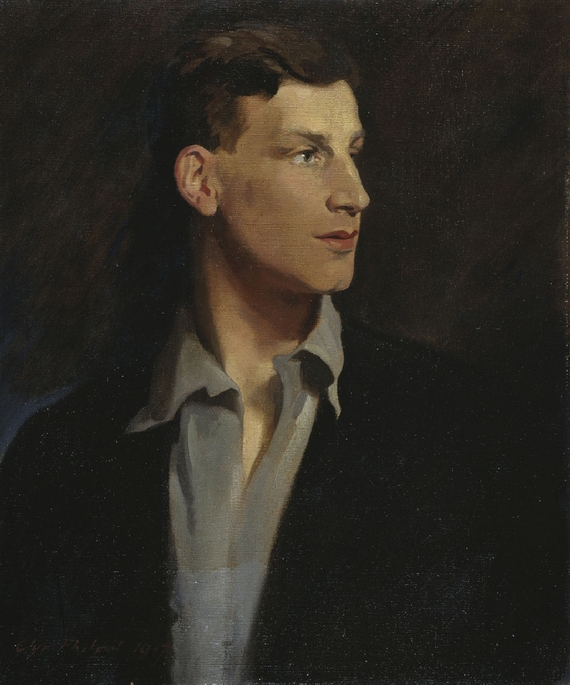
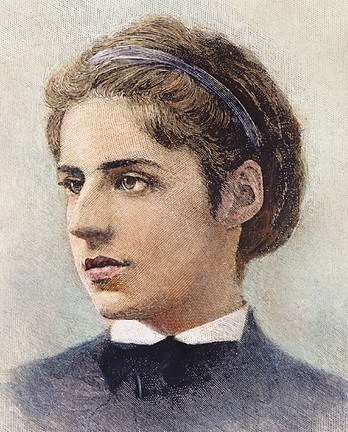
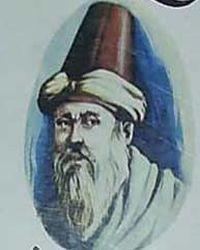
We present this work in honor of the poet’s 135th birthday.
Siegfried Sassoon English 1886 – 1967
You’ve heard me, scornful, harsh, and discontented, Mocking and loathing War: you’ve asked me why Of my old, silly sweetness I’ve repented— My ecstasies changed to an ugly cry.
You are aware that once I sought the Grail, Riding in armour bright, serene and strong; And it was told that through my infant wail There rose immortal semblances of song.
But now I’ve said good-bye to Galahad, And am no more the knight of dreams and show: For lust and senseless hatred make me glad, And my killed friends are with me where I go.
Wound for red wound I burn to smite their wrongs; And there is absolution in my songs.
Not while the snow-shroud round dead earth is rolled, And naked branches point to frozen skies.— When orchards burn their lamps of fiery gold, The grape glows like a jewel, and the corn A sea of beauty and abundance lies, Then the new year is born. Look where the mother of the months uplifts In the green clearness of the unsunned West, Her ivory horn of plenty, dropping gifts, Cool, harvest-feeding dews, fine-winnowed light; Tired labor with fruition, joy and rest Profusely to requite. Blow, Israel, the sacred cornet! Call Back to thy courts whatever faint heart throb With thine ancestral blood, thy need craves all. The red, dark year is dead, the year just born Leads on from anguish wrought by priest and mob, what undreamed-of morn? For never yet, since on the holy height, The Temple’s marble walls of white and green Carved like the sea-waves, fell, and the world’s light Went out in darkness,—never was the year Greater with portent and with promise seen, Than this eve now and here. Even as the Prophet promised, so your tent Hath been enlarged unto earth’s farthest rim. To snow-capped Sierras from vast steppes ye went, Through fire and blood and tempest-tossing wave, For freedom to proclaim and worship Him, Mighty to slay and save. High above flood and fire ye held the scroll, Out of the depths ye published still the Word. No bodily pang had power to swerve your soul: Ye, in a cynic age of crumbling faiths, Lived to bear witness to the living Lord, Or died a thousand deaths. In two divided streams the exiles part, One rolling homeward to its ancient source, One rushing sunward with fresh will, new heart. By each the truth is spread, the law unfurled, Each separate soul contains the nation’s force, And both embrace the world. Kindle the silver candle’s seven rays, Offer the first fruits of the clustered bowers, The garnered spoil of bees. With prayer and praise Rejoice that once more tried, once more we prove How strength of supreme suffering still is ours For Truth and Law and Love.
We stand in the rain in a long line waiting at Ford Highland Park. For work. You know what work is—if you’re old enough to read this you know what work is, although you may not do it. Forget you. This is about waiting, shifting from one foot to another. Feeling the light rain falling like mist into your hair, blurring your vision until you think you see your own brother ahead of you, maybe ten places. You rub your glasses with your fingers, and of course it’s someone else’s brother, narrower across the shoulders than yours but with the same sad slouch, the grin that does not hide the stubbornness, the sad refusal to give in to rain, to the hours of wasted waiting, to the knowledge that somewhere ahead a man is waiting who will say, “No, we’re not hiring today,” for any reason he wants. You love your brother, now suddenly you can hardly stand the love flooding you for your brother, who’s not beside you or behind or ahead because he’s home trying to sleep off a miserable night shift at Cadillac so he can get up before noon to study his German. Works eight hours a night so he can sing Wagner, the opera you hate most, the worst music ever invented. How long has it been since you told him you loved him, held his wide shoulders, opened your eyes wide and said those words, and maybe kissed his cheek? You’ve never done something so simple, so obvious, not because you’re too young or too dumb, not because you’re jealous or even mean or incapable of crying in the presence of another man, no, just because you don’t know what work is.
You know you are truly alive when you’re living among lions Isak Dinesen
I never had a farm in Africa, nor was I at the hills of Ngong, and perhaps because I was a rebellious youth, I refused to read the book. Isak was a country on my mind, never a body skinny and consumed by the syphilis, an echoless shadow the grass cut through without any perceived musicality.
For years I held the book in my hand and my hands would tremble. I recall the rain falling over the prairies. If I closed my eyes I would see those men lingering at sunset, seen from that false luminosity that only the written page can give.
Death moved the doors. The lover or the money vanished like leaves. I never had a farm in Africa; I never felt the smell of coffee invading the rooms at sunrise. There were only lions occupying my sleep, their roaring was the only memorable thing as I awoke.
“Wild geese have never flown as far as Hengyang”; How then will my embroidered words be carried all the way to Yongchang? Like the willow’s flowers by the end of spring, I am ill-fated indeed; In the mists of that alien land, you feel the pangs of despair. “Oh, to go home, to go home,” you mourn to the year’s bitter end. “Oh, if it would rain, if it would rain,” I complain to the bright dawn. One hears of vain promises that you could be set free; When will the Golden Cock reach all the way to Yelang?
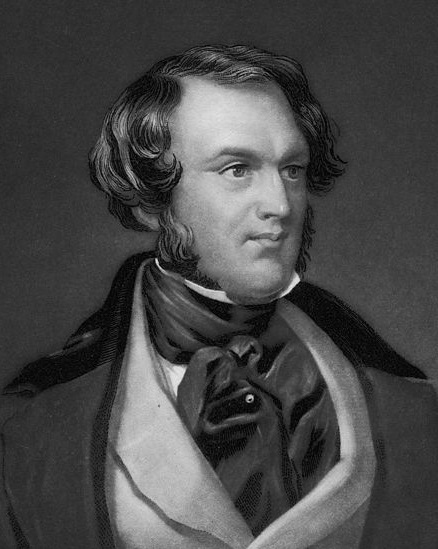
We present this work in honor of the poet’s 150th birthday.
John Le Gay Brereton Australian 1871 – 1943
“Our loss was light,” the paper said, “Compared with damage to the Hun”: She was a widow, and she read One name upon the list of dead Her son, her only son.
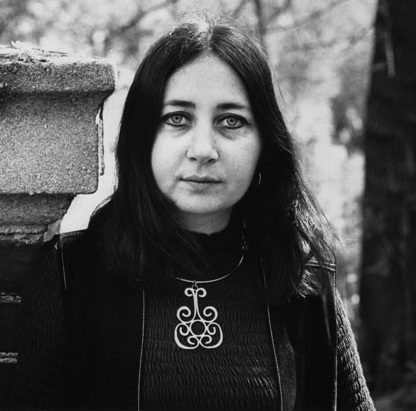
We present this work in honor of the poet’s 80th birthday.
Gwendolyn MacEwen Canadian 1941 – 1987
my friends, my sweet barbarians, there is that hunger which is not for food — but an eye at the navel turns the appetite round with visions of some fabulous sandwich, the brain’s golden breakfast eaten with beasts with books on plates
let us make an anthology of recipes, let us edit for breakfast our most unspeakable appetites — let us pool spoons, knives and all cutlery in a cosmic cuisine, let us answer hunger with boiled chimera and apocalyptic tea, an arcane salad of spiced bibles, tossed dictionaries — (O my barbarians we will consume our mysteries)
and can we, can we slake the gaping eye of our desires? we will sit around our hewn wood table until our hair is long and our eyes are feeble, eating, my people, O my insatiates, eating until we are no more able to jack up the jaws any longer —
to no more complain of the soul’s vulgar cavities, to gaze at each other over the rust-heap of cutlery, drinking a coffee that takes an eternity — till, bursting, bleary, we laugh, barbarians, and rock the universe — and exclaim to each other over the table over the table of bones and scrap metal over the gigantic junk-heaped table: