The Rebel

We present this work in honor of the 45th anniversary of the poet’s death.
08-29 Islam
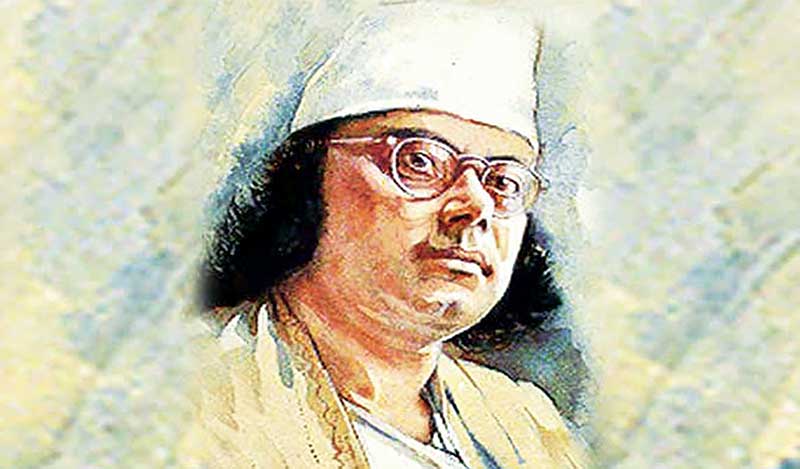
Kazi Nazrul Islam
Indian
1899 – 1976


Say, Valiant,
Say: High is my head!

Looking at my head
Is cast down the great Himalayan peak!
Say, Valiant,
Say: Ripping apart the wide sky of the universe,
Leaving behind the moon, the sun, the planets
and the stars
Piercing the earth and the heavens,
Pushing through Almighty’s sacred seat
Have I risen,
I, the perennial wonder of mother-earth!
The angry God shines on my forehead
Like some royal victory’s gorgeous emblem.
Say, Valiant,
Ever high is my head!

I am irresponsible, cruel and arrogant,
I an the king of the great upheaval,
I am cyclone, I am destruction,
I am the great fear, the curse of the universe.
I have no mercy,
I grind all to pieces.
I am disorderly and lawless,
I trample under my feet all rules and discipline!
I am Durjati, I am the sudden tempest of ultimate summer,
I am the rebel, the rebel-son of mother-earth!
Say, Valiant,
Ever high is my head!

I am the hurricane, I am the cyclone
I destroy all that I found in the path!
I am the dance-intoxicated rhythm,
I dance at my own pleasure,
I am the unfettered joy of life!
I am Hambeer, I am Chhayanata, I am Hindole,
I am ever restless,
I caper and dance as I move!
I do whatever appeals to me, whenever I like,
I embrace the enemy and wrestle with death,
I am mad. I am the tornado!
I am pestilence, the great fear,
I am the death of all reigns of terror,
I am full of a warm restlessness for ever!
Say, Valiant,
Ever high is my head!

I am creation, I am destruction,
I am habitation, I am the grave-yard,
I am the end, the end of night!
I am the son of Indrani
With the moon in my head
And the sun on my temple
In one hand of mine is the tender flute
While in the other I hold the war bugle!
I am the Bedouin, I am the Chengis,
I salute none but me!
I am thunder,
I am Brahma’s sound in the sky and on the earth,
I am the mighty roar of Israfil’s bugle,
I am the great trident of Pinakpani,
I am the staff of the king of truth,
I am the Chakra and the great Shanka,
I am the mighty primordial shout!
I am Bishyamitra’s pupil, Durbasha the furious,
I am the fury of the wild fire,
I burn to ashes this universe!
I am the gay laughter of the generous heart,
I am the enemy of creation, the mighty terror!
I am the eclipse of the twelve suns,
I herald the final destruction!
Sometimes I am quiet and serene,
I am in a frenzy at other times,
I am the new youth of dawn,
I crush under my feet the vain glory of the Almighty!

I am the fury of typhoon,
I am the tumultuous roar of the ocean,
I am ever effluent and bright,
I trippingly flow like the gaily warbling brook.
I am the maiden’s dark glassy hair,
I am the spark of fire in her blazing eyes.
I am the tender love that lies
In the sixteen year old’s heart,
I am the happy beyond measure!
I am the pining soul of the lovesick,
I am the bitter tears in the widow’s heart,
i am the piteous sighs of the unlucky!
I am the pain and sorrow of all homeless sufferers,
I am the anguish of the insulted heart,
I am the burning pain and the madness of the jilted lover!

I am the unutterable grief,
I am the trembling first touch of the virgin,
I am the throbbing tenderness of her first stolen kiss.
I am the fleeting glace of the veiled beloved,
I am her constant surreptitious gaze.
I am the gay gripping young girl’s love,
I am the jingling music of her bangles!
I am the eternal-child, the adolescent of all times,
I am the shy village maiden frightened by her own budding youth.
I am the soothing breeze of the south,
I am the pensive gale of the east.
I am the deep solemn song sung by the wondering bard,
I am the soft music played on his lyre!
I am the harsh unquenched mid-day thirst,
I am the fierce blazing sun,
I am the softly trilling desert spring,
I am the cool shadowy greenery!
Maddened with an intense joy I rush onward,
I am insane! I am insane!
Suddenly I have come to know myself,
All the false barriers have crumbled today!
I am the rising, I am the fall,
I am consciousness in the unconscious soul,
I am the flag of triumph at the gate of the world,
I am the glorious sign of man’s victory,
Clapping my hands in exultation I rush like the hurricane,
Traversing the earth and the sky.
The mighty Borrak is the horse I ride.
It neighs impatiently, drunk with delight!
I am the burning volcano in the bosom of the earth,
I am the wild fire of the woods,
I am Hell’s mad terrific sea of wrath!
I ride on the wings of the lightning with joy and profound,
I scatter misery and fear all around,
I bring earth-quakes on this world!

I am Orpheus’s flute,
I bring sleep to the fevered world,
I make the heaving hells temple in fear and die.
I carry the message of revolt to the earth and the sky!
I am the mighty flood,
Sometimes I make the earth rich and fertile,
At another times I cause colossal damage.
I snatch from Bishnu’s bosom the two girls!
I am injustice, I am the shooting star,
I am Saturn, I am the fire of the comet,
I am the poisonous asp!
I am Chandi the headless, I am ruinous Warlord,
Sitting in the burning pit of Hell
I smile as the innocent flower!
I am the cruel axe of Parsurama,
I shall kill warriors
And bring peace and harmony in the universe!
I am the plough on the shoulders of Balarama,
I shall uproot this miserable earth effortlessly and with ease,
And create a new universe of joy and peace.
Weary of struggles, I, the great rebel,
Shall rest in quiet only when I find
The sky and the air free of the piteous groans of the oppressed.
Only when the battle fields are cleared of jingling bloody sabres
Shall I, weary of struggles, rest in quiet,
I the great rebel.

I am the rebel eternal,
I raise my head beyond this world,
High, ever erect and alone!


Translation by Kabir Chowdhury

I See the World Falling

08-27 Terracina
Laura Terracina
Italian
1519 – 1577


I see the world falling, I see it beguiled,
I see virtue abandoned,
And the Muses contemptuously held,
So much that nearly is my heart entombed.

I see hate and envy all twisted
about thought of friends, and with false song;
I see the worthy betrayed by the vile,
And all to our loss, the heavens rebel.

None the standard of the common good hold firm,
Instead for private gain all declaim,
While heavy are their hearts with motives dark.

I see and in seeing hold even self hateful,
So that for loathing I would,
See myself sightless or the world entire, blind.


Translation by Michael Curtotti

At the Feast

We present this work in honor of the 100th anniversary of the poet’s death.

08-26 Gumilyov
Nikolay Gumilyov
Russian
1886 – 1921


There’s Prince Diego, falling in a love,
He dozed and he laid his head midst table’s stuff,
He lost his goblet, cast from silver’s milk,
And freed his jacket of a crimson silk.

And he is seeing the transparent stream,
And on the stream — the boat white as steam,
In which the trip, a lot of time ago,
His bride and he had had to undergo.

Space after space immediately springs
And, like two looks, burn two amazing rings;
But now sacred isles are seen in haze,
Where will resound the mysterious phrase,
And where, in wreaths of roses, at last,
They will be married by the Jesus Christ.

But at that time, the king has laid on him
The heavy look, where evil mixed with whim,
And jokers are adjusting to his heart,
The reddish pieces — flowers of blood,
And sexy bride with moderated rage,
Is kissing the impudent, lustful page.


Translation by Yevgeny Bonver

Aspiring Miss Delaine

We present this work in honor of the poet’s 185th birthday.

08-25 Harte
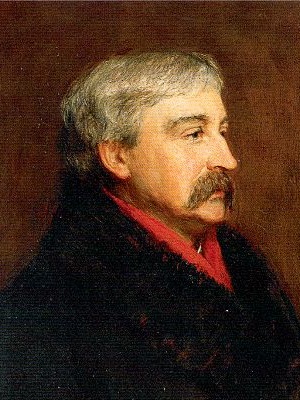
Bret Harte
American
1836 – 1902


(a chemical narrative)

Certain facts which serve to explain
The physical charms of Miss Addie De Laine,
Who, as the common reports obtain,
Surpassed in complexion the lily and rose;
With a very sweet mouth and a retrousse nose;
A figure like Hebe’s, or that which revolves
In a milliner’s window, and partially solves
That question which mentor and moralist pains,
If grace may exist minus feeling or brains.

Of course the young lady had beaux by the score,
All that she wanted,—what girl could ask more?
Lovers that sighed and lovers that swore,
Lovers that danced and lovers that played,
Men of profession, of leisure, and trade;
But one, who was destined to take the high part
Of holding that mythical treasure, her heart,—
This lover, the wonder and envy of town,
Was a practicing chemist, a fellow called Brown.

I might here remark that ‘twas doubted by many,
In regard to the heart, if Miss Addie had any;
But no one could look in that eloquent face,
With its exquisite outline and features of grace,
And mark, through the transparent skin, how the tide
Ebbed and flowed at the impulse of passion or pride,—
None could look, who believed in the blood’s circulation
As argued by Harvey, but saw confirmation
That here, at least, Nature had triumphed o’er art,
And as far as complexion went she had a heart.

But this par parenthesis. Brown was the man
Preferred of all others to carry her fan,
Hook her glove, drape her shawl, and do all that a belle
May demand of the lover she wants to treat well.
Folks wondered and stared that a fellow called Brown—
Abstracted and solemn, in manner a clown,
Ill dressed, with a lingering smell of the shop—
Should appear as her escort at party or hop.
Some swore he had cooked up some villainous charm,
Or love philter, not in the regular Pharm-
Acopoeia, and thus, from pure malice prepense,
Had bewitched and bamboozled the young lady’s sense;
Others thought, with more reason, the secret to lie
In a magical wash or indelible dye;
While Society, with its censorious eye
And judgment impartial, stood ready to damn
What wasn’t improper as being a sham.

For a fortnight the townfolk had all been agog
With a party, the finest the season had seen,
To be given in honor of Miss Pollywog,
Who was just coming out as a belle of sixteen.
The guests were invited; but one night before
A carriage drew up at the modest back door
Of Brown’s lab’ratory, and, full in the glare
Of a big purple bottle, some closely veiled fair
Alighted and entered: to make matters plain,
Spite of veils and disguises, ‘twas Addie De Laine.

As a bower for true love, ‘twas hardly the one
That a lady would choose to be wooed in or won:
No odor of rose or sweet jessamine’s sigh
Breathed a fragrance to hallow their pledge of troth by,
Nor the balm that exhales from the odorous thyme;
But the gaseous effusions of chloride of lime,
And salts, which your chemist delights to explain
As the base of the smell of the rose and the drain.
Think of this, O ye lovers of sweetness! and know
What you smell when you snuff up Lubin or Pinaud.

I pass by the greetings, the transports and bliss,
Which of course duly followed a meeting like this,
And come down to business,—for such the intent
Of the lady who now o’er the crucible leant,
In the glow of a furnace of carbon and lime,
Like a fairy called up in the new pantomime,—
And give but her words, as she coyly looked down
In reply to the questioning glances of Brown:
‘I am taking the drops, and am using the paste,
And the little white powders that had a sweet taste,
Which you told me would brighten the glance of my eye,
And the depilatory, and also the dye,
And I’m charmed with the trial; and now, my dear Brown,
I have one other favor,—now, ducky, don’t frown,—
Only one, for a chemist and genius like you
But a trifle, and one you can easily do.
Now listen: to-morrow, you know, is the night
Of the birthday soiree of that Pollywog fright;
And I’m to be there, and the dress I shall wear
Is too lovely; but’— ‘But what then, ma chere?’
Said Brown, as the lady came to a full stop,
And glanced round the shelves of the little back shop.
‘Well, I want—I want something to fill out the skirt
To the proper dimensions, without being girt
In a stiff crinoline, or caged in a hoop
That shows through one’s skirt like the bars of a coop;
Something light, that a lady may waltz in, or polk,
With a freedom that none but you masculine folk
Ever know. For, however poor woman aspires,
She’s always bound down to the earth by these wires.
Are you listening? Nonsense! don’t stare like a spoon,
Idiotic; some light thing, and spacious, and soon—
Something like—well, in fact—something like a balloon!’

Here she paused; and here Brown, overcome by surprise,
Gave a doubting assent with still wondering eyes,
And the lady departed. But just at the door
Something happened,—’tis true, it had happened before
In this sanctum of science,—a sibilant sound,
Like some element just from its trammels unbound,
Or two substances that their affinities found.

The night of the anxiously looked for soiree
Had come, with its fair ones in gorgeous array;
With the rattle of wheels and the tinkle of bells,
And the ‘How do ye do’s’ and the ‘Hope you are well’s;’
And the crush in the passage, and last lingering look
You give as you hang your best hat on the hook;
The rush of hot air as the door opens wide;
And your entry,—that blending of self-possessed pride
And humility shown in your perfect-bred stare
At the folk, as if wondering how they got there;
With other tricks worthy of Vanity Fair.
Meanwhile, the safe topic, the beat of the room,
Already was losing its freshness and bloom;
Young people were yawning, and wondering when
The dance would come off; and why didn’t it then:
When a vague expectation was thrilling the crowd,
Lo! the door swung its hinges with utterance proud!
And Pompey announced, with a trumpet-like strain,
The entrance of Brown and Miss Addie De Laine.

She entered; but oh! how imperfect the verb
To express to the senses her movement superb!
To say that she ‘sailed in’ more clearly might tell
Her grace in its buoyant and billowy swell.
Her robe was a vague circumambient space,
With shadowy boundaries made of point-lace;
The rest was but guesswork, and well might defy
The power of critical feminine eye
To define or describe: ‘twere as futile to try
The gossamer web of the cirrus to trace,
Floating far in the blue of a warm summer sky.

‘Midst the humming of praises and glances of beaux
That greet our fair maiden wherever she goes,
Brown slipped like a shadow, grim, silent, and black,
With a look of anxiety, close in her track.
Once he whispered aside in her delicate ear
A sentence of warning,—it might be of fear:
‘Don’t stand in a draught, if you value your life.’
(Nothing more,—such advice might be given your wife
Or your sweetheart, in times of bronchitis and cough,
Without mystery, romance, or frivolous scoff.)
But hark to the music; the dance has begun.
The closely draped windows wide open are flung;
The notes of the piccolo, joyous and light,
Like bubbles burst forth on the warm summer night.
Round about go the dancers; in circles they fly;
Trip, trip, go their feet as their skirts eddy by;
And swifter and lighter, but somewhat too plain,
Whisks the fair circumvolving Miss Addie De Laine.
Taglioni and Cerito well might have pined
For the vigor and ease that her movements combined;
E’en Rigelboche never flung higher her robe
In the naughtiest city that’s known on the globe.
‘Twas amazing, ‘twas scandalous; lost in surprise,
Some opened their mouths, and a few shut their eyes.

But hark! At the moment Miss Addie De Laine,
Circling round at the outer edge of an ellipse
Which brought her fair form to the window again,
From the arms of her partner incautiously slips!
And a shriek fills the air, and the music is still,
And the crowd gather round where her partner forlorn
Still frenziedly points from the wide window-sill
Into space and the night; for Miss Addie was gone!
Gone like the bubble that bursts in the sun;
Gone like the grain when the reaper is done;
Gone like the dew on the fresh morning grass;
Gone without parting farewell; and alas!
Gone with a flavor of hydrogen gas!

When the weather is pleasant, you frequently meet
A white-headed man slowly pacing the street;
His trembling hand shading his lack-lustre eye,
Half blind with continually scanning the sky.
Rumor points him as some astronomical sage,
Re-perusing by day the celestial page;
But the reader, sagacious, will recognize Brown,
Trying vainly to conjure his lost sweetheart down,
And learn the stern moral this story must teach,
That Genius may lift its love out of its reach.

Delight in Disorder

We present this work in honor of the poet’s 430th birthday.

08-24 Herrick
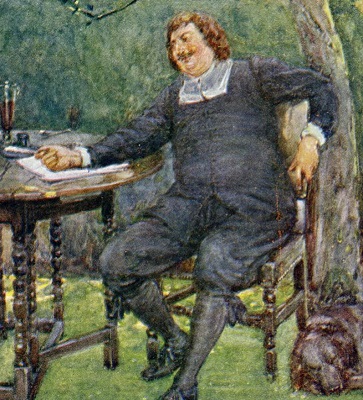
Robert Herrick
English
1591 – 1674


A sweet disorder in the dress
Kindles in clothes a wantonness;
A lawn about the shoulders thrown
Into a fine distraction;
An erring lace, which here and there
Enthrals the crimson stomacher;
A cuff neglectful, and thereby
Ribands to flow confusedly;
A winning wave, deserving note,
In the tempestuous petticoat;
A careless shoe-string, in whose tie
I see a wild civility:
Do more bewitch me, than when art
Is too precise in every part.

Fraternity

08-23 Aldrich
Anne Reeve Aldrich
American
1866 – 1892


I ask not how thy suffering came,
Or if by sin, or if by shame,
Or if by Fate’s capricious rulings:
To my large pity all’s the same.

Come close and lean against a heart
Eaten by pain and stung by smart;
It is enough if thou hast suffered,—
Brother or sister then thou art.

We will not speak of what we know,
Rehearse the pang, nor count the throe,
Nor ask what agony admitted
Thee to the Brotherhood of Woe.

But in our anguish-darkened land
Let us draw close, and clasp the hand;
Our whispered password holds assuagement,—
The solemn “Yea, I understand!”

Maxims

08-22 Ajiba
Ahmad Ibn Ajiba
Moroccan
1747 – 1809


If one did not stop in the shadows of things,
the heart would be illuminated by the sun of gnosis.

If it were not for shackles and obstacles,
the suns of realities would be seen to shine.

If there were neither individual will nor free will,
the shadow of otherness would withdraw from the heart.

If there were not passions and desires,
aspirations would become real in less than the wink of an eye.

If there were not bad tendencies and defects,
invisible secrets would make themselves manifest.

Without the struggle with oneself,
the secret of the elect would not appear.

Without the company of true men,
no one knows how to distinguish imperfection from perfection.

Without the company of the great,
the hearts and their depths cannot be purified.

Without the service of true men,
no one can reach the degrees of perfection.


Translation by David Streight

Growing Old

We present this work in honor of National Senior Citizens Day.

08-21 Arnold
Matthew Arnold
English
1822 – 1888


What is it to grow old?
Is it to lose the glory of the form,
The lustre of the eye?
Is it for beauty to forego her wreath?
Yes, but not for this alone.

Is it to feel our strength –
Not our bloom only, but our strength – decay?
Is it to feel each limb
Grow stiffer, every function less exact,
Each nerve more weakly strung?

Yes, this, and more! but not,
Ah, ‘tis not what in youth we dreamed ‘twould be!
‘Tis not to have our life
Mellowed and softened as with sunset-glow,
A golden day’s decline!

‘Tis not to see the world
As from a height, with rapt prophetic eyes,
And heart profoundly stirred;
And weep, and feel the fulness of the past,
The years that are no more!

It is to spend long days
And not once feel that we were ever young.
It is to add, immured
In the hot prison of the present, month
To month with weary pain.

It is to suffer this,
And feel but half, and feebly, what we feel:
Deep in our hidden heart
Festers the dull remembrance of a change,
But no emotion -none.

It is – last stage of all –
When we are frozen up within, and quite
The phantom of ourselves,
To hear the world applaud the hollow ghost
Which blamed the living man.

Champ de Mars, 1914

We present this work in honor of the 95th anniversary of the poet’s death.

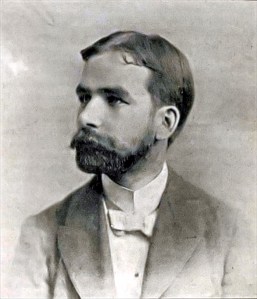
Robert Stanley Weir
Canadian
1856 – 1926

Unscathed as yet by battle-scars,
Trampling the sad December’s snow,
The Khaki lads on Champ de Mars
Are girding for the distant foe.
East with a dream comes marching by;
Each all aflame for England’s fight.
But O presaging heart, say why
That sound of weeping in the night?

The Duke came down one frosty day
And walked between the khaki ranks.
Full grave his look. We heard him say:
“Soldiers, the Empire gives you thanks.
Love live the King! Our foes shall learn
You stand with Him for simple right;
And may God grant you safe return.”
But still that sound all through the night!

O, marching from the Camp de Mars
They cross the seas; they storm the trench,
Fighting beneath the troubled stars
With Belgians brave and valiant French;
Fighting, till victory austere,
Shall crush the Great Betrayer’s might.
But O my beating heart, dost hear

That sound of weeping in the night?